
Acid-Treated Starch
Acid-Treated Starch is a food-grade modified starch used by industrial manufacturers for low hot viscosity, high-solids cooking, gel texture, film formation, coating performance, binding, bulking, carrier functionality, moisture management and process stability. It is commonly discussed as a thin-boiling starch because controlled acid treatment reduces starch molecular size and hot-paste viscosity while retaining important granular and gel-forming characteristics. This page is prepared for purchasing, R&D, quality assurance and regulatory teams that need a practical starting point for grade selection, specification comparison, documentation review and quotation requests.
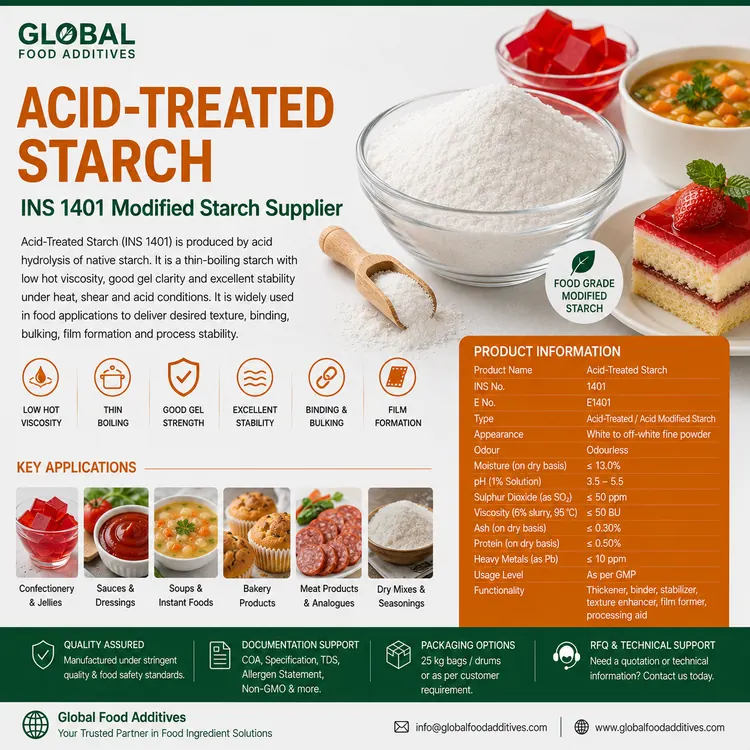
Product identity
| Product | Acid-Treated Starch |
|---|---|
| Also known as | Acid-modified starch, thin-boiling starch, INS 1401 starch |
| Category | Modified Starches, Fibres & Bulking Agents |
| Function | Texture ingredient, low-viscosity starch, gel-forming starch, bulking agent, binder or carrier ingredient |
| INS / label reference | INS 1401; E-number or ingredient declaration must be verified by destination market |
| CAS / identity | Variable; depends on botanical source, degree of treatment and supplier specification |
| Possible botanical sources | Corn, waxy maize, tapioca, potato, wheat, rice or other approved starch bases |
| Modification principle | Controlled acid hydrolysis of native starch to reduce molecular weight and hot-paste viscosity |
| Typical form | Fine powder, granular powder, agglomerated powder or instantized grade |
| Industrial selection basis | Viscosity profile, fluidity, gel strength, particle size, botanical source, pH, colour, odour, microbiology and regulatory documentation |
Application fit
Potential use areas depend on grade performance, formulation design and local permission. Common review areas may include:
- Confectionery, jelly sweets, gum candies and moulded starch systems
- Food coatings, edible films, glazes and surface applications
- Soups, sauces, gravies and culinary preparations
- Dressings, condiments and prepared meal systems
- Bakery creams, fillings, icings and dry bakery mixes
- Meat products, poultry systems and formed products
- Powdered beverages, seasonings, premixes and carrier systems
Technical purchasing notes
Acid-Treated Starch should not be purchased only by product name. In industrial use, the practical value of the grade depends on botanical origin, treatment level, molecular degradation, viscosity profile, gel strength, film-forming behaviour, particle size, hydration speed, colour, odour, pH and compatibility with the customer’s full formulation. Before approval, compare the supplier specification against the intended food matrix, heating process, solids level, shear level, acidity, sugar concentration, cooling profile, storage conditions and required declaration language.
How Acid-Treated Starch works in food systems
Acid treatment partially hydrolyses starch chains, especially in the more accessible regions of the granule. This reduces the hot-paste viscosity compared with many native starches, allowing higher solids to be cooked, deposited or processed with lower resistance to flow. After cooling, selected grades can develop firm gels, strong films or controlled textures. This combination of low hot viscosity and useful final structure is why Acid-Treated Starch is frequently evaluated in confectionery, coating, film-forming, jelly and high-solids systems.
The performance profile differs from native starch, pregelatinized starch, oxidized starch, cross-linked starch and acetylated starch. Acid-Treated Starch is generally selected when formulators need easier hot processing, faster cooking, thinner hot paste, improved film clarity or strong gel formation after cooling. It may not be the best choice where high heat, low pH, high shear or freeze-thaw resistance is the primary requirement; in those cases, cross-linked or stabilized starches may need to be compared.
Functional performance areas
- Low hot viscosity: supports higher-solids cooking, pumping, depositing and moulding operations.
- Gel formation: selected grades can form firm gels after cooling, useful in confectionery and structured systems.
- Film formation: supports coatings, surface films, glaze systems and confectionery shells.
- Texture design: helps build short, firm, clean-cut, cohesive or set textures depending on grade and dosage.
- Water management: contributes to moisture distribution, binding and product stability when correctly selected.
- Carrier and bulking use: may support dry blends, flavour carriers, seasonings and premix distribution.
Critical formulation variables
- Botanical origin: corn, waxy maize, tapioca, potato, wheat or rice
- Target hot viscosity during cooking, pumping, coating, depositing or filling
- Final gel strength, bite, firmness, elasticity or film performance
- Solids level, sugar concentration and water availability
- pH of the finished product and timing of acid addition
- Process temperature, holding time, shear and cooling curve
- Compatibility with flavours, colours, acids, salts, proteins, gums and fats
- Label requirement, allergen position, GMO status and clean-label expectations
- Target shelf life, syneresis, moisture migration and storage temperature
Application guidance by food category
| Food system | Potential technical role | Review points before approval |
|---|---|---|
| Confectionery and jelly sweets | Low hot viscosity, high-solids processing, gel structure, clean cut and shape retention | Gel strength, solids level, cooking temperature, depositing viscosity, acid addition, setting time, bite profile and moisture migration |
| Food coatings and edible films | Film formation, surface binding, glaze support and barrier contribution | Film clarity, brittleness, adhesion, drying speed, cracking, humidity response and compatibility with colours or flavours |
| Soups, sauces and gravies | Body, texture adjustment, viscosity control and mouthfeel support | Hot viscosity, cooling viscosity, pH, salt level, heat process, shear, reheating behaviour and sensory texture |
| Dressings and condiments | Texture contribution, water binding, cling and suspension support | Acidity, oil phase, emulsifier system, mixing shear, storage temperature, separation risk and declaration language |
| Bakery fillings and creams | Firmness, moisture control, filling stability and cutting performance | Bake stability, pumpability, sugar level, cooling behaviour, syneresis, starch retrogradation and shelf-life texture |
| Meat and poultry products | Binding, yield support, purge control and structure contribution | Protein system, salt level, phosphate use, cooking loss, slicing behaviour, freeze-thaw exposure and local meat-product rules |
| Dry mixes and premixes | Carrier, bulking agent, flow support and controlled hydration ingredient | Particle size, dusting, flowability, hydration speed, caking, segregation and moisture barrier of packaging |
Industrial specification checklist
A complete sourcing request should define measurable parameters instead of relying on a generic product name. Acid-Treated Starch grades can differ significantly in hot viscosity, fluidity, gel strength and process response even when they share the same additive name. The following items help purchasing, QA and R&D teams compare offers more accurately.
Physical and chemical criteria
- Botanical origin and modification description
- Moisture content and water activity where relevant
- pH of slurry or solution according to supplier method
- Ash, protein, fat and fibre where specified
- Viscosity method, starch concentration, temperature and instrument details
- Fluidity value, alkali number or other supplier-specific degradation index
- Gel strength, set time or texture profile where relevant
- Particle-size distribution, bulk density and powder flowability
- Whiteness, colour, odour, taste neutrality and visual appearance
- Film-forming behaviour, clarity or coating performance where required
Food safety and compliance criteria
- Total plate count, yeast and mould, coliforms and pathogen limits
- Heavy metals and contaminant limits according to destination market
- Allergen status, including wheat/gluten risk if wheat starch is used
- GMO status and identity-preserved options where required
- Sulphite, residual acid or processing-aid declarations where relevant
- Halal, kosher, vegan or other market-specific declarations
- Country of origin, manufacturing site and traceability documents
- Food additive compliance statement for the target market
- Specification alignment with customer, retailer or private-label standards
Hot viscosity, gel strength and fluidity selection
The main commercial value of Acid-Treated Starch is often its thin-boiling behaviour. A lower hot viscosity can allow a manufacturer to cook higher starch solids, deposit confectionery masses more easily, form coatings with controlled thickness or reduce pumping load. However, low hot viscosity alone is not enough: the final product may also require gel strength, film integrity, clarity, cut quality, low syneresis or stable texture after storage.
| Selection target | Preferred review focus | Why it matters |
|---|---|---|
| High-solids confectionery | Low hot viscosity, gel strength, set time and final bite | Supports depositing, mould release, shape retention and consumer texture. |
| Thin coating or glaze | Film formation, adhesion, viscosity and drying behaviour | Controls coating uniformity, cracking, gloss and surface quality. |
| Firm jelly or gel system | Gel strength, clarity, syneresis and texture after storage | Prevents weak set, excessive brittleness or water release. |
| Pumpable sauce base | Hot viscosity, shear response, cooling viscosity and mouthfeel | Balances factory handling with finished-product body. |
| Dry blend or carrier use | Particle size, flowability, dusting and hydration speed | Improves dosing accuracy, blend uniformity and factory handling. |
Processing and handling notes
Acid-Treated Starch performance can change significantly depending on dispersion, heating, hold time, solids level and cooling. Poor powder addition may cause lumping, incomplete hydration, uneven gelatinization or inconsistent gel strength. For accurate trials, document the starch addition point, dry-blend sequence, water temperature, mixing speed, cook-up temperature, holding time, pH adjustment stage, acid addition timing, cooling profile and final storage conditions.
- Pre-blend with sugar, flour, starch or other dry ingredients where suitable to improve dispersion and reduce lump formation.
- Confirm whether the grade is cook-up, pregelatinized, agglomerated or instantized before designing the process.
- Run trials at the same solids, pH, sugar, salt, fat and shear conditions expected in factory production.
- Measure viscosity at practical stages: after dispersion, after cooking, during depositing, after cooling and after storage.
- For confectionery, validate depositing temperature, mould release, set time, cutting behaviour and texture after ageing.
- For coatings, evaluate film thickness, drying, cracking, gloss, adhesion and humidity response.
- For acidic systems, confirm whether additional acid exposure reduces final viscosity or gel strength.
- Store in dry, cool conditions, protected from moisture, odour pickup, pests and direct contamination.
Comparison with other starch options
| Alternative | Why it may be compared | Selection note |
|---|---|---|
| Native starch | Basic thickening, body and low-cost viscosity contribution | Often has higher hot viscosity and less controlled thin-boiling behaviour than Acid-Treated Starch. |
| Pregelatinized starch | Cold-water swelling and instant viscosity | Useful where full cooking is not available, but texture and processing differ from cook-up acid-treated grades. |
| Dextrin | Film formation, binding, solubility and adhesive properties | May be compared for coatings and dry systems but has different viscosity and gel behaviour. |
| Oxidized starch | Film formation, lower viscosity, adhesion and improved clarity | Often compared for coatings, confectionery and batters where controlled film properties are needed. |
| Cross-linked starches | Resistance to heat, acid and shear in demanding processes | Preferred when process tolerance is more important than low hot viscosity and strong gel set. |
| Acetylated or hydroxypropylated starches | Freeze-thaw stability, storage texture and reduced syneresis | Often reviewed for frozen, chilled and refrigerated products where stability after storage is critical. |
| Starch sodium octenyl succinate | Emulsification, encapsulation and flavour-carrier functionality | Not a direct replacement; selected when emulsifying or spray-drying performance is required. |
Quality assurance and incoming inspection
For recurring industrial supply, incoming quality control should confirm that each lot matches the approved supplier specification and trial-approved reference. Acid-Treated Starch may look visually similar to native starch, but small changes in treatment level, moisture, particle size or botanical origin can affect hot viscosity, gel strength, depositing behaviour and finished-product texture.
- Check product name, lot number, production date, expiry date and country of origin against the certificate of analysis.
- Confirm moisture, pH, ash, viscosity, fluidity, particle size and microbiological values against the approved specification.
- Inspect packaging integrity, pallet condition, odour, colour, moisture exposure and foreign-material risk.
- Confirm INS 1401 reference and local declaration language against the approved regulatory file.
- Run a standard cook-up viscosity or gel-strength test using the same internal method for every incoming batch.
- For confectionery or coating use, compare application performance against an approved reference sample.
- Keep retained samples for traceability, complaint handling and supplier performance review.
Regulatory and label review
Acid-Treated Starch is associated with the INS 1401 modified-starch reference, but the exact permitted use, food categories, maximum levels, purity criteria and label declaration depend on the destination market. Finished-product manufacturers should verify whether the ingredient is allowed in the intended food category and whether the correct local declaration is “Acid-Treated Starch,” “Modified Starch,” “INS 1401,” “E1401,” “starch,” “texturizer,” “thickener” or another market-specific wording.
For export projects, regulatory review should follow the country where the finished food will be sold, not only the country where the ingredient is purchased. This is especially important for private-label products, infant or child-oriented foods, organic programs, clean-label positioning, gluten-free claims, non-GMO claims and retailer-specific additive policies.
Documents to request
- Product specification or technical data sheet with test methods
- Certificate of analysis for the available batch or lot
- Safety data sheet where applicable
- Food-grade statement and intended-use declaration
- Origin, manufacturer, production site and traceability information
- Shelf-life, storage condition and retest-date information
- Allergen, GMO, gluten, halal, kosher and vegan statements where required
- Botanical source declaration and wheat/gluten status where relevant
- Moisture, pH, ash, viscosity, fluidity and particle-size data
- Gel-strength, cook-up or application-performance data where available
- Microbiological limits and contaminant statements
- Heavy-metal declaration according to destination-market requirements
- Label declaration guidance and INS / E-number confirmation
- Packaging details, net weight, pallet configuration and container loading estimate
- Market-specific declarations required by the destination country
Packaging, logistics and storage
Acid-Treated Starch is commonly supplied in multiwall paper bags, PE-lined bags, kraft bags, big bags or export pallet configurations depending on supplier and grade. Industrial buyers should confirm bag size, inner liner, moisture barrier, pallet type, stretch wrapping, batch coding, shelf life at dispatch, container loading quantity and whether the packaging format is suitable for food-ingredient handling in the receiving factory.
Supplier qualification workflow
- Define the application: food category, process, target texture, hot viscosity, gel strength, solids level and destination market.
- Share the benchmark: existing supplier specification, COA, sample, formula note, label declaration or approved reference.
- Screen documents: compare TDS, COA, allergen, GMO, origin, shelf-life, microbiology and regulatory declarations.
- Run bench trials: evaluate dispersion, cook-up behaviour, hot viscosity, gel strength, texture, flavour neutrality and colour.
- Validate plant performance: test under real mixing, heating, pumping, depositing, moulding, filling, cooling and storage conditions.
- Approve commercially: lock final specification, packaging, lead time, minimum order quantity, incoterm and recurring documentation.
How to request this product
Send the product name, target grade or reference specification, intended application, quantity, destination country, packaging preference, expected shipment date, delivery term and required documents. If you already purchase Acid-Treated Starch, attach or describe your existing specification, label declaration, certificate of analysis, viscosity target, fluidity value, gel-strength target, botanical source requirement or benchmark sample so supplier options can be compared more accurately.
Useful answers
What is Acid-Treated Starch used for in food manufacturing?
Acid-Treated Starch is typically discussed for low hot viscosity, high-solids processing, gel texture, film formation, confectionery structure, bulking, binding, encapsulation, moisture control and process stability. Exact suitability depends on grade, botanical origin, application, process, regulations and supplier documents.
Why is Acid-Treated Starch called thin-boiling starch?
It is often called thin-boiling starch because controlled acid treatment reduces the molecular size of the starch and lowers hot-paste viscosity. This can help manufacturers process higher solids while still achieving useful gel, texture or film properties after cooling.
Is Acid-Treated Starch suitable for confectionery?
It may be suitable for selected confectionery systems, especially where low hot viscosity, high-solids cooking, depositing, gel strength or clean-cut texture is required. Final suitability should be validated by trial work using the real sugar, acid, flavour, colour, cooking and storage conditions.
Can Global Food Additives source Acid-Treated Starch?
Global Food Additives can review sourcing options for Acid-Treated Starch according to target specification, botanical source, application, quantity, destination, packaging, delivery term and required documentation.
Which documents should be requested?
Buyers commonly request a technical data sheet or specification, certificate of analysis, safety data sheet where applicable, origin statement, shelf-life information, botanical source declaration, allergen and GMO declarations, microbiological limits, label guidance and packing details.
Is this product permitted in every country?
No. Food additive use depends on destination-market rules, food category, use level, purity criteria, label requirements and buyer responsibility. Always verify local regulation before commercial use.
Tell us which food additive or ingredient you need.
Send product names, target specifications, quantity, destination country, packaging preference, delivery term, and document requirements. Our team will review your inquiry and respond from orders@foodgradeadditives.com.
Your message has been received. You will be redirected to the home page.