
Bacillus Coagulans Culture
Bacillus Coagulans Culture is a food-grade microbial preparation used by manufacturers in selected foods, beverages and functional formulations where a defined strain, viable count, spore stability and process tolerance are required. Depending on the supplier strain and documentation, it may be evaluated as a microbial culture, probiotic-positioned ingredient, fermentation-support culture or stability-focused culture ingredient.
Industrial purchasing should never treat Bacillus Coagulans Culture as a generic commodity. Commercial performance depends on strain identity, CFU count, spore count, viable count at end of shelf life, carrier system, overage strategy, heat exposure, water activity, pH, oxygen, packaging barrier, storage conditions and regulatory acceptance in the destination market. Global Food Additives supports food manufacturers with supplier screening, specification review, document collection, quotation coordination and export-ready communication.
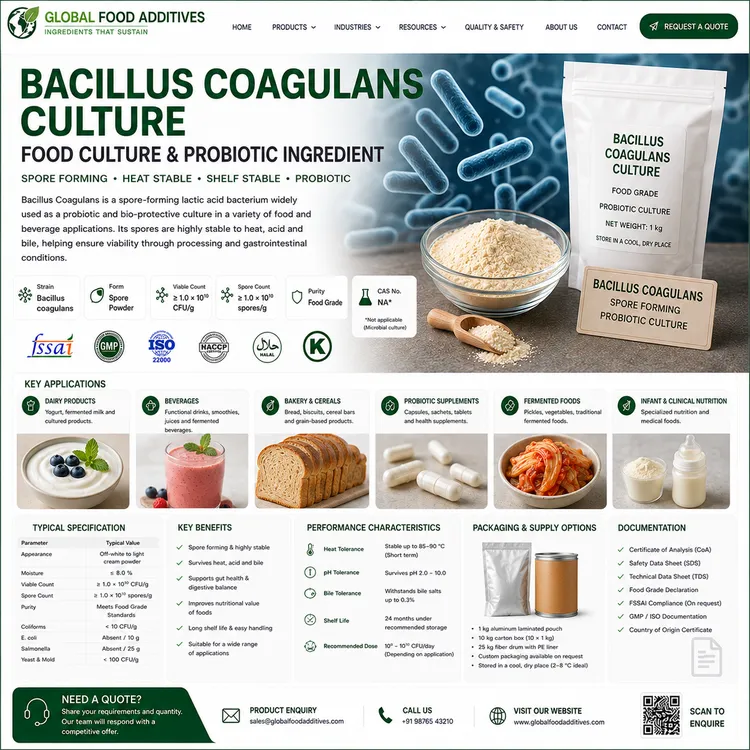
Product identity
| Product | Bacillus Coagulans Culture |
|---|---|
| Common names | Bacillus coagulans, B. coagulans, spore-forming culture, food-grade microbial preparation, probiotic culture preparation |
| Category | Fermentation, Cultures & Bio-Protective Ingredients |
| Function | Microbial culture, probiotic-positioned ingredient, fermentation-support culture or bio-protective ingredient depending on strain and market |
| E / INS number | Confirm by destination market, application, strain and supplier documentation |
| CAS / identity | Microbial preparation; strain identity and taxonomy should be confirmed by supplier documents |
| Taxonomy note | Bacillus coagulans may appear in updated scientific literature under revised taxonomic naming; commercial and regulatory documents should use the accepted name required by the destination market |
| Typical form | Freeze-dried culture, spray-dried culture, spore concentrate, powder, granule, premix or application-specific carrier blend |
| Typical declaration basis | CFU/g, spores/g, CFU per serving, viable count at manufacture or viable count at end of shelf life |
| Key performance role | Viable culture delivery, spore stability, process survival, controlled incorporation and finished-product count retention |
Application fit
Bacillus Coagulans Culture is usually evaluated where a strain-specific culture must survive processing, storage and distribution better than many non-spore-forming organisms. Potential use areas may include:
- Powdered drink mixes, instant beverages and dry nutritional blends
- Functional gummies, chewables, tablets and compressed food formats
- Snack bars, cereal bars, protein bars and dry bakery-style products
- Selected baked goods where heat exposure and final viable count are validated
- Dairy-style products, fermented dairy concepts and plant-based fermented foods
- Vegetable ferments, cereal ferments, sourdough systems and controlled culture trials
- Premixes for food, beverage and supplement-adjacent manufacturing lines
Technical performance overview
Bacillus Coagulans Culture is commonly selected because spore-forming cultures can be more resistant to heat, dryness, compression, oxygen exposure and storage stress than many vegetative probiotic cultures. In industrial food systems, this can support better count retention through manufacturing and shelf life, but performance remains highly strain-specific and matrix-specific.
The most important commercial question is not only the initial CFU count, but the guaranteed viable count at the time relevant to the buyer: at manufacture, at shipment, at end of shelf life or per finished serving. To evaluate this properly, the buyer should understand dose, overage, matrix stress, processing temperature, water activity, oxygen exposure, packaging barrier, storage temperature and the analytical method used to count viable organisms or spores.
Key formulation variables
| Strain identity | Culture function, safety data, stability and regulatory support are strain-specific; request complete strain designation and identification method. |
|---|---|
| CFU count | Compare CFU/g, CFU/serving and guaranteed viable count at end of shelf life, not only initial potency. |
| Spore count | Spore concentration and sporulation quality influence survival through heat, dryness and storage. |
| Carrier system | Maltodextrin, starch, dextrose, fibre, dairy carrier or other carrier systems affect flow, label declaration, allergen status and stability. |
| Water activity | Low water activity improves survival in many dry systems; high-moisture systems require application-specific validation. |
| Heat exposure | Temperature, residence time, moisture level and product core temperature determine viable-count retention after processing. |
| pH and acidity | Acidic matrices may be suitable for some strains, but survival and germination behavior should be validated in the finished product. |
| Oxygen and packaging | Packaging oxygen barrier, headspace, desiccants and humidity protection can influence shelf-life count retention. |
Industrial advantages
- Spore-forming culture format can support improved process and storage tolerance
- Suitable for many dry blends, premixes and low-water-activity products
- Can be supplied as high-count concentrate for accurate industrial dosing
- Often compatible with powder blending, encapsulation, tableting or compression when validated
- Can support finished-product CFU targets when overage and shelf life are correctly designed
- May be easier to incorporate into heat-exposed food systems than many vegetative cultures
- Useful for functional food projects where strain documentation and stability are critical
- Can be blended with fibres, prebiotic ingredients, vitamins, minerals or flavours when compatibility is confirmed
Culture specification and strain control
For Bacillus Coagulans Culture, the specification should clearly identify the strain and the count basis. Generic species-level wording is usually not enough for a serious industrial purchase. Different strains can differ in sporulation efficiency, heat tolerance, acid tolerance, growth profile, finished-product survival, safety dossier, antibiotic-resistance profile and claim support.
| Specification area | Why it matters | What to request |
|---|---|---|
| Strain designation | Determines identity, traceability, application history and any strain-specific documentation | Full strain name, internal code, deposit number where available and identification method |
| Potency | Determines dosing, cost-in-use and finished serving count | CFU/g, spores/g, guaranteed count at manufacture and guaranteed count at end of shelf life |
| Purity | Protects quality, safety and customer audit compliance | Pathogen limits, contaminant organisms, yeast, mould, coliforms, Enterobacteriaceae and absence testing |
| Carrier and excipients | Affects label declaration, allergens, GMO status, flowability and stability | Complete carrier declaration, processing aids, anti-caking agents and allergen / GMO statements |
| Stability | Supports shelf-life planning and overage calculation | Stability data in bulk powder, model matrix or similar application under relevant storage conditions |
| Regulatory support | Required for market entry, label approval and customer quality systems | Food-grade statement, strain safety dossier, regulatory opinion, GRAS or equivalent documents where applicable |
Application and process guidance
The correct grade should be selected according to the manufacturing process. Direct blending into dry powders is usually less stressful than incorporation into high-moisture systems followed by heat processing. For bakery, extrusion, gummies, bar production, hot-fill beverages or compressed formats, survival should be tested after the actual process and during the full intended shelf life. Supplier data may be useful for screening, but final validation should be done in the buyer's product and package.
Recommended evaluation steps
- 1. Define the commercial target: CFU per serving, viable count at end of shelf life, target market, label wording and serving size.
- 2. Confirm strain identity: request the complete strain designation, identification method, origin, safety dossier and regulatory support.
- 3. Map the process: document mixing, hydration, heat exposure, compression, extrusion, cooling, drying, filling and storage conditions.
- 4. Calculate overage: include expected processing loss, storage loss, analytical variation and safety margin for finished-product claims.
- 5. Run pilot trials: test count after processing, after packaging and at accelerated and real-time stability points.
- 6. Validate label compliance: confirm probiotic wording, culture name, serving count, claims and regulatory acceptance in the destination market.
Where extra caution is needed
- Products making probiotic or health-related claims without strain-specific substantiation
- High-moisture products stored ambient for long periods
- Hot-fill, baking, extrusion, pasteurisation or retort processes without survival validation
- Compressed tablets or hard gummies where pressure and heat can reduce count
- Acidic beverages or fruit systems with low pH and long shelf life
- Products containing antimicrobials, preservatives, high alcohol, essential oils or aggressive flavours
- Export markets with strict microbial ingredient, novel food or probiotic-label restrictions
Typical industrial application areas
| Application | Technical objective | Purchasing notes |
|---|---|---|
| Powdered beverages and instant mixes | Stable dry delivery of a defined culture with good count retention | Check carrier compatibility, water activity, flavour oils, acidulants, mineral systems, packaging barrier and reconstitution instructions. |
| Gummies and chewables | Culture delivery in a consumer-friendly format | Evaluate heat exposure, syrup temperature, pH, water activity, compression, deposit temperature and shelf-life count loss. |
| Bars and snacks | Inclusion in low-moisture food matrices | Review fat phase, water activity, mixing temperature, chocolate coating, packaging oxygen barrier and storage temperature. |
| Bakery and baked systems | Survival through controlled heat exposure where feasible | Test core temperature, bake time, post-bake addition options, water activity and finished-product count at shelf life. |
| Dairy-style and plant-based products | Culture addition for defined microbial positioning or fermentation-support concepts | Check pH, cold-chain conditions, starter-culture interaction, preservatives, sugar level and viable count during storage. |
| Dry premixes | Uniform distribution in powder blends and stable count during storage | Review blend uniformity, segregation, particle size, electrostatic behavior, moisture ingress and dosage accuracy. |
| Fermented foods | Controlled culture addition, acidification support or application-specific microbial contribution | Confirm strain growth behavior, acid production, interaction with native flora, process temperature and regulatory status. |
Specification checklist for buyers
For industrial purchasing, compare Bacillus Coagulans Culture by viable performance and documentation quality. A lower-cost culture may become more expensive if it requires high overage, loses count quickly, has unclear strain identity, carries unsuitable excipients or cannot support the intended market claim.
Technical specification points
- Complete strain designation and taxonomy statement
- CFU/g, spores/g and guaranteed count basis
- Viable count at manufacture, shipment and end of shelf life
- Recommended overage and stability-loss assumptions
- Carrier, excipient and processing-aid declaration
- Moisture, water activity, particle size and bulk density
- Heat tolerance, acid tolerance and bile tolerance data where available
- Microbiological purity and pathogen absence limits
- Antibiotic-resistance profile and safety assessment where required
- Heavy metals, contaminants and residual solvent statements where relevant
- Shelf life, storage temperature and opened-pack handling
- Analytical method for CFU or spore enumeration
Commercial comparison points
- Minimum order quantity and sample availability
- Standard potency levels and available custom dilutions
- Cold-chain or ambient-shipping requirements
- Standard packaging size, moisture barrier, oxygen barrier and desiccant options
- Batch reservation, lead time and annual supply continuity
- Halal, Kosher, allergen, GMO, vegan and gluten statements where required
- Support for private label, premix, sachet, tablet or gummy applications
- Destination-market regulatory documents and finished-label support
Quality, safety and contamination control
Microbial cultures require a strong quality-control package because the ingredient itself is a live or viable biological preparation. Buyers should request evidence of strain identity, controlled fermentation, controlled drying or sporulation, absence of pathogens, batch traceability, microbiological purity and validated enumeration methods. For export and customer audits, the supplier should provide clear documentation on manufacturing site, food-safety certification, allergen controls, GMO status and storage requirements.
Because Bacillus species can differ significantly by strain, buyers should avoid relying on species name alone. Safety review may include toxin-production assessment where relevant, antibiotic-resistance profile, whole-genome or molecular identification data where available, absence of undesirable contaminants and confirmation that the specific strain is suitable for the intended food category and consumer group.
Processing and handling notes
Bacillus Coagulans Culture should be protected from moisture, high humidity, unnecessary heat exposure and extended open-bag handling. Even when supplied as a robust spore-forming culture, poor storage and processing can reduce viable count. For powders, pre-blend into a compatible carrier to improve distribution before adding to the full batch. Avoid adding culture directly into high-shear, high-temperature or high-moisture zones unless the process has been validated.
| Processing factor | Industrial importance | What to confirm |
|---|---|---|
| Addition point | Controls exposure to heat, moisture, shear and antimicrobial ingredients | Whether culture should be added pre-process, post-process, post-cooling or into a dry premix |
| Thermal exposure | Determines viable count loss during baking, extrusion, hot-fill or cooking | Core temperature, residence time, product moisture and post-process CFU recovery |
| Water activity | Strongly influences shelf-life stability in dry and semi-dry products | Finished-product water activity, moisture migration and packaging barrier |
| Blend uniformity | Ensures serving-to-serving count consistency | Premix ratio, particle size match, mixer type, blend time and sampling method |
| Storage conditions | Protects potency before and after opening | Recommended temperature, humidity, resealing method, desiccant use and shelf life after opening |
Regulatory and label review notes
Bacillus Coagulans Culture should be reviewed by exact strain, intended use, consumer group, dose, food category and destination market. The terms “culture,” “probiotic,” “live culture,” “spore-forming culture” and any health-related wording may be regulated differently across countries. Some markets require strain-level identification, evidence of safety, claim substantiation, viable count declaration, novel food review or specific wording for the label.
Buyers should confirm whether the product is being used as a technological culture, a probiotic-positioned ingredient, a functional food ingredient, a dietary supplement ingredient or another category under local rules. The final label should be reviewed for species name, strain designation, CFU declaration, serving size, storage instructions, expiry count and any customer-specific restrictions.
Industrial troubleshooting guide
| Observed issue | Possible cause | Corrective action to test |
|---|---|---|
| Finished product has low CFU count | Insufficient overage, heat damage, moisture exposure, poor storage or unsuitable matrix | Increase overage, change addition point, reduce heat exposure, improve packaging barrier and validate count at shelf life. |
| Uneven CFU distribution | Poor premixing, particle-size mismatch, segregation or low inclusion rate | Prepare a carrier premix, improve mixing time, match particle size and use validated sampling across the batch. |
| Culture loses potency in storage | High humidity, oxygen ingress, high temperature or reactive ingredients | Use moisture-barrier packaging, add desiccant where suitable, reduce storage temperature and review formula compatibility. |
| Unexpected flavour or odour impact | Carrier contribution, fermentation residues, high dosage or interaction with flavours | Request neutral carrier grade, reduce overage if possible, test flavour masking and compare alternative supplier grades. |
| Regulatory label concern | Unclear strain identity, unsupported probiotic wording or unsuitable claim | Request strain documents, revise wording, remove unsupported claims and confirm destination-market rules before launch. |
| Premix clumping or poor flow | Moisture pick-up, hygroscopic carrier or incompatible powder blend | Improve storage, use anti-caking or flow-support grade where permitted, reduce humidity and review bag barrier. |
Documents to request
A complete Bacillus Coagulans Culture purchasing file should support procurement, R&D, quality assurance, regulatory, production and customer-audit teams. Depending on application and destination market, buyers commonly request:
- Product specification or technical data sheet
- Certificate of analysis for available batch or lot
- Safety data sheet where applicable
- Full strain designation and taxonomy statement
- Strain identification method and deposit information where available
- CFU/g, spores/g and viable-count guarantee basis
- Enumeration method and sampling method
- Stability data for bulk product and relevant application matrix where available
- Heat, acid, bile, compression or process-tolerance data where relevant
- Carrier, excipient, processing-aid and allergen declarations
- GMO, vegan, gluten, Halal and Kosher statements where required
- Microbiological purity and pathogen absence data
- Antibiotic-resistance profile and safety dossier where required
- Origin, manufacturer, shelf-life and storage information
- Packaging details, pallet configuration and shipping temperature guidance
- Market-specific regulatory declarations required by the destination country
Packaging and logistics
Bacillus Coagulans Culture may be supplied in foil laminate bags, vacuum-sealed packs, nitrogen-flushed packs, HDPE containers, drums, sachet-ready packs or bulk cartons depending on potency and supplier capability. Packaging should protect the culture from moisture, oxygen, heat and physical contamination. For high-potency concentrates, accurate weighing and closed handling are important to protect operator hygiene and dosing precision.
Some grades may be shipped and stored at ambient temperature, while others may require refrigerated or temperature-controlled logistics. The buyer should confirm shipping conditions, maximum transport temperature, shelf-life remaining at dispatch, cold-chain requirement, storage after opening, desiccant use and whether potency is guaranteed at shipment or at end of shelf life.
How to request this product
Send the product name, target strain or reference specification, required CFU/g or CFU per serving, quantity, destination country, packaging preference, expected shipment date and required documents. If you already purchase Bacillus Coagulans Culture, attach or describe your current specification, label, certificate of analysis, target application, use level, process conditions and shelf-life target so supplier options can be compared more accurately.
Useful answers
What is Bacillus Coagulans Culture used for in food manufacturing?
Bacillus Coagulans Culture is typically discussed for defined microbial culture delivery, probiotic-positioned foods, process-stable culture inclusion, selected fermentation concepts and finished-product CFU targets. Exact suitability depends on strain, grade, application, process, regulations and supplier documents.
Why is the strain name important?
Performance and safety support are strain-specific. Buyers should request the full strain designation, identification method, safety dossier, CFU guarantee, application data and regulatory documents instead of approving only a generic species name.
What does CFU mean?
CFU means colony-forming units. It is used to express viable count. Buyers should confirm whether the supplier guarantees CFU at manufacture, at shipment, at end of shelf life or per finished serving.
Can Bacillus Coagulans Culture be used in heat-processed foods?
It may be suitable in some heat-exposed foods because spore-forming cultures can show improved process tolerance. However, survival must be validated in the real product because temperature, time, moisture, pH and packaging strongly affect final count.
Can it be used in beverages?
It may be evaluated in powdered beverages, instant drinks and selected ready-to-drink systems. Buyers should check pH, water activity, preservative system, heat treatment, oxygen exposure, packaging and viable-count retention during shelf life.
Which specification parameters matter most?
Important parameters include strain identity, CFU/g, spores/g, viable count at end of shelf life, overage strategy, carrier system, moisture, water activity, particle size, stability data, microbiological purity, pathogen absence and regulatory documentation.
Can Global Food Additives source Bacillus Coagulans Culture?
Global Food Additives can review sourcing options for Bacillus Coagulans Culture according to target strain, target CFU, application, quantity, destination, packaging preference, delivery term and documentation requirements.
Is this product permitted in every country?
No. Microbial culture use depends on destination-market rules, exact strain, food category, use level, label requirements, probiotic wording, health-claim restrictions and buyer responsibility.
Tell us which food additive or ingredient you need.
Send product names, target specifications, quantity, destination country, packaging preference, delivery term, and document requirements. For Bacillus Coagulans Culture, please also include target strain, CFU requirement, application, process temperature, water activity, shelf-life target, storage condition and any probiotic or label wording requirements. Our team will review your inquiry and respond from orders@foodgradeadditives.com.
Your message has been received. You will be redirected to the home page.