
Brewer’s Yeast Extract
Brewer’s Yeast Extract is a food-grade yeast-derived ingredient used by industrial food manufacturers for savoury flavour development, umami enhancement, broth character, flavour rounding, salt-reduction support, bitterness masking, fermentation nutrition and clean-label flavour-building systems. It is especially valuable in formulations where manufacturers need depth, roasted notes, meaty perception or fermented character without relying only on added MSG, hydrolyzed vegetable protein or artificial flavour systems.
This page is prepared as a technical sourcing reference for purchasing teams, R&D technologists, flavour houses, QA departments, regulatory teams and import managers who need to compare yeast source, flavour profile, specification, salt level, nucleotide content, documentation, packaging and supplier suitability before quotation or approval.
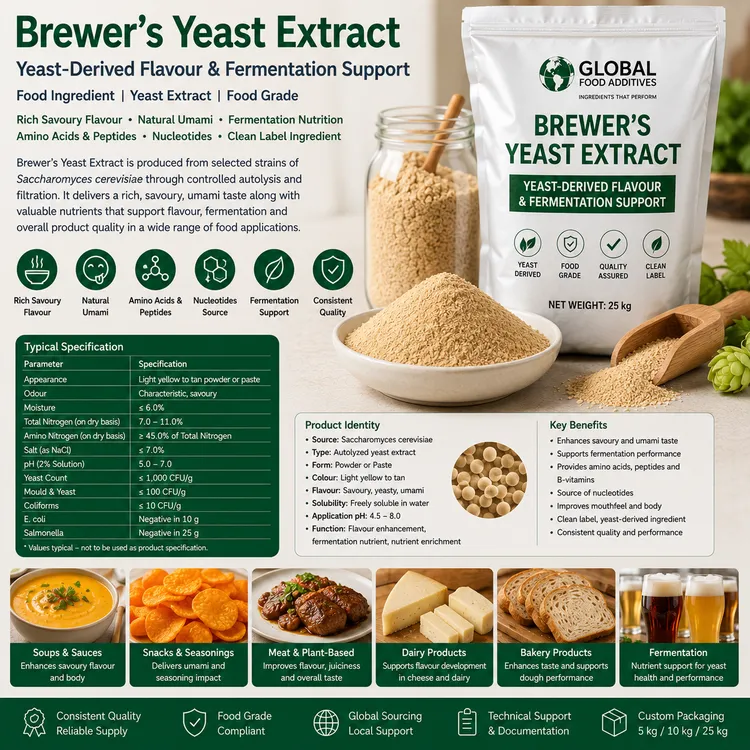
Product identity
| Product | Brewer’s Yeast Extract |
|---|---|
| Common names | Brewers yeast extract, yeast extract, autolyzed yeast extract, Saccharomyces cerevisiae extract, yeast-derived savoury ingredient |
| Category | Fermentation, Cultures & Bio-Protective Ingredients |
| Function | Savoury flavour ingredient / umami contributor / fermentation nutrient / yeast-derived food ingredient |
| E / INS number | Confirm by destination market and supplier documentation |
| CAS / identity | Yeast-derived; confirm identity and production method from supplier documentation |
| Typical source | Brewer’s yeast or food-grade Saccharomyces cerevisiae biomass, depending on supplier process |
| Typical form | Powder, granule, paste, liquid concentrate, spray-dried extract or standardized savoury blend |
| Typical grade focus | Food grade, low-salt grade, high-nucleotide grade, savoury flavour grade, fermentation nutrient grade, vegetarian flavour grade or customer-specific blend |
Application fit
Brewer’s Yeast Extract is evaluated where manufacturers need yeast-derived flavour, nutritional contribution for fermentation, flavour standardisation or umami depth. Suitability depends on salt level, nucleotide profile, free amino acids, bitterness, colour, solubility, heat process, label requirement and final sensory target.
- Soups, bouillons, stocks, gravies, sauces and culinary bases
- Snack seasonings, chips, crackers, extruded snacks and savoury coatings
- Meat products, processed meat, marinades, rubs and cooked-meat flavour systems
- Plant-based meat alternatives and vegan savoury flavour systems
- Fermentation media, sourdough systems and culture-support applications after validation
- Vegetable ferments, plant-based ferments and savoury fermented products
- Dairy-style savoury systems, cheese seasonings and processed cheese flavour bases
- Ready meals, instant noodles, dry mixes, frozen meals and prepared food systems
Technical function in food systems
Brewer’s Yeast Extract is produced from yeast biomass by processes such as autolysis, enzymatic hydrolysis, concentration and drying, depending on supplier technology. During production, yeast cell components are broken down into soluble amino acids, peptides, nucleotides, minerals and other flavour-active compounds. These components can contribute savoury taste, umami perception, kokumi-like mouthfulness, roasted notes, broth character and flavour continuity in prepared foods.
In industrial formulation, yeast extract is normally used as a flavour-building ingredient rather than a direct preservative or live starter culture. It may also be used as a nutrient source in selected fermentation systems because it can provide nitrogen, vitamins, minerals and growth-supporting compounds. The final performance depends on grade selection, dosage, matrix, process temperature, salt system, pH and interaction with spices, proteins, fats, carbohydrates and other flavour enhancers.
Key functional properties
- Umami enhancement: Supports savoury depth through naturally occurring amino acids and nucleotide-related flavour components.
- Flavour rounding: Helps reduce harsh edges in salty, acidic, spicy or highly processed food systems.
- Salt-reduction support: Can improve perceived savouriness where sodium reduction is being evaluated.
- Meaty and roasted notes: Certain grades contribute broth, roasted, cooked, fermented, soy-like or meat-like flavour profiles.
- Bitterness masking: May help round bitterness from plant proteins, hydrolysates, minerals or high-intensity flavours.
- Fermentation nutrition: Can provide nitrogen, peptides, minerals and yeast-derived nutrients for selected microbial processes.
- Clean-label positioning: Often used in flavour systems where manufacturers prefer yeast-derived ingredients over some artificial flavour routes.
Process variables to control
- Dosage level, target sensory impact and interaction with salt
- Heat process, Maillard reaction potential and flavour development during cooking
- pH, acidity, water activity and product storage conditions
- Compatibility with spices, hydrolyzed proteins, MSG, I+G, soy sauce powders and meat flavours
- Colour contribution in light-coloured products such as dairy-style sauces or cream soups
- Solubility and sediment risk in beverages, broths and liquid concentrates
- Bitterness risk at high dosage or with certain high-protein matrices
- Label declaration and claim impact in vegetarian, vegan, halal, kosher or gluten-sensitive products
Industrial formulation guidance
For industrial purchasing and R&D work, Brewer’s Yeast Extract should be selected by flavour profile and analytical specification, not only by generic product name. Two products may both be sold as yeast extract but differ significantly in free amino nitrogen, salt level, nucleotide content, colour, bitterness, roast profile, solubility, powder flow, microbiological specification and label suitability. Pilot trials are essential before changing supplier or grade.
Recommended use evaluation
- Define the target sensory direction: brothy, meaty, roasted, fermented, cheesy, soy-like, mild umami or dark savoury.
- Confirm the finished product category: soup, sauce, snack, meat, plant-based, seasoning, broth, bakery filling or fermentation medium.
- Compare salt content, nucleotide content, free glutamate, total nitrogen and sensory profile before approval.
- Test in the real product matrix, not only in water solution.
- Evaluate flavour before and after heat treatment, drying, freezing, storage and reheating.
- Check solubility, sediment, colour impact, flavour carry-through and aftertaste.
- Confirm local labeling rules and customer requirements before commercial launch.
Common processing risks
- Excessive salt: Some yeast extracts contain significant sodium chloride and may affect nutrition targets.
- Bitterness: High dosage or certain hydrolysis profiles can create bitter or yeasty notes.
- Colour darkening: Dark yeast extracts may not be suitable for light sauces, dairy-style bases or cream-coloured products.
- Flavour mismatch: A roasted grade may not match a mild broth or dairy-style application.
- Solubility issues: Poorly soluble grades can create sediment, specks or filtration problems.
- Label concerns: Yeast source, gluten status, GMO status, “natural flavour” claims and additive classification can vary by market.
- Not a live culture: Most yeast extract grades are inactive; do not use them as starter cultures unless viability is documented.
Application-specific value
Brewer’s Yeast Extract is used across multiple food categories where savoury taste, mouthfeel and flavour continuity are critical. It may be compared with monosodium glutamate, hydrolyzed vegetable protein, soy sauce powder, mushroom extract, meat extract, vegetable powders, fermented flavour bases, disodium ribonucleotides, spices and natural flavour systems. The best choice depends on flavour target, label strategy, sodium level, cost-in-use and destination-market rules.
Soups, sauces and culinary bases
- Builds broth, cooked, roasted and savoury background notes in soups, sauces, gravies and bouillons.
- Can improve flavour depth in reduced-salt systems when used with a balanced seasoning matrix.
- May support colour and flavour standardisation across different batches of vegetables, proteins or spices.
- Trials should evaluate solubility, sediment, heat stability, colour impact and aftertaste.
Snacks and seasonings
- Provides umami, roasted and fermented notes in chips, crackers, extruded snacks and seasoning powders.
- Useful in cheese, barbecue, roasted meat, mushroom, onion, gravy and soy-style flavour systems.
- Can improve coating flavour intensity and reduce flatness in dry seasoning blends.
- Powder grades should be checked for flowability, caking, dusting and uniform distribution.
Meat and plant-based foods
- Supports meaty, brothy or cooked notes in processed meats, sausages, marinades and meat alternatives.
- Can help mask pea, soy, wheat or other plant-protein bitterness in vegan and vegetarian formulations.
- May improve savoury impact in low-fat or reduced-salt products where flavour release is weaker.
- Finished products should be evaluated for bite, juiciness perception, aftertaste and cooking loss.
Fermentation and culture-support systems
- Can provide yeast-derived nitrogen, peptides, minerals and vitamins for selected fermentation systems.
- May be evaluated in sourdough, vegetable ferments, plant-based ferments or microbial process media.
- Should not be assumed to contain live yeast or protective cultures unless supplier documentation confirms viability.
- Process trials should measure acidification, growth, flavour development, gas production and batch consistency.
Typical specification points to review
For industrial purchasing, the most useful comparison is performance per dosage, not only price per kilogram. Brewer’s Yeast Extract grades may differ in nitrogen profile, nucleotide content, salt contribution, colour, flavour direction, solubility, microbiological quality and label acceptability. Buyers should request the supplier’s actual specification and certificate of analysis before approval.
Technical parameters
| Total nitrogen | Useful indicator of yeast-derived protein, peptide and amino acid contribution. |
|---|---|
| Amino nitrogen | Important for fermentation nutrition, savoury intensity and hydrolysis comparison. |
| Protein content | Relevant for nutrition review and comparison between extract grades. |
| Free glutamate | Key contributor to umami perception; confirm if required by buyer specification. |
| Nucleotide content | High-nucleotide grades may deliver stronger savoury enhancement and synergy with glutamate. |
| Salt content | Important for sodium targets, seasoning balance and nutrition labeling. |
| Moisture / loss on drying | Important for powder flowability, shelf life, caking risk and active solids comparison. |
| Ash | Useful for mineral and salt contribution review. |
| pH | Relevant for flavour balance, solubility and compatibility with acidic or fermented systems. |
| Colour | Important for cream soups, light sauces, dairy-style products and clear broths. |
| Solubility | Critical for broths, beverages, liquid concentrates, soups and process media. |
| Particle size | Affects dry blending, dusting, dissolution speed and uniform distribution. |
| Microbiology | Review total plate count, yeast and mold, coliforms, Salmonella and other pathogens according to buyer requirement. |
| Heavy metals | Should comply with food-grade and destination-market limits. |
Commercial parameters
| Packaging | Commonly supplied in multi-layer bags, cartons, drums, jars, pails or liquid containers depending on form. |
|---|---|
| Net weight | Confirm available pack sizes according to supplier, form, origin and destination logistics. |
| Palletization | Confirm pallet type, wrapping, stack height, container loading and moisture protection. |
| Shelf life | Confirm from supplier documents; depends on moisture, packaging, salt level and storage conditions. |
| Storage | Store tightly closed in a clean, dry, cool and well-ventilated area away from moisture, heat and strong odors. |
| Handling | Powder grades require dust and caking control; paste or liquid grades require hygienic handling and container integrity. |
| MOQ | Depends on supplier, stock position, flavour grade, packaging format and destination logistics. |
| Lead time | Depends on production schedule, sensory approval, documentation, inspection and freight route. |
| Cost-in-use | Compare flavour impact, salt contribution, dosage efficiency and sensory performance rather than kilogram price alone. |
Quality, food safety and compliance notes
Brewer’s Yeast Extract for food manufacturing should be purchased only with clear food-grade documentation, traceability and sensory approval. The buyer should verify that the material is suitable for the intended food category, destination market, customer standard and finished-product label. Where the product is used for export, private label, vegan positioning, natural flavour claims or gluten-sensitive products, regulatory and customer-policy confirmation should be completed before commercial use.
QA team checklist
- Confirm product name, yeast source, food-grade status and intended function.
- Check whether the material is inactive yeast extract, autolyzed yeast extract, hydrolyzed yeast extract or another yeast-derived preparation.
- Compare supplier specification with internal purchasing and application requirements.
- Review actual batch COA before shipment or release.
- Confirm salt content, total nitrogen, amino nitrogen, moisture, solubility and microbiological limits.
- Verify allergen, gluten, GMO, halal, kosher, vegan or other buyer-required statements where applicable.
- Check production date, expiry date, batch number, label information and packaging integrity.
- Conduct incoming QC and sensory trials before changing supplier, grade or dosage.
- Confirm storage conditions and aroma protection during warehousing and transport.
Regulatory review points
- Destination-market naming rules for yeast extract, autolyzed yeast extract or flavouring ingredient
- Food category, use level and finished-product label declaration
- Natural flavour, clean-label, no-MSG-added or vegan claim requirements
- Gluten status where brewer’s yeast source or brewery-derived streams may be relevant
- GMO, allergen, halal, kosher and vegetarian policy requirements
- Import documentation, customs description and local registration requirements
- Customer standards, retailer restricted lists and flavour-enhancer policies
- Finished-product safety, sensory quality and compliance responsibility
Documents to request
A complete Brewer’s Yeast Extract inquiry should include both technical and commercial document requirements. This helps reduce delays during supplier qualification, sample approval, sensory evaluation, customer audits, customs clearance and first production trials.
Core documents
- Product specification or technical data sheet
- Certificate of analysis for available batch or representative lot
- Safety data sheet
- Food-grade statement or regulatory compliance declaration
- Yeast source and production-method statement where available
- Origin statement and manufacturer information where available
- Shelf-life and recommended storage conditions
- Product label, packaging details and pallet configuration
Optional buyer-specific documents
- Halal certificate, kosher certificate or other market-specific certification
- Allergen statement and cross-contamination declaration
- Gluten statement where brewer’s yeast source is relevant
- GMO status declaration
- Vegan or vegetarian suitability statement where required
- Heavy metal statement or contaminant declaration
- Microbiological specification and pathogen statement
- Carrier, diluent or processing-aid statement where applicable
- Country-specific import, customs or registration documents
How to request this product
Send the product name, target flavour profile, application, required form, salt level preference, quantity, destination country, packaging preference, delivery term, expected shipment date and required documents. If you already purchase Brewer’s Yeast Extract, attach or describe your existing specification, label, certificate of analysis, sensory target, flavour standard or sample reference so supplier options can be compared more accurately.
Information that improves quotation accuracy
- Target application and finished-product type
- Required sensory profile: mild, brothy, meaty, roasted, fermented, cheesy, soy-like or high-umami
- Powder, granule, paste, liquid concentrate or blend requirement
- Salt level, nucleotide content or free-glutamate requirement, if available
- Current yeast extract grade, dosage or reference COA
- Label requirements such as vegan, halal, kosher, gluten-free, no-MSG-added or natural flavour positioning
- Required annual volume and first-order quantity
- Preferred packaging size and pallet requirement
- Destination port, warehouse or delivery city
- Required Incoterms such as EXW, FOB, CFR, CIF or DAP
- Required certificates and destination-market declarations
- Sample quantity and expected approval timeline
Supplier comparison criteria
- Food-grade documentation completeness
- Consistency of flavour profile between batches
- Salt, nucleotide, amino nitrogen and total nitrogen control
- Application performance in the buyer’s real product matrix
- Microbiological and contaminant control
- Solubility, colour and powder-handling performance
- Packaging strength, aroma protection and moisture control
- Batch traceability and shelf-life remaining at shipment
- Export experience and document responsiveness
- Total landed cost and performance cost-in-use
Useful answers
What is Brewer’s Yeast Extract used for in food manufacturing?
Brewer’s Yeast Extract is used as a yeast-derived food ingredient for savoury flavour development, umami enhancement, broth character, salt-reduction support, bitterness masking, fermentation nutrition and flavour standardisation in soups, sauces, seasonings, snacks, meat products, plant-based foods and prepared meals.
Is Brewer’s Yeast Extract a live starter culture?
Usually no. Most yeast extract products are inactive extracts made from processed yeast cells. They can support flavour or provide nutrients in selected fermentation systems, but they should not be treated as live starter cultures unless supplier documentation confirms viable organisms and strain identity.
Does Brewer’s Yeast Extract contain MSG?
Yeast extract naturally contains amino acids, including glutamate, which contributes to umami taste. Whether a product can be labelled “no added MSG” or similar depends on local regulations, supplier composition and customer policy. Buyers should confirm the intended claim before use.
Can Brewer’s Yeast Extract support salt reduction?
Yes, certain yeast extract grades can improve savoury intensity and mouthfulness in reduced-salt formulations. However, some grades also contain salt, so the sodium contribution must be reviewed during nutrition and sensory development.
Which technical parameters should be checked before purchasing?
Buyers should compare total nitrogen, amino nitrogen, protein content, salt content, moisture, ash, pH, solubility, colour, flavour profile, nucleotide content, free glutamate, particle size, microbiological limits, heavy metals, allergen status, GMO status, packaging type and shelf life.
Can Global Food Additives source Brewer’s Yeast Extract?
Global Food Additives can review sourcing options for Brewer’s Yeast Extract according to target specification, flavour profile, salt level, application, form, quantity, destination, packaging preference, delivery term and required documentation.
Which documents should be requested?
Buyers commonly request a technical data sheet, product specification, certificate of analysis, safety data sheet, food-grade statement, origin statement, yeast source declaration, allergen or GMO declaration where required, shelf-life information, label details and packing configuration.
Is this product permitted in every country?
No. Use, naming and labeling depend on destination-market rules, food category, use level, yeast source, production method, claims and buyer responsibility. The buyer should confirm local regulations and customer standards before commercial use.
What should be tested during factory trials?
Factory trials should evaluate flavour impact, dosage, salt contribution, solubility, sediment, colour, heat stability, bitterness, aftertaste, aroma retention, storage stability, compatibility with spices and proteins, and performance against the target sensory standard.
Tell us which food additive or ingredient you need.
Send product names, target specifications, quantity, destination country, packaging preference, delivery term, and document requirements. Our team will review your inquiry and respond from orders@foodgradeadditives.com.
Your message has been received. You will be redirected to the home page.