
Calcium Chloride E509
Calcium Chloride is a food-grade calcium salt used in selected food applications for firming, mineral balance, dairy coagulation support, tofu gelation, brine adjustment, electrolyte contribution, pH-control support and process functionality. It is one of the most practical calcium-ion sources for manufacturers that need high solubility, fast calcium availability and reliable performance in liquid, brine, dairy, vegetable, fruit and protein systems.
Global Food Additives supports dairy processors, tofu manufacturers, pickle and canned-vegetable producers, beverage companies, brewing operations, fruit processors, culinary manufacturers and ingredient distributors with Calcium Chloride sourcing, specification comparison, technical document collection, packaging coordination and export-ready quotation support.
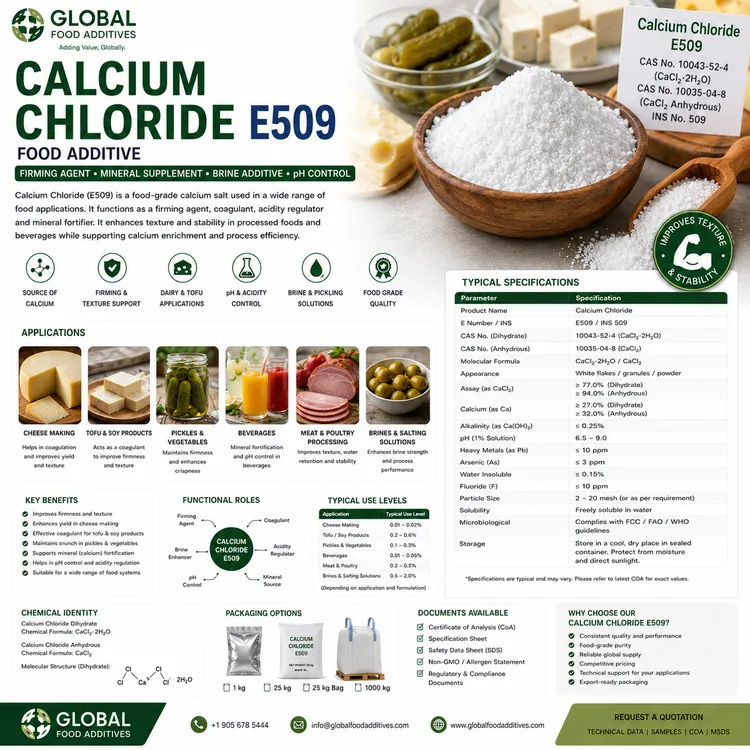
Product identity
| Product | Calcium Chloride |
|---|---|
| Common additive reference | E509 / INS 509 |
| CAS / identity | 10043-52-4 for anhydrous calcium chloride |
| Related hydrate identity | 10035-04-8 for calcium chloride dihydrate |
| Chemical formula | CaCl2 for anhydrous grade; CaCl2·2H2O for dihydrate grade |
| Category | Phosphates, Salts & Sequestrants |
| Functional class | Firming agent / calcium source / brine ingredient / processing aid / pH-control support / mineral-control ingredient |
| Typical form | Flake, pellet, prill, powder, granule, dihydrate crystal or liquid solution grade |
| Commercial focus | Food-grade compliance, assay control, low impurity profile, correct hydrate basis, packaging integrity, moisture protection and batch traceability |
Application fit
Potential use areas must be checked against destination-market rules, finished-food category, customer specifications and process conditions. Typical technical review areas may include:
- Cheese making, processed cheese and dairy coagulation support
- Tofu, soybean curd and plant-protein gelation systems
- Pickles, olives, fermented vegetables and canned vegetables
- Fruit firming, fresh-cut fruit and canned fruit texture control
- Beverages, bottled water and electrolyte mineral systems
- Brewing water adjustment and mineral correction
- Alginate gelation and spherification systems where permitted
- Brines, sauces, condiments and specialty culinary systems
Technical function in food systems
Calcium Chloride supplies readily available calcium ions. In plant tissues, calcium can interact with pectin structures, helping improve firmness, bite, shape retention and resistance to thermal processing. In dairy systems, added calcium can support casein micelle behavior, rennet coagulation, curd firmness and whey separation, particularly when milk has been pasteurized, homogenized or otherwise processed. In tofu and plant-protein systems, calcium ions contribute to gel formation, texture and water retention.
Because Calcium Chloride is highly soluble and hygroscopic, it is effective but must be handled carefully. Anhydrous grades release heat when dissolved in water, so industrial users should add the material slowly into water with agitation and appropriate safety procedures. Solid material also absorbs moisture readily, which can cause caking, lumping and concentration variation if packaging or warehouse conditions are poorly controlled.
Functional benefits to evaluate
- Fast calcium-ion availability in aqueous food systems
- Firming support for vegetables, fruits, pickles and canned products
- Improved curd formation, rennet response and yield consistency in cheese making
- Controlled coagulation and texture development in tofu production
- Mineral correction in brewing water and beverage systems
- Electrolyte contribution for selected beverages where permitted
- Support for alginate gel formation in specialty food processing
- Useful liquid brine formats for automated dosing and continuous production
Key formulation variables
| Hydrate basis | Anhydrous and dihydrate grades differ in calcium chloride content and dosage calculation. |
|---|---|
| Solution concentration | Liquid grades should be specified by percentage, density, assay and acceptable tolerance. |
| pH and acidity | Food-system pH influences calcium interaction with pectin, proteins, phosphates and alginates. |
| Process temperature | Heat treatment can affect firming, protein coagulation, brine uptake and mineral stability. |
| Salt system | Sodium chloride, potassium chloride, phosphates and citrates can influence calcium availability. |
| Bitterness and taste | Calcium Chloride can taste salty or bitter at higher levels, so sensory validation is important. |
| Moisture control | Solid grades are hygroscopic and need moisture-resistant packaging and dry storage. |
Industrial application guidance
Calcium Chloride should be selected according to the real process objective. A cheese plant may require a dilute liquid dosing solution for milk standardization, while a pickle manufacturer may need brine-strength control and firm texture after pasteurization. A tofu producer may need controlled coagulation and yield, while a beverage manufacturer may need mineral adjustment without excessive bitterness. Each application requires the correct form, concentration, dosage method and document package.
Cheese making and dairy processing
In cheese production, Calcium Chloride is commonly reviewed for improving milk coagulation and curd firmness when milk calcium balance has been affected by pasteurization, homogenization or storage. Buyers should validate dosage, milk pH, rennet activity, curd cut timing, moisture target, yield and finished cheese texture in the actual process.
Tofu and plant-protein systems
In tofu and soybean curd production, Calcium Chloride can act as a coagulant that contributes to gel structure and calcium content. The final texture depends on soy protein concentration, heating profile, coagulant concentration, addition method, mixing intensity, pressing conditions and target product style.
Pickles and fermented vegetables
In pickles, olives and fermented vegetables, Calcium Chloride may help maintain firmness and crispness during brining, fermentation, pasteurization and storage. The brine formula should be validated for calcium level, salt concentration, acidity, microbial stability, flavor impact and regulatory compliance.
Canned fruits and vegetables
In canned vegetable and fruit systems, Calcium Chloride can support tissue firmness and reduce softening during heat treatment. Application trials should evaluate dose, blanching conditions, fill brine composition, container type, thermal process and texture after shelf-life storage.
Beverages and electrolyte systems
In bottled water, sports drinks and electrolyte beverages, Calcium Chloride may contribute calcium and chloride ions. Formulators should check flavor impact, mineral balance, clarity, precipitation risk, pH, other electrolytes, nutrition-label rules and maximum permitted levels.
Brewing water adjustment
In brewing, Calcium Chloride may be used to adjust calcium and chloride levels in brewing liquor. Calcium can influence mash chemistry and yeast performance, while chloride can affect mouthfeel and flavor perception. Brewers should validate dosage by water analysis, beer style, mash pH and sensory profile.
Alginate gelation and specialty foods
Calcium Chloride is a strong calcium source for sodium alginate gelation and spherification-style systems. Because of its strong taste, formulators often use it in controlled baths or rinse steps rather than directly in delicate finished foods. Food legality and sensory impact must be confirmed.
Brines, sauces and culinary systems
In culinary brines, sauces and condiments, Calcium Chloride may support mineral balance, texture and pH-control strategies. Buyers should validate flavor, bitterness, saltiness, water activity, acid balance, preservation system and label declaration before commercial use.
Form selection: anhydrous, dihydrate or liquid solution
The correct commercial form has a major effect on cost-in-use, handling, storage, dosing accuracy and safety. Anhydrous Calcium Chloride has higher active content but is more hygroscopic and releases more heat when dissolved. Dihydrate grades are easier to calculate for some food operations and may be preferred where moisture handling is manageable. Liquid solution grades reduce dusting and dissolution work but require density, concentration and microbial-control checks.
Solid grade considerations
- Higher active content for anhydrous material
- Flakes, pellets, prills or granules for different handling systems
- Moisture-sensitive packaging required to prevent caking
- Exothermic dissolution must be controlled during solution preparation
- Particle size affects dissolution speed, dusting and feeder performance
Liquid grade considerations
- Specify calcium chloride percentage and density range
- Confirm food-grade water quality and microbial controls
- Review pump, tank, pipe and dosing-equipment compatibility
- Check freezing point, crystallization risk and storage temperature
- Confirm shelf-life, preservative status and batch traceability
Specification checklist for buyers
For industrial purchasing, the most valuable comparison is not only the product name. Buyers should compare the supplier specification against the intended food application, process conditions, dosage method, regulatory market and internal quality standard. A strong specification helps QA, R&D, production and purchasing teams confirm suitability before commercial commitment.
Chemical and physical controls
- Identity as Calcium Chloride / E509 / INS 509
- Assay or calcium chloride content on declared basis
- Anhydrous, dihydrate or liquid concentration basis
- Calcium content and chloride content where required
- Appearance, color and odor
- Moisture or water content for solid grades
- Density and concentration for liquid grades
- pH under supplier test conditions
- Alkalinity or acidity limits where specified
- Insoluble matter or foreign matter limits
- Particle size distribution or mesh range for solid grades
- Bulk density, flowability and caking tendency for automated dosing
Purity, safety and compliance checks
- Heavy metals limits according to buyer or regulatory specification
- Lead, arsenic, cadmium and mercury limits where required
- Iron limits where color, clarity or beverage quality is sensitive
- Magnesium and alkali salts where specified by buyer standard
- Sulfate, sodium, potassium or other ionic impurity limits where relevant
- Microbiological requirements for liquid grades or sensitive food applications
- Food-grade statement and intended-use declaration
- Batch number, production date, retest date and shelf-life
- SDS classification and safe handling recommendations
- Allergen, GMO, halal, kosher, vegan and irradiation declarations when requested
- Country-of-origin and manufacturer traceability information
Regulatory and label review
Calcium Chloride is identified as E509 / INS 509 and may be reviewed as a firming agent, stabilizer, thickener, pH-control agent, humectant, flavor enhancer, nutrient supplement, processing aid or related functional ingredient depending on the market and application. However, an additive number alone does not guarantee permission in every food category or every country.
In the United States, calcium chloride is listed under 21 CFR 184.1193 with defined food functions and use according to current good manufacturing practice, including maximum levels for several food categories. For other markets, including the European Union, Middle East, Africa, Asia-Pacific and Latin America, buyers should verify the current additive regulation for the exact finished food, dosage, label declaration and customer standard.
For export projects, confirm the final food category, intended function, dosage, product form, label wording, customer specification and destination-market rule before ordering commercial volume. If a supplier cannot provide a market-specific regulatory statement, the buyer should obtain confirmation from a qualified regulatory consultant or the relevant local authority.
Dosage and process validation considerations
Use level should be based on the permitted function, target calcium contribution, process need and final sensory quality. Calcium Chloride is effective at relatively low levels in many applications, but excessive use can create bitter, salty, mineral or harsh notes. In dairy and tofu systems, dosage affects coagulation rate, gel strength, yield, whey release and final texture. In fruits and vegetables, dosage affects firmness, crunch, pectin interaction and potential mineral taste.
Recommended validation work
- Compare anhydrous, dihydrate and liquid grades where process flexibility allows
- Verify dose calculation on active calcium chloride and calcium-ion basis
- Measure texture changes in fruit, vegetable, tofu or dairy applications
- Evaluate bitterness, saltiness and mineral taste at the target dosage
- Check pH, ionic strength and interaction with phosphates, citrates and proteins
- Run heat-process and shelf-life trials under realistic packaging conditions
- Confirm final label wording and legal use level before commercial launch
- Document approved dosing method, dilution procedure and lot traceability
Common process checks
| Weighing accuracy | Calcium chloride dosage should be controlled because small changes can affect texture and taste. |
|---|---|
| Dilution method | Add Calcium Chloride slowly to water with agitation; avoid adding water onto a large solid mass. |
| Temperature rise | Anhydrous material dissolves exothermically and may raise solution temperature. |
| Solution clarity | Check insoluble matter, turbidity and precipitation when used in beverages or brines. |
| Equipment compatibility | Review corrosion resistance for tanks, pumps, valves and dosing lines. |
| Finished-product testing | Use retained samples to verify texture, taste, pH, stability and calcium level. |
Comparison with related calcium salts
Calcium Chloride is commonly compared with calcium lactate, calcium gluconate, calcium citrate, calcium carbonate, calcium sulfate, calcium phosphate and magnesium chloride. The best choice depends on solubility, taste, calcium availability, pH effect, texture mechanism, label preference, cost-in-use, process design and destination-market regulation.
When Calcium Chloride may be considered
- When a highly soluble calcium source is needed
- When rapid calcium-ion availability is important
- When cheese or tofu production needs coagulation support
- When fruits or vegetables require firming or crispness support
- When beverage or brewing applications require mineral correction
- When liquid dosing is preferred in continuous industrial production
- When E509 / INS 509 is permitted in the exact food category
When another calcium source may be better
- When the finished product cannot tolerate bitter or mineral taste
- When a less hygroscopic solid ingredient is required
- When slow calcium release or lower solubility is preferred
- When the label strategy favors citrate, lactate or gluconate salts
- When high calcium fortification is needed with minimal chloride contribution
- When corrosion risk or handling conditions make chloride brines unsuitable
Quality documentation to request
Documentation quality is often the deciding factor for food additive purchasing. Before confirming an order, request current and batch-specific documents where possible:
- Product specification or technical data sheet showing identity, grade and key limits
- Certificate of analysis for the offered batch or a representative recent lot
- Assay basis showing anhydrous, dihydrate or solution concentration clearly
- Safety data sheet with handling, storage, PPE and transport information
- Food-grade declaration and intended-use statement
- Country-of-origin, manufacturer and traceability statement where available
- Shelf-life, retest period and storage-condition statement
- Allergen, GMO, irradiation, vegan/vegetarian, halal or kosher declarations when required
- Heavy metals, ionic impurities or microbiology declaration according to buyer specification
- Packaging specification, net weight, gross weight and pallet configuration
- Regulatory statement for the destination market, if available from the supplier
- Sample CoA and pre-shipment document review for new suppliers
- Label draft or package marking information for import and warehouse control
Packaging, storage and logistics
Calcium Chloride should be handled as a controlled food additive with clean, sealed packaging and traceable lot identification. Solid grades require strong moisture protection because Calcium Chloride is highly hygroscopic and can cake or liquefy if exposed to humid air. Liquid grades require controlled tanks, drums or IBC packaging with clear concentration, density and batch information.
Packaging details to confirm
| Net weight | Confirm available pack sizes such as 20 kg, 25 kg, big bags, drums, IBCs or supplier-specific formats. |
|---|---|
| Inner liner | Request moisture-resistant, food-compatible liners for solid grades. |
| Seal integrity | Confirm closure method, tamper evidence and protection against moisture ingress. |
| Liquid packaging | Confirm drum or IBC suitability, concentration, density, headspace and leak protection. |
| Palletization | Ask for bags or drums per pallet, pallet dimensions, wrapping and export pallet treatment. |
| Labeling | Confirm product name, hydrate form, lot number, net weight, origin, shelf-life and handling marks. |
| Container loading | Check maximum payload, humidity protection, desiccant needs and segregation from incompatible materials. |
Storage recommendations
- Keep containers tightly closed when not in use
- Store in a dry, cool and well-ventilated warehouse
- Protect from water, humidity, condensation and direct sunlight
- Keep away from strong odors, acids and incompatible chemicals
- Prevent dust generation during weighing, charging and transfer
- Use first-expiry, first-out stock rotation
- Maintain lot traceability from receipt to production batch
- Segregate food-grade Calcium Chloride from industrial, deicing or technical grades
Industrial purchasing notes
When sourcing Calcium Chloride, procurement teams should define the technical and commercial target before requesting offers. A clear inquiry improves supplier matching, reduces document delays and helps avoid comparing non-equivalent grades. The most useful inquiry normally includes additive identity, E/INS number, target specification, hydrate form, assay basis, required concentration, annual demand, first-order quantity, destination country, delivery term, packaging preference, required certifications and any buyer-specific restricted-substance limits.
For manufacturers using automated dosing, the physical or liquid grade is especially important. Particle size, dusting tendency, caking tendency, bulk density, solution concentration, density and viscosity can affect weighing accuracy, dissolution time, pumpability, brine preparation and production consistency. For export projects, document consistency between invoice, label, CoA, packing list and regulatory statement should be checked before shipment.
Supplier qualification questions
Technical questions
- Is the supplied grade anhydrous, dihydrate or liquid solution?
- Which food-grade specification standard does the material follow?
- What is the assay basis and acceptable tolerance?
- Can particle size distribution and bulk density be confirmed for solid grades?
- Can solution concentration and density be confirmed for liquid grades?
- Can the supplier provide representative and batch-specific certificates of analysis?
- Are heavy metals, iron, insoluble matter and ionic impurities routinely controlled?
- Can the supplier provide a sample for dairy, tofu, brine, beverage or vegetable trials?
Commercial questions
- What is the minimum order quantity and standard lead time?
- Which packaging formats are available for export?
- Can the supplier support annual contracts or scheduled shipments?
- Which incoterms, ports and payment terms are available?
- Can documents be reviewed before shipment?
- Can the supplier provide market-specific declarations when required?
- Can the supplier support distributor, private-label or manufacturer documentation needs?
How to request this product
Send the product name, target grade or reference specification, hydrate form, assay basis, required concentration if liquid, quantity, destination country, delivery term, packaging preference, expected shipment date and required documents. If you already purchase Calcium Chloride, attach or describe your existing specification, label, certificate of analysis, dosage method or approved supplier standard so supplier options can be compared more accurately.
Useful answers
What is Calcium Chloride used for in food manufacturing?
Calcium Chloride E509 is used as a firming agent, calcium source, brine ingredient, cheese-making aid, tofu coagulant, electrolyte, pH-control support and processing aid in selected food applications. Exact suitability depends on grade, form, process, dosage, regulations and supplier documents.
Why is Calcium Chloride used in cheese making?
It can help restore calcium balance in pasteurized or processed milk and improve rennet coagulation, curd firmness, whey separation and yield consistency. Dairy plants should validate dose, milk pH, rennet system and finished cheese texture in their own process.
Can Calcium Chloride be used for fruit and vegetable firming?
Yes, where permitted. Calcium ions can interact with pectin structures in fruits and vegetables, helping maintain firmness, crispness and shape during brining, canning, pasteurization or storage.
Is Calcium Chloride used in tofu?
Calcium Chloride may be used as a tofu coagulant where regulations and customer specifications allow. Texture depends on soy protein level, heat treatment, concentration, addition method, mixing, pressing and target tofu style.
What is the difference between anhydrous and dihydrate Calcium Chloride?
Anhydrous Calcium Chloride has higher active CaCl2 content and releases more heat during dissolution. Calcium Chloride dihydrate contains water of crystallization, so dosage calculations must account for the lower active basis. Buyers should specify the required form clearly.
Is Calcium Chloride easy to dissolve?
Yes, Calcium Chloride is highly soluble, but dissolution of anhydrous material is exothermic. Industrial users should add it slowly into water with agitation and follow the supplier safety data sheet.
Is Calcium Chloride permitted in every country?
No. Food additive use depends on destination-market rules, food category, maximum use level, label requirements and buyer responsibility. Buyers should verify final regulatory status before use.
Which documents should be requested?
Buyers commonly request a product specification, technical data sheet, certificate of analysis, safety data sheet, origin statement, shelf-life information, storage conditions, packaging details, label information and destination-market declarations when required.
What should be checked on the certificate of analysis?
Check lot number, production date, test date, identity, assay, hydrate basis, calcium chloride content, pH, moisture or solution concentration, insoluble matter, iron, heavy metals, microbiology where specified and whether the certificate matches the supplied batch and purchase specification.
Can Global Food Additives source Calcium Chloride?
Global Food Additives can review sourcing options according to target grade, form, assay, quantity, destination, packaging, documentation, shipment schedule and regulatory expectations. Availability depends on supplier stock, origin, certification and buyer requirements.
Tell us which food additive or ingredient you need.
Send product names, target specifications, quantity, destination country, packaging preference, delivery term, and document requirements. Our team will review your inquiry and respond from orders@foodgradeadditives.com.
Your message has been received. You will be redirected to the home page.