
Calcium Disodium EDTA E385
Calcium Disodium EDTA is a food-grade sequestrant and chelating agent used in selected food systems to control trace-metal activity, support oxidative stability, protect color and flavor, improve product clarity and extend quality retention where regulations permit. It is especially relevant for formulations in which iron, copper and other polyvalent metal ions can accelerate rancidity, discoloration, vitamin degradation, flavor loss, haze formation or texture instability.
Global Food Additives supports food manufacturers, ingredient distributors and industrial buyers with practical sourcing, document collection, specification comparison, regulatory review support and export-ready quotation coordination for Calcium Disodium EDTA and related oxidation-control ingredients.
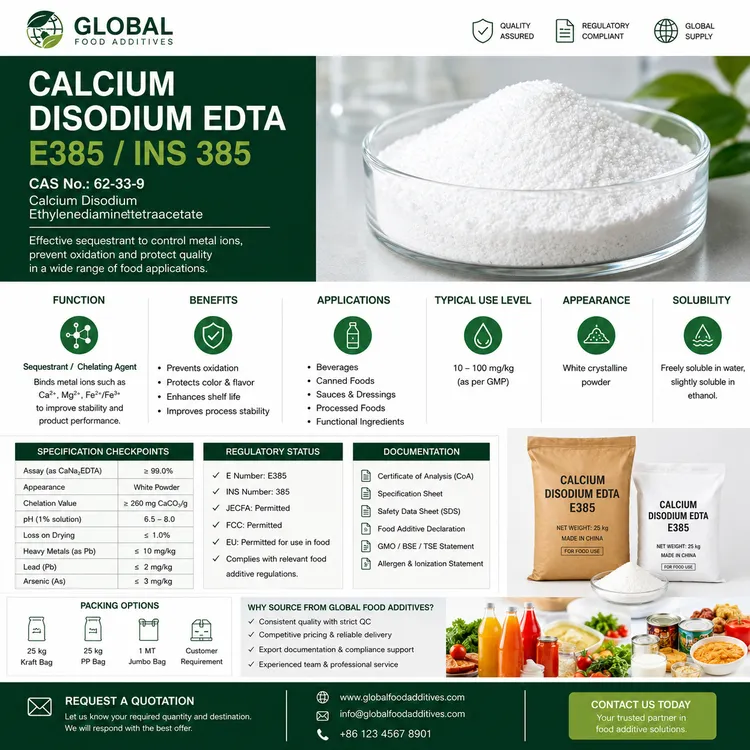
Product identity
| Product | Calcium Disodium EDTA |
|---|---|
| Full chemical name | Calcium disodium ethylenediaminetetraacetate |
| Common additive reference | E385 / INS 385 |
| CAS / identity | 62-33-9 |
| Category | Antioxidants & Oxidation Control |
| Functional class | Sequestrant / chelating agent / preservative support ingredient |
| Typical form | White to off-white crystalline powder or granulated powder, depending on supplier grade |
| Commercial focus | Food-grade compliance, controlled purity, batch traceability, reliable solubility and complete documentation |
Application fit
Potential use areas must be checked against the destination market, final food category and maximum permitted level. Typical review areas may include:
- Beverages, soft drinks and acidified drink systems
- Mayonnaise, salad dressings, sauces and sandwich spreads
- Pickled vegetables and acidified vegetable systems
- Canned vegetables, legumes, potatoes and mushrooms
- Cooked canned seafood systems where struvite or color stability is a concern
- Flavor carriers, soluble spice extractives and sensitive liquid concentrates
- Products requiring color, flavor, clarity or oxidative stability support
Technical function in food systems
Calcium Disodium EDTA works primarily by chelating trace metal ions that can catalyze oxidation and other quality-loss reactions. In many food and beverage systems, very low concentrations of iron or copper can accelerate lipid oxidation, promote off-flavors, reduce color brightness, affect vitamin stability and create haze or precipitate issues. By binding these metal ions, Calcium Disodium EDTA helps reduce their catalytic activity and supports a more stable finished product.
In industrial formulation work, Calcium Disodium EDTA is usually not evaluated as a stand-alone preservation solution. It is commonly reviewed as part of a hurdle system that may include pH control, heat processing, oxygen control, hygienic design, packaging barrier selection, antioxidant selection, preservative systems and cold-chain or ambient shelf-life validation.
Functional benefits to evaluate
- Metal-ion sequestration for iron, copper and other polyvalent ions
- Reduced oxidative rancidity in oil-containing sauces and dressings
- Improved color retention in selected canned and acidified foods
- Flavor protection in beverages, sauces, spice systems and soluble carriers
- Support for clarity and haze control in liquid products
- Reduced risk of mineral crystal defects in selected seafood applications
- Improved stability of sensitive ingredients when used within permitted limits
Formulation variables
| pH | Check chelation performance and regulatory suitability under the actual product pH. |
|---|---|
| Metal load | Consider metal contribution from water, salt, spices, processing equipment and raw materials. |
| Oxygen exposure | Review headspace, filling temperature, packaging barrier and storage conditions. |
| Processing step | Confirm whether EDTA is added during premix, brine preparation, sauce batching or final blending. |
| Competing chelators | Citric acid, phosphates, proteins and other ingredients may influence metal-ion availability. |
| Label strategy | Verify required additive name, E-number or local declaration wording before commercial launch. |
Industrial application guidance
Calcium Disodium EDTA is selected when a formulation needs targeted control of trace metals rather than general antioxidant marketing language. The strongest applications are typically systems where metal-catalyzed quality loss is measurable through accelerated shelf-life testing, peroxide value, anisidine value, colorimetry, sensory panels, turbidity, metal analysis or customer complaint history.
Beverages and liquid systems
In beverages, Calcium Disodium EDTA may be evaluated for flavor retention, color protection, clarity support and reduction of metal-catalyzed oxidation. Buyers should confirm solubility, pH compatibility, process addition point, interaction with preservatives and local beverage-category permissions before use.
Dressings, mayonnaise and sauces
Oil-in-water emulsions are vulnerable to oxidation at the oil-water interface, where trace metals can catalyze rancidity. Calcium Disodium EDTA may support antioxidant systems by reducing metal activity and helping maintain flavor, color and shelf-life quality in permitted formulations.
Pickled and canned vegetables
In acidified and canned vegetable systems, Calcium Disodium EDTA may be reviewed for color, flavor and texture retention. The final assessment should consider brine composition, heat process, pH, container type, storage time and destination-market additive limits.
Seafood and canned products
Selected seafood systems may require control of discoloration, mineral crystal formation or appearance defects. Buyers should verify the exact food category, maximum level, processing condition and customer specification before approving Calcium Disodium EDTA for seafood applications.
Flavor and spice extract systems
Soluble spice extractives and flavor carriers may contain trace metals from botanical raw materials or process water. Calcium Disodium EDTA can be assessed for color and flavor stability where permitted and where the supplier grade is compatible with the solvent or carrier system.
Legumes and starch-rich canned foods
Canned beans, potatoes and other low-acid or heat-processed foods may experience color or appearance changes during storage. Calcium Disodium EDTA may be reviewed as part of the stabilization system when the relevant food category and use level are legally permitted.
Specification checklist for buyers
For industrial purchasing, the most valuable comparison is not only the product name. Buyers should compare the supplier specification against the target regulation, production process and final food application. Useful specification parameters may include:
Chemical and physical controls
- Assay or purity basis, including hydrate form where specified
- Identity confirmation by supplier method
- Appearance, color and odor
- Moisture or loss on drying
- pH of solution under supplier test conditions
- Solubility or clarity of solution
- Insoluble matter or foreign matter limits
- Particle size or mesh range if relevant to dosing and dust control
- Bulk density if required for automated powder handling
Purity, safety and compliance checks
- Heavy metals limits according to buyer or regulatory specification
- Lead, arsenic, cadmium and mercury limits where required
- Nitrilotriacetic acid or related impurity limits where specified
- Food-grade statement and intended-use declaration
- Residual solvent or process impurity statements where relevant
- Microbiological requirements if the product is used in sensitive dry blending
- Batch number, production date, retest date and shelf-life
- SDS classification and safe handling recommendations
- Allergen, GMO, halal, kosher and vegan declarations if requested
Regulatory review notes
Calcium Disodium EDTA is referenced internationally as E385 / INS 385, but an additive number does not create universal permission. In the United States, calcium disodium EDTA is listed for specified foods and prescribed limitations under 21 CFR 172.120. Examples include certain canned carbonated soft drinks, dressings, mayonnaise, sauces, sandwich spreads, pickled vegetables, canned vegetables, cooked canned seafood, legumes, fermented malt beverages and other defined applications, with limits calculated according to the regulation.
For the European Union, Middle East, Africa, Asia-Pacific and Latin American markets, buyers should verify the current additive regulation for the exact food category. Some countries may permit Calcium Disodium EDTA in selected categories only, may require declaration as E385, may define maximum levels differently, or may restrict use in products marketed for children, natural-positioned products or retailer-specific clean-label programs.
For export projects, the safest workflow is to confirm the formula, food category, use level, label wording and destination-market rule before purchasing commercial volume. If the supplier cannot issue a market-specific statement, the buyer should obtain approval from a qualified regulatory consultant or the local authority.
Dosage and validation considerations
Use level must always be based on the permitted maximum for the final food category and the actual technical need. Calcium Disodium EDTA is typically evaluated at low ppm levels, so accurate weighing, premix preparation and uniform distribution are important. Overdosing can create compliance risk, while underdosing may fail to control oxidation or metal-related defects.
Recommended validation work
- Compare control formula versus EDTA-containing formula
- Measure color change during accelerated and real-time storage
- Track flavor retention using trained sensory or customer panels
- Monitor peroxide value, anisidine value or other oxidation markers where relevant
- Measure haze, turbidity or sediment in beverage and liquid systems
- Check interaction with preservatives, acids, emulsifiers and packaging
- Confirm final product label and legal use level before launch
Common process checks
| Water quality | High-metal water can reduce finished-product stability and should be controlled. |
|---|---|
| Premix preparation | Prepare a controlled solution or dispersion when needed for uniform dosing. |
| Addition point | Add early enough for metal-ion binding, but according to validated process conditions. |
| Heat treatment | Confirm performance after pasteurization, sterilization or hot filling. |
| Packaging | Oxygen barrier, metal cans, closures and headspace can influence final stability. |
Quality documentation to request
Documentation quality is often the deciding factor for food additive purchasing. Before confirming an order, request current and batch-specific documents where possible:
- Product specification or technical data sheet showing identity, grade and key limits
- Certificate of analysis for the offered batch or a representative recent lot
- Safety data sheet with handling, storage, PPE and transport information
- Food-grade declaration and intended-use statement
- Country of origin and manufacturer or producer declaration where available
- Shelf-life, retest period and storage-condition statement
- Allergen, GMO, irradiation, vegan/vegetarian, halal or kosher declarations when required
- Heavy metals, impurity or contaminant declaration according to buyer specification
- Packaging specification, net weight, gross weight and pallet configuration
- Regulatory statement for the destination market, if available from the supplier
- Sample CoA and pre-shipment document review for new suppliers
Packaging, storage and logistics
Calcium Disodium EDTA should be handled as a controlled food additive with clean, sealed packaging and traceable lot identification. Packaging options depend on supplier capability and order quantity, but buyers commonly request multiwall bags, fiber drums, cartons with inner liners or palletized export packaging suitable for dry food ingredients.
Packaging details to confirm
| Net weight | Confirm available pack sizes such as 20 kg, 25 kg or drum packaging. |
|---|---|
| Inner liner | Request food-compatible liner protection for moisture and contamination control. |
| Palletization | Ask for bags or drums per pallet, pallet dimensions, wrapping and export pallet treatment. |
| Labeling | Confirm product name, lot number, net weight, origin, shelf-life and handling marks. |
| Container loading | Check maximum payload, moisture protection and desiccant needs for sea freight. |
Storage recommendations
- Keep containers tightly closed when not in use
- Store in a dry, cool and well-ventilated warehouse
- Protect from moisture, condensation and direct sunlight
- Avoid contamination with incompatible chemicals according to SDS guidance
- Use first-expiry, first-out stock rotation
- Maintain lot traceability from receipt to production batch
- Prevent dust generation during weighing, charging and transfer
Comparison with related oxidation-control ingredients
Calcium Disodium EDTA is often compared with citric acid, sodium citrate, ascorbic acid, sodium erythorbate, tocopherols, rosemary extract, phosphates and direct preservatives. The best choice depends on the failure mode being controlled. If the primary issue is metal-catalyzed oxidation, chelation may be valuable. If the primary issue is microbial growth, pH and preservative systems may be more important. If the primary issue is fat oxidation without metal involvement, direct antioxidants or oxygen-control packaging may be required.
When Calcium Disodium EDTA may be considered
- When trace iron or copper accelerates oxidation or discoloration
- When beverages, sauces or dressings lose flavor during storage
- When canned or acidified products require color retention support
- When permitted regulations allow E385 / INS 385 in the exact food category
- When a low-level sequestrant can strengthen a broader stability system
When another solution may be better
- When E385 is not permitted in the destination food category
- When the brand requires a clean-label or no-EDTA positioning
- When oxidation is driven mainly by oxygen exposure instead of metals
- When microbial control requires pH, heat process or preservatives instead
- When sensory testing shows unwanted interaction with the formula
Industrial purchasing notes
When sourcing Calcium Disodium EDTA, procurement teams should define the commercial and technical target before requesting offers. A clear inquiry improves supplier matching, reduces document delays and helps avoid comparing non-equivalent grades. The most useful inquiry normally includes additive identity, E/INS number, target specification, annual demand, first-order quantity, destination country, delivery term, packaging preference, required certifications and any buyer-specific restricted-substance limits.
For manufacturers using automated dosing, the physical grade is especially important. Particle size, dusting tendency, bulk density and solubility can affect weighing accuracy, premix preparation, powder charging and operator exposure controls. For export projects, document consistency between invoice, label, CoA, packing list and regulatory statement should be checked before shipment.
How to request this product
Send the product name, target grade or reference specification, quantity, destination country, delivery term, packaging preference, expected shipment date and required documents. If you already purchase Calcium Disodium EDTA, attach or describe your existing specification, label, certificate of analysis or approved supplier requirement so alternatives can be compared more accurately.
Useful answers
What is Calcium Disodium EDTA used for in food manufacturing?
Calcium Disodium EDTA E385 is used as a sequestrant and chelating agent in selected food applications. It helps bind trace metal ions that can accelerate oxidation, discoloration, flavor loss, vitamin degradation, haze formation and quality decline.
Is Calcium Disodium EDTA an antioxidant?
It is more accurately described as a sequestrant or chelating agent. It supports antioxidant performance by reducing metal-catalyzed oxidation, but it does not work in the same way as direct antioxidants such as tocopherols, ascorbates or rosemary extract.
Which foods commonly require EDTA review?
Buyers often review Calcium Disodium EDTA for beverages, sauces, salad dressings, mayonnaise, sandwich spreads, pickled products, canned vegetables, cooked canned seafood, legumes and soluble flavor systems. The exact permission and maximum level must be verified for the destination market.
Is this product permitted in every country?
No. Food additive use depends on destination-market rules, food category, maximum use level, label requirements and buyer responsibility. Buyers should verify final regulatory status before use.
Which documents should be requested?
Buyers commonly request a product specification, technical data sheet, certificate of analysis, safety data sheet, origin statement, shelf-life information, storage conditions, packaging details, label information and destination-market declarations when required.
What should be checked on the certificate of analysis?
Check lot number, production date, test date, assay or purity, appearance, pH, moisture or loss on drying, insoluble matter, heavy metals where specified, impurity limits and whether the certificate matches the supplied batch and purchase specification.
Can Global Food Additives source Calcium Disodium EDTA?
Global Food Additives can review sourcing options according to target grade, quantity, destination, packaging, documentation, shipment schedule and regulatory expectations. Availability depends on supplier stock, origin, certification and buyer requirements.
Tell us which food additive or ingredient you need.
Send product names, target specifications, quantity, destination country, packaging preference, delivery term, and document requirements. Our team will review your inquiry and respond from orders@foodgradeadditives.com.
Your message has been received. You will be redirected to the home page.