
Calcium Hydrogen Phosphate
Calcium Hydrogen Phosphate, commonly known as Dicalcium Phosphate or Dibasic Calcium Phosphate, is a food-grade calcium phosphate used in selected applications for calcium and phosphate contribution, buffering, mineral fortification, leavening-system support, anticaking, flow improvement and dry-premix standardisation. It is identified under the E341 calcium phosphate group in many markets.
Industrial sourcing should focus on exact identity, hydrate form, assay, calcium content, phosphorus or P2O5 content, solubility, pH, particle size, bulk density, impurity limits, application performance and destination-market documentation. Global Food Additives supports food manufacturers with supplier comparison, specification review, sample coordination, document collection and export-ready quotation communication.
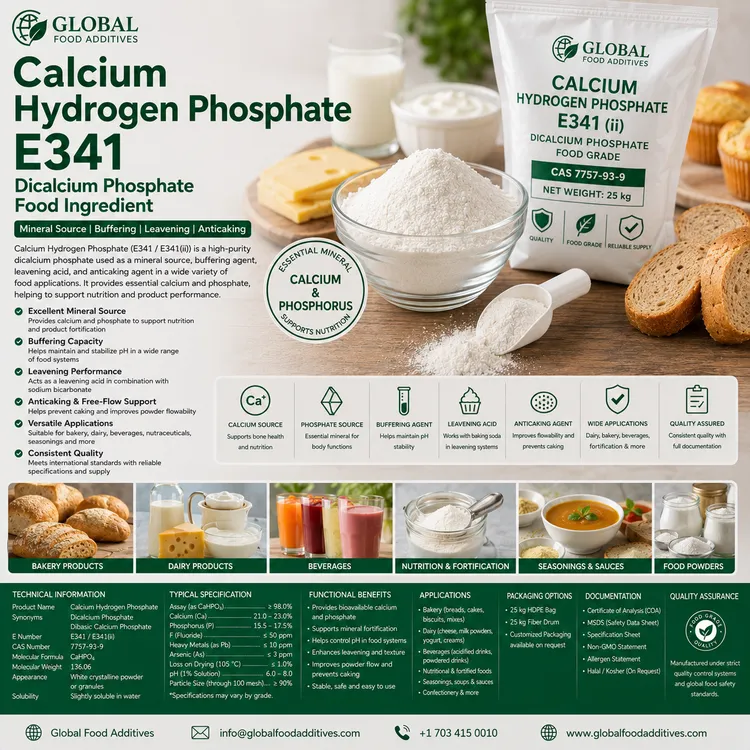
Product identity
| Product | Calcium Hydrogen Phosphate |
|---|---|
| Common names | Dicalcium Phosphate, Dibasic Calcium Phosphate, Calcium Phosphate Dibasic, Food Grade Dicalcium Phosphate |
| Category | Phosphates, Salts & Sequestrants |
| Function | Calcium and phosphate source / buffering ingredient / mineral fortification ingredient / leavening-system component / anticaking and flow-support ingredient |
| E / INS number | E341; often E341(ii) for dicalcium phosphate where subcategories are used |
| CAS / identity | 7757-93-9; confirm exact hydrate form and CAS in supplier documentation |
| Chemical identity | Calcium hydrogen phosphate; may be supplied as anhydrous or hydrated dicalcium phosphate grades |
| Typical form | Fine powder, crystal, granule, directly compressible grade, premix-ready grade, low-dust grade or application-specific phosphate blend |
| Typical appearance | White to off-white powder or granule depending on grade, particle size and hydrate form |
| Solubility profile | Low to limited water solubility compared with many sodium and potassium phosphates; practical performance depends on pH, particle size and matrix |
| Key performance role | Mineral delivery, phosphate contribution, buffering, dry blend flow, leavening acid support and calcium-phosphate balance |
Application fit
Calcium Hydrogen Phosphate is selected where calcium and phosphate functionality, dry powder handling, leavening-system behavior or mineral enrichment are required. Potential use areas may include:
- Bakery leavening systems, baking powders, self-raising flour and dry bakery premixes
- Flour, cereals, extruded products, nutrition powders and calcium/phosphate fortification systems
- Dry beverage mixes, instant drinks and mineral premixes where solubility is validated
- Tablets, sachets, supplements and directly compressible food or nutrition formats where permitted
- Processed cheese, dairy-style systems and mineral-balance trials where technically suitable
- Meat, seafood and protein systems only where phosphate type, solubility and local rules support the application
- Powdered ingredients needing anticaking, flow support or carrier functionality
- Pet food, feed-adjacent or technical nutrition projects only where grade and regulation match the market
Technical performance overview
Calcium Hydrogen Phosphate is an inorganic calcium phosphate that can contribute both calcium and phosphate to a food system. It is not interchangeable with highly soluble sodium phosphates or potassium phosphates. Its lower solubility and calcium-rich composition make it useful in mineral fortification, anticaking, dry blends, tablets and some leavening systems, but less suitable for applications that require rapid phosphate dissolution, strong sequestration or high water-binding performance unless validated in the target matrix.
In bakery leavening systems, dicalcium phosphate grades can be used as part of a controlled acid-base reaction with sodium bicarbonate. The reaction profile depends on particle size, hydrate form, moisture, temperature, mixing time, batter hold time and oven conditions. In nutrition and fortification systems, the key issue is accurate delivery of calcium and phosphorus per serving while maintaining acceptable taste, texture, powder flow and label compliance.
Key formulation variables
| Hydrate form | Anhydrous and hydrated grades differ in molecular weight, assay, calcium contribution, phosphorus contribution, bulk density and process performance. |
|---|---|
| Calcium content | Important for calcium-fortification calculations, nutrition labels, mineral balance and cost-in-use comparison. |
| Phosphorus / P2O5 | Important for phosphate contribution, regulatory phosphate limits, leavening balance and nutrient declarations. |
| Solubility | Low solubility can be useful in dry blends but may create sediment, grittiness or incomplete dispersion in beverages or liquid systems. |
| Particle size | Controls dissolution rate, reaction speed in leavening systems, mouthfeel, dusting, flowability and segregation risk. |
| pH behavior | Influences buffering, leavening reaction, protein interaction and final product pH where the ingredient dissolves or reacts. |
| Flowability | Critical for premixes, tablets, automated feeders, dry beverage blends, flour systems and high-speed packaging. |
| Impurity profile | Food-grade phosphate specifications commonly require control of fluoride, arsenic, lead, heavy metals and acid-insoluble matter. |
Industrial advantages
- Provides both calcium and phosphate in one mineral ingredient
- Useful in selected calcium and phosphorus fortification systems
- Can support leavening-system design in bakery and dry mixes
- Can improve flow and anticaking performance in powder systems where suitable
- Available in particle-size controlled grades for premix and tablet applications
- Lower solubility can reduce immediate reactivity in selected dry applications
- Can be supplied as directly compressible or granulated grade for nutrition formats
- Can support mineral-balance formulations where sodium-free phosphate contribution is desired
Calcium, phosphorus and dosage planning
For nutrition projects, dosage should be calculated from elemental calcium and phosphorus contribution rather than only from Calcium Hydrogen Phosphate weight. Hydrate form, assay basis and moisture content can change the mineral contribution per kilogram. If a finished product makes a calcium, phosphorus or mineral-related claim, the target level should be verified by finished-product analysis and reviewed against destination-market nutrition rules.
| Calculation area | Why it matters | What to request or confirm |
|---|---|---|
| Assay basis | Determines raw material potency and specification compliance | Assay range, test method and whether reported on as-is, dried, anhydrous or hydrate basis |
| Elemental calcium | Required for calcium-fortification dosage and label calculation | Calcium content, COA value and supplier conversion basis |
| Phosphorus or P2O5 | Required for phosphate balance, leavening design and phosphorus label calculation | Phosphorus content, phosphate content or P2O5 value, depending on specification |
| Hydrate form | Changes molecular weight, mineral contribution, solubility and price comparison | Anhydrous, dihydrate or other specified grade, with CAS and identity confirmation |
| Finished serving target | Links dosage to nutrition panel, claims and regulatory tolerance | mg calcium or phosphorus per serving, local reference value and analytical tolerance |
| Process retention | Important for insoluble minerals that can settle, separate or be lost during filtration | Process loss, sediment, filtration loss, mixing uniformity and finished-product assay recovery |
Application and process guidance
The correct Calcium Hydrogen Phosphate grade should be selected according to final use. Bakery systems may require a specific reaction rate, neutralising value and particle size. Nutrition powders may require good flow and low dust. Beverage premixes may require controlled dispersibility and acceptable mouthfeel. Tablets or compressed products may require directly compressible grades with defined bulk density, compactability and particle-size profile.
Recommended evaluation steps
- 1. Define the function: mineral fortification, phosphate contribution, leavening acid, anticaking, flow support, carrier or tablet mineral source.
- 2. Confirm exact grade: request hydrate form, assay, calcium content, phosphorus or P2O5 value, particle size and COA.
- 3. Check the application matrix: share pH, moisture, proteins, acids, starches, gums, fat, salts, bicarbonate level and process temperature.
- 4. Run bench trials: evaluate dissolution, sediment, grittiness, pH effect, leavening response, powder flow and sensory impact.
- 5. Validate scale-up: test feeding, dusting, mixing uniformity, segregation, filtration loss, packaging and shelf-life behavior.
- 6. Confirm compliance: verify additive status, phosphate limits, nutrient-source approval, label declaration and destination-market rules.
Where extra caution is needed
- Clear beverages or liquid systems where low solubility may create sediment or haze
- High-calcium formulations where chalky mouthfeel or mineral taste may become noticeable
- Leavening systems where particle size and reaction speed strongly affect product volume
- Protein systems where calcium and phosphate can affect stability, hydration or texture
- Multi-mineral premixes where density differences create segregation risk
- Products with strict phosphorus limits, phosphate restrictions or special nutrition rules
- Applications requiring strong sequestration, where sodium or potassium phosphates may perform differently
Typical industrial application areas
| Application | Technical objective | Purchasing notes |
|---|---|---|
| Bakery leavening systems | Controlled acid reaction with bicarbonate, pH management and batter or dough lift support | Check neutralising value, reaction rate, particle size, moisture, blend uniformity and finished-product volume. |
| Flour and cereal fortification | Calcium and phosphate contribution in dry cereal-based foods | Review particle-size match, dry-blend uniformity, dusting, mineral taste, label targets and local fortification rules. |
| Nutrition powders and meal replacements | Mineral source and premix component for calcium/phosphorus delivery | Check bulk density, flowability, serving uniformity, mouthfeel, sediment after reconstitution and stability. |
| Tablets, gummies and supplement formats | Mineral delivery, direct compression or filler-mineral function | Evaluate compressibility, particle size, flow, grit, mineral assay, label compliance and permitted category. |
| Dry beverage mixes | Mineral contribution in powder systems where complete solubility is not always required | Check sediment, mouthfeel, dispersibility, flavour masking, acidity and consumer preparation conditions. |
| Processed cheese and dairy-style systems | Mineral balance and phosphate contribution where technically appropriate | Calcium hydrogen phosphate is less soluble than common emulsifying salts; validate melt, pH, texture and solubility carefully. |
| Meat, seafood and protein systems | Selected phosphate or mineral balance trials where permitted | Confirm that the grade provides the intended functionality; highly soluble phosphates may be required for water binding. |
| Powdered ingredients and dry blends | Flow support, anticaking contribution and mineral standardisation | Review particle size, bulk density, dusting, caking, humidity exposure and segregation during transport. |
Specification checklist for buyers
For industrial purchasing, Calcium Hydrogen Phosphate should be compared by usable mineral contribution, physical handling, application performance and documentation quality. Price per kilogram can be misleading if the compared grades differ in hydrate form, calcium content, phosphorus content, flowability, particle size or compendial compliance.
Technical specification points
- Assay and identity confirmation
- Hydrate form and CAS confirmation
- Calcium content and conversion basis
- Phosphorus, phosphate or P2O5 content
- pH of slurry or solution under defined conditions
- Solubility, dispersibility and insoluble matter
- Particle size distribution and sieve residue
- Bulk density, tapped density, flowability and dusting tendency
- Moisture, loss on drying and water activity where relevant
- Fluoride, arsenic, lead, mercury, cadmium and heavy metals according to market requirements
- Acid-insoluble substances and related phosphate impurities
- Microbiological specification for food-grade and low-heat applications where relevant
- Shelf life, storage temperature and opened-pack handling instructions
Commercial comparison points
- Minimum order quantity and sample availability
- Standard grade: fine powder, granular, low-dust, directly compressible or premix-ready
- Standard packaging size, liner type, bag, carton, drum or big-bag configuration
- Food-grade, FCC, USP, EP, JECFA, EU or customer-specific compliance where required
- Batch size, production lead time and annual supply continuity
- Halal, Kosher, allergen, GMO, vegan and gluten statements where required
- Suitability for bakery, fortification, dry blending, tablets or beverage premixes
- Destination-market regulatory declaration and label support documents
Quality, safety and compliance control
Food-grade Calcium Hydrogen Phosphate should be purchased with a complete specification and batch COA. Quality teams should review assay, hydrate form, calcium and phosphorus contribution, impurity profile, heavy metals, fluoride, arsenic, acid-insoluble matter, particle size, moisture, packaging integrity and shelf-life conditions. For nutrition products, finished-product testing should verify mineral levels and serving-to-serving uniformity.
Because calcium phosphates can be used for several functions, the requested documentation should match the intended purpose. A fortification project may require nutrient-source approval and mineral conversion data. A leavening project may require reaction-rate or neutralising-value guidance. A dry-blend project may require particle-size and flowability data. A supplement-style format may require compendial and compressibility data.
Processing and handling notes
Calcium Hydrogen Phosphate should be stored in sealed original packaging in a cool, dry and clean warehouse. Protect it from moisture, odours and cross-contamination. In dry blends, pre-blending with a carrier can improve distribution when used at low dosage. In liquid or reconstituted systems, allow sufficient mixing and evaluate sediment or grittiness. For leavening systems, protect the blend from moisture to prevent premature reaction with bicarbonate or other reactive ingredients.
| Processing factor | Industrial importance | What to confirm |
|---|---|---|
| Dry blending | Controls mineral uniformity, reaction consistency and serving-to-serving accuracy | Preblend ratio, mixing time, particle-size match, bulk density and sampling plan |
| Leavening reaction | Determines gas release, batter pH, oven spring and product texture | Neutralising value, bicarbonate balance, particle size, moisture, hold time and baking temperature |
| Reconstitution | Affects mouthfeel, sediment and consumer experience in beverages or powders | Water temperature, agitation, serving preparation, suspension stability and flavour masking |
| Moisture control | Protects flowability, anticaking function and leavening-system stability | Bag liner, warehouse humidity, open-bag handling, desiccant need and shelf-life storage |
| Feeding and dosing | Impacts accuracy in automated premix, flour and tablet lines | Bulk density, flowability, feeder design, dust extraction and hopper performance |
Regulatory and label review notes
Calcium Hydrogen Phosphate is included in the E341 calcium phosphate group in many markets and may be treated as dicalcium phosphate, dibasic calcium phosphate, a phosphate additive, a nutrient source, an anticaking agent, a leavening acid or a mineral ingredient depending on the application and destination-market rules. Buyers should verify food-category permissions, maximum phosphate levels, nutrient-source approval, label declaration and claim rules before commercial use.
For U.S.-oriented review, calcium phosphate is listed in 21 CFR 182.1217 as mono-, di- and tribasic calcium phosphate and is generally recognized as safe when used in accordance with good manufacturing practice. For other destinations, buyers should review local additive lists, purity criteria, phosphorus limits, infant and medical-food rules, and finished-label requirements.
Industrial troubleshooting guide
| Observed issue | Possible cause | Corrective action to test |
|---|---|---|
| Sediment in beverage or reconstituted powder | Low solubility, coarse particle size, high dosage or insufficient suspension system | Use finer grade, improve agitation, reduce dose if possible, add suspension support or select a more soluble mineral source. |
| Chalky or gritty mouthfeel | Large particles, high mineral load or poor dispersion | Trial smaller particle size, improve flavour masking, reduce dosage or use a blended mineral system. |
| Low leavening volume | Wrong reaction rate, moisture damage, particle-size mismatch or poor bicarbonate balance | Review neutralising value, adjust bicarbonate ratio, protect from humidity and trial a different particle-size grade. |
| Premix segregation | Bulk-density difference, particle-size mismatch or transport vibration | Use carrier preblend, choose granulated grade, match particle size and validate top/middle/bottom samples. |
| Finished mineral assay below target | Wrong hydrate conversion, filtration loss, sediment loss, sampling error or low assay | Confirm hydrate form, review COA, adjust dosage, improve mixing and validate finished-product analytical recovery. |
| Powder caking or poor flow | Moisture exposure, fine particle size, damaged packaging or humid warehouse | Improve moisture-barrier packaging, use low-dust or granular grade, reseal opened bags and control humidity. |
Documents to request
A complete Calcium Hydrogen Phosphate purchasing file should support procurement, R&D, quality assurance, regulatory, production and customer-audit teams. Depending on application and destination market, buyers commonly request:
- Product specification or technical data sheet
- Certificate of analysis for available batch or lot
- Safety data sheet where applicable
- Food-grade declaration and intended-use statement
- Assay, identification, hydrate form and CAS confirmation
- Calcium content and phosphorus or P2O5 content
- pH, solubility, insoluble matter and dispersibility information
- Particle size, bulk density, tapped density, flowability and dusting data
- Moisture, loss on drying and shelf-life data
- Fluoride, arsenic, lead, mercury, cadmium and heavy-metal declarations
- Microbiological specification and pathogen absence statement where relevant
- Compendial compliance statement where required, such as FCC, USP, EP, JECFA or customer-specific standard
- Allergen statement, GMO statement, gluten statement and vegan suitability statement
- Halal and Kosher certificates where required
- Origin, manufacturer, shelf-life and storage information
- Label declaration guidance and market-specific regulatory statement
- Packaging details, pallet configuration and transport recommendations
Packaging and logistics
Calcium Hydrogen Phosphate is commonly supplied in multi-layer paper bags, PE-lined bags, cartons, fibre drums, plastic drums, big bags or sealed containers depending on grade and order size. Packaging should protect against moisture, contamination and powder leakage. Fine powders may require dust-control precautions during weighing, while granular or directly compressible grades may support improved handling in premix and tablet operations.
For export shipments, buyers should confirm net weight, gross weight, pallet dimensions, container loading, shelf life remaining at dispatch, storage temperature, humidity protection, customs classification and whether destination-market import documentation is required. Warehouse teams should store the ingredient in sealed original packaging until use and avoid exposure to water, steam, strong odours and incompatible chemicals.
How to request this product
Send the product name, target grade or reference specification, required assay, hydrate form, particle size, application, quantity, destination country, packaging preference, expected shipment date and required documents. If you already purchase Calcium Hydrogen Phosphate, attach or describe your existing specification, certificate of analysis, label, application, use level and finished-product market so supplier options can be compared more accurately.
Useful answers
What is Calcium Hydrogen Phosphate used for in food manufacturing?
Calcium Hydrogen Phosphate is typically discussed for calcium and phosphate contribution, buffering, mineral fortification, leavening-system support, anticaking, powder-flow improvement and premix-ready formulation. Exact suitability depends on grade, application, process, regulations and supplier documents.
Is Calcium Hydrogen Phosphate the same as Dicalcium Phosphate?
Yes. Calcium Hydrogen Phosphate is commonly called Dicalcium Phosphate or Dibasic Calcium Phosphate. Buyers should confirm the exact hydrate form and regulatory name for the destination market.
Is Calcium Hydrogen Phosphate soluble in water?
It has limited water solubility compared with many sodium and potassium phosphates. This can be acceptable in dry systems, tablets and some premixes, but liquid and beverage applications require careful testing for sediment, haze and mouthfeel.
Can it be used in bakery leavening systems?
It may be used in selected leavening systems where the grade, reaction rate, particle size, bicarbonate balance and moisture control are suitable. Bench and pilot trials should confirm gas release, pH, volume and texture.
Can it be used for calcium fortification?
Yes, it may be used as a calcium and phosphate source where permitted. Dosage should be calculated from elemental calcium, phosphorus contribution, hydrate form, serving size, label target and destination-market rules.
Which specification parameters matter most?
Important parameters include assay, hydrate form, calcium content, phosphorus or P2O5 content, pH, solubility, particle size, bulk density, flowability, moisture, fluoride, arsenic, heavy metals, microbiology, shelf life and storage requirements.
Can Global Food Additives source Calcium Hydrogen Phosphate?
Global Food Additives can review sourcing options for Calcium Hydrogen Phosphate according to target specification, hydrate form, particle size, quantity, destination, packaging preference, delivery term and required documentation.
Is this product permitted in every country?
No. Food additive use, nutrient-source status, phosphate limits, food-category permissions, maximum levels, label declaration and claims depend on destination-market rules, supplier documentation and buyer responsibility.
Tell us which food additive or ingredient you need.
Send product names, target specifications, quantity, destination country, packaging preference, delivery term, and document requirements. For Calcium Hydrogen Phosphate, please also include hydrate form, target function, calcium or phosphorus target, particle size, application, use level, pH or leavening requirement and any phosphate-limit or label requirements. Our team will review your inquiry and respond from orders@foodgradeadditives.com.
Your message has been received. You will be redirected to the home page.