
Calcium Propionate
Calcium Propionate is a food-grade preservative used for antimicrobial shelf-life support, especially in bakery and other moisture-sensitive food systems where mould growth, rope spoilage, yeast activity and distribution stability must be controlled. For industrial purchasing, the key evaluation is not only the price per kilogram, but the suitability of the grade for the formula, target pH, processing method, dosage strategy, labeling rules, packaging format and quality documentation.
Global Food Additives supports food manufacturers, distributors and importers with Calcium Propionate sourcing coordination, specification comparison, supplier document collection and export-ready commercial communication. Each request is reviewed according to intended application, required grade, destination country, regulatory expectations, quantity, packing preference and shipment plan.
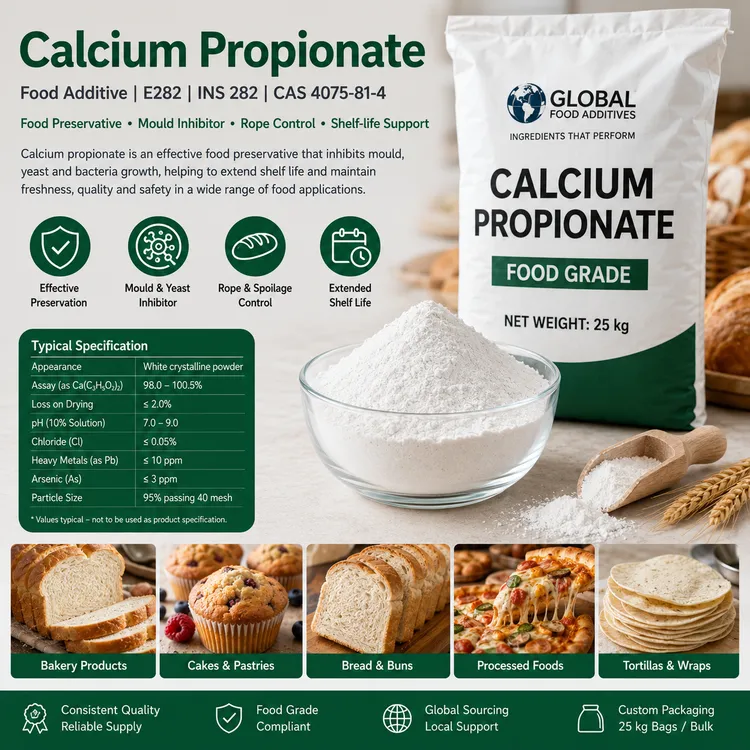
Product identity
| Product | Calcium Propionate |
|---|---|
| Category | Preservatives & Antimicrobials |
| Function | Preservative / antimicrobial shelf-life support |
| E / INS number | E282 / INS 282 |
| CAS / identity | 4075-81-4 |
| Chemical identity | Calcium salt of propionic acid |
| Typical form | White crystalline powder, granule or free-flowing powder |
| Typical odor | Neutral to faint propionic acid odor, depending on grade and storage condition |
| Key sourcing focus | Assay, particle size, solubility, pH, loss on drying, purity, heavy metals, microbiology, packaging and regulatory suitability |
Application fit
Calcium Propionate is normally selected where the manufacturer needs a practical preservative system for flour-based, moisture-containing or storage-sensitive products. It is particularly relevant when the final food must tolerate distribution, retail holding and variable humidity without visible mould growth or premature spoilage.
- Bread, rolls, buns, tortillas, pita and flatbread
- Cakes, muffins, sweet baked goods and bakery fillings
- Bakery premixes and dry functional blends
- Cheese and selected dairy-related applications where permitted
- Confections, frostings, puddings, fillings, jams and jellies where market rules allow
- Specialty food systems requiring antimicrobial shelf-life support
Technical performance overview
Calcium Propionate works as part of a hurdle-based preservation strategy. Its performance depends on water activity, pH, product moisture, preservative distribution, baking or cooking process, cooling hygiene, packaging material, storage temperature, expected shelf life and the initial microbial load of the production environment. In bakery systems, it is commonly evaluated for mould inhibition and control of rope spoilage associated with spore-forming bacteria.
The active antimicrobial effect is linked to propionate functionality. In practical formulation work, Calcium Propionate should be tested at the target use level in the actual recipe because flour quality, yeast level, dough pH, fermentation time, proofing conditions and packaging humidity can all influence final shelf-life results. Overdosing or poor dispersion can also affect fermentation behavior, taste perception and product quality.
Functional benefits
- Helps inhibit mould development in bakery and selected food systems
- Supports control of rope spoilage in bread and flour-based products
- Improves shelf-life stability during distribution and retail storage
- Can be added directly to flour, dry premix or dough depending on process design
- Offers calcium contribution compared with sodium-based propionate options
- Can support export products exposed to long transit times and variable storage conditions
Process considerations
- pH dependency: antimicrobial performance is influenced by product pH and acid balance.
- Water activity: higher moisture systems usually require more complete shelf-life validation.
- Distribution: uniform mixing is essential to avoid localized under-dosing or flavor impact.
- Yeast systems: use level and timing should be validated so fermentation is not negatively affected.
- Thermal process: baking reduces microbial load, but post-bake handling and packaging hygiene remain critical.
- Packaging: moisture barrier, oxygen exposure and condensation control can strongly affect mould risk.
Industrial application matrix
| Application area | Typical manufacturing challenge | Technical purchasing / QC focus |
|---|---|---|
| Yeast-leavened bread | Mould growth, rope spoilage, post-bake contamination and variable shelf life | Assay, dosage validation, dough compatibility, pH impact, flour mixing behavior and COA consistency |
| Tortillas and flatbread | High moisture, flexible texture requirements and mould risk during packed storage | Fine particle size, uniform dispersion, preservative system compatibility and sensory impact |
| Cakes and sweet bakery | Spoilage risk in high-moisture, high-sugar or filled products | Solubility, flavor neutrality, pH compatibility, label declaration and finished-product shelf-life testing |
| Bakery premixes | Need for dry-blend stability, dosing accuracy and uniform distribution | Particle size distribution, flowability, bulk density, anti-caking behavior and packaging integrity |
| Cheese and dairy-related systems | Microbial stability and surface spoilage control where permitted | Market permission, application-specific limits, microbiological specification and supplier declarations |
| Fillings, jams and confectionery systems | Moisture migration, microbial risk and extended storage requirements | pH, soluble solids, preservative compatibility, regulatory category review and sensory performance |
Specification points to compare
Calcium Propionate specifications can vary by manufacturer, grade, particle size and target market. A strong procurement review should compare the full technical profile, not only the product name. The most useful supplier offer includes physical, chemical, microbiological, regulatory and logistics information in one clear package.
Physical parameters
- Appearance, color and odor
- Powder, fine powder, crystal or granular form
- Particle size distribution or sieve analysis
- Bulk density and flow behavior
- Solubility and dispersion behavior in the target process
- Loss on drying or moisture content
- Packaging condition and resistance to humidity during storage
Chemical and purity parameters
- Assay of Calcium Propionate on dry or as-is basis
- pH of solution where listed on the supplier specification
- Free acid or alkalinity where relevant to buyer specification
- Insoluble matter or clarity of solution
- Heavy metals such as lead, arsenic, mercury or cadmium according to applicable limits
- Conformity with FCC, JECFA, EU, USP/NF or customer-specific standard where required
Microbiological and food safety review
- Total plate count, yeast and mold limits where required
- Absence requirements for pathogens according to buyer or market expectations
- GMP, HACCP, ISO 22000, FSSC 22000, BRCGS or equivalent system documentation where available
- Allergen, gluten, GMO, vegan, halal or kosher statements when required
- Foreign matter prevention, metal detection and packaging integrity information
- Batch traceability, recall procedure and manufacturer declaration support
Logistics and commercial parameters
- Net bag weight, liner type, outer bag material and pallet configuration
- Shelf life, production date, expiry date and recommended storage conditions
- Minimum order quantity, lead time and available shipment terms
- Country of origin, manufacturer identity and export documentation
- Container loading capacity, humidity protection and transport suitability
- Sample availability, trial batch support and repeat-order consistency
Bakery formulation and processing notes
In bakery production, Calcium Propionate is usually evaluated as part of a complete shelf-life system that includes sanitation, fermentation control, cooling discipline, packaging selection and distribution temperature. The product can be dosed through flour, premix or dry ingredient systems, but it must be distributed evenly to avoid weak points in preservation and to prevent localized sensory or fermentation effects.
| Processing stage | Technical point | Industrial relevance |
|---|---|---|
| Dry mixing | Blend Calcium Propionate uniformly with flour or premix ingredients | Improves dosage accuracy and reduces localized under-protection |
| Dough preparation | Check compatibility with yeast, enzymes, emulsifiers, acids and mineral salts | Protects volume, texture, proofing behavior and final product quality |
| Baking | Thermal processing reduces microbial load but does not replace preservative design | Post-bake contamination can still create mould risk if hygiene is weak |
| Cooling | Control condensation before packing | Surface moisture can reduce shelf life even when preservative is present |
| Packaging | Select moisture and oxygen barrier properties according to product type | Packaging strongly influences mould risk, texture retention and export performance |
| Storage trial | Validate finished product under real time and accelerated conditions | Confirms practical shelf life before commercial launch or supplier change |
Quality-control checklist for incoming material
For consistent industrial use, Calcium Propionate should be reviewed through supplier documentation and incoming goods inspection. A buyer's quality team may create an internal acceptance plan covering identity, packaging condition, certificate of analysis comparison, lot traceability and functional performance in the intended formula.
| QC step | What to verify | Why it matters |
|---|---|---|
| Document match | Product name, grade, batch number, manufacturer, production date and expiry or retest date | Confirms traceability and avoids receiving the wrong grade or outdated material |
| Packaging inspection | Bag integrity, liner condition, pallet wrap, moisture exposure and label readability | Protects purity, handling behavior and food safety during storage |
| COA comparison | Assay, moisture, pH, insoluble matter, heavy metals and microbiological values | Confirms the supplied lot meets buyer-approved specification limits |
| Application trial | Mixing behavior, fermentation impact, mould control, flavor impact and final shelf life | Validates that the grade works in the buyer's actual production system |
| Storage monitoring | Warehouse humidity, bag closure, stacking condition and stock rotation | Maintains product quality during inventory holding and export logistics |
Technical purchasing notes
When reviewing Calcium Propionate, compare the supplier specification against the intended food application, process conditions, preservative target, label expectations and local regulations. For industrial purchasing, the most useful inquiry includes target grade, reference specification, intended use, expected dosage range, physical form, packaging size, quantity, destination country, delivery term and documentation requirements.
Buyers should also clarify whether the product is intended for bakery use, dairy-related applications, confectionery, dry premix use, export shelf-life support or another permitted food category. This distinction affects the suitable grade, required declarations, label wording, maximum use review and final customer approval process.
Packaging, storage and handling
Calcium Propionate is commonly supplied in multi-layer paper bags, PE-lined bags, woven PP bags, fiber drums or other export-ready packaging depending on supplier and order size. Because the product is a functional preservative, packaging integrity, dryness, warehouse hygiene and traceable batch labeling are important quality and commercial factors.
Packaging details to request
- Net weight per bag, drum or big bag
- Inner liner material and moisture protection level
- Pallet type, pallet dimensions and pallet wrap method
- Number of bags per pallet and net weight per pallet
- Container loading plan for LCL, 20-foot or 40-foot shipments
- Label language, batch coding format and destination-market label needs
Storage recommendations to confirm
- Keep sealed in original packaging until use
- Store in a dry, clean and well-ventilated warehouse
- Protect from water, condensation, strong odors and contamination sources
- Use resealing procedures for partially used bags
- Apply first-expiry-first-out or first-in-first-out stock rotation
- Confirm supplier shelf life and retest conditions before purchase
Regulatory and labeling review
Calcium Propionate may be identified as E282 or INS 282 in markets where this identification is accepted. However, permission, maximum use level, category coverage and label declaration vary by destination country and final food category. Buyers are responsible for confirming that the selected grade, supplier documentation, finished product application and final label comply with the destination-market rules.
For export projects, market-specific declarations should be requested early. These may include food-grade status, GMO statement, allergen statement, halal certificate, kosher certificate, contaminant compliance, origin declaration, manufacturer declaration, certificate of analysis, certificate of free sale and any customer-specific restricted substance declarations.
Documents to request
- Product specification or technical data sheet
- Certificate of analysis for the available batch or lot
- Safety data sheet where applicable
- Food-grade, origin, manufacturer, shelf-life and storage information
- Allergen, GMO, gluten, vegan, halal or kosher declarations when required
- Heavy metals, contaminant, microbiological and purity statements where applicable
- Label draft, packaging details, pallet configuration and container loading information
- Market-specific declarations requested by the destination country or end customer
- Traceability, batch coding and recall-support information
- Compliance statement against the buyer's required standard, such as FCC, JECFA, EU or customer specification
How to request this product
Send the product name, target grade or reference specification, intended application, approximate use level, quantity, destination country, packaging preference, expected shipment date, preferred delivery term and required documents. If you already purchase Calcium Propionate, attach or describe your existing specification, label, sample COA or supplier data sheet so alternatives can be compared accurately.
Recommended inquiry details
- Product: Calcium Propionate / E282 / INS 282
- Target application and food category
- Required grade, specification or reference COA
- Expected use level or current formula requirement
- Annual volume and first-order quantity
- Destination country and delivery term
- Packaging preference and pallet requirements
- Required certificates and market-specific declarations
What we can coordinate
- Supplier and grade comparison based on technical documents
- COA, TDS, SDS and declaration collection
- Export-ready packing and documentation review
- Quotation coordination according to quantity and delivery term
- Sample availability review where feasible
- Commercial communication between buyer and supplier
Useful answers
What is Calcium Propionate used for in food manufacturing?
Calcium Propionate is typically used as a preservative and antimicrobial shelf-life support ingredient. It is especially relevant in bakery systems where mould control, rope inhibition, post-bake contamination control and extended storage stability are important.
Why is Calcium Propionate common in bakery products?
It is compatible with many flour-based systems and can help protect bread, rolls, tortillas, cakes and other bakery products from spoilage when used with good sanitation, proper cooling, suitable packaging and validated dosage.
Which technical parameters are most important?
Important parameters include assay, particle size, solubility, pH, loss on drying, insoluble matter, heavy metals, microbial status, appearance, odor, flow behavior, packaging integrity and grade-specific regulatory documentation.
Can Calcium Propionate affect yeast fermentation?
Yes, depending on level, formulation and process conditions. In yeast-leavened systems, the use level should be validated to support mould control without negatively affecting proofing behavior, volume, texture or flavor.
Can Global Food Additives source Calcium Propionate?
Global Food Additives can review Calcium Propionate sourcing options according to target specification, quantity, destination, delivery term, packaging format and required documentation.
Which documents should be requested?
Buyers commonly request a technical data sheet, product specification, certificate of analysis, safety data sheet, origin statement, shelf-life information, storage recommendation, label details, packaging information and market-specific declarations.
Is this product permitted in every country?
No. Food additive permission depends on destination-market rules, food category, use level, final label requirements, supplier grade and buyer responsibility. Regulatory approval should be checked before purchase and before use in production.
How should buyers compare supplier offers?
Compare supplier offers by specification, assay basis, particle size, COA detail, documentation completeness, packaging suitability, lead time, shelf life, origin, traceability, logistics cost and total delivered value, not only by unit price.
Tell us which food additive or ingredient you need.
Send product names, target specifications, quantity, destination country, packaging preference, delivery term, and document requirements. Our team will review your inquiry and respond from orders@foodgradeadditives.com.
Your message has been received. You will be redirected to the home page.