
Chymosin
Chymosin is a food-grade milk-clotting enzyme used by dairy manufacturers for controlled coagulation, curd formation, cheese yield, whey separation, curd firmness and repeatable cheese-making performance. Industrial grade selection should consider enzyme source, activity strength, chymosin-to-pepsin ratio, milk type, cheese technology, coagulation temperature, pH, calcium balance, dosage system, storage stability, religious certification, allergen/GMO status and destination-market food-enzyme rules.
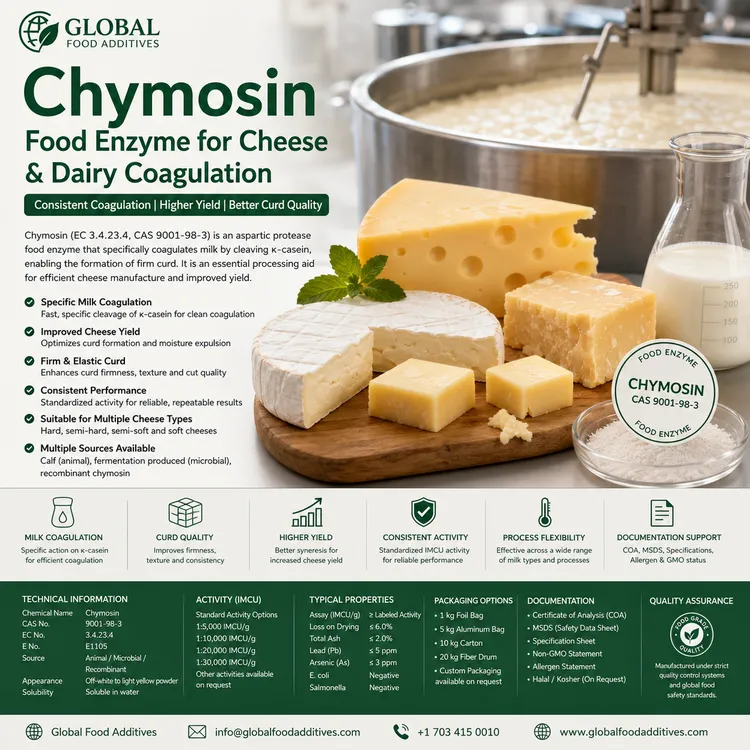
Product identity
| Product | Chymosin |
|---|---|
| Common names | Rennet enzyme, rennin, milk-clotting enzyme, cheese coagulant, fermentation-produced chymosin |
| Category | Enzymes & Processing Aids |
| Function | Food enzyme / dairy processing aid / milk-clotting enzyme for cheese manufacturing |
| E / INS number | Food enzymes are normally managed by destination-market enzyme rules; confirm classification and label treatment by supplier documentation |
| CAS / identity | 9001-98-3 |
| Enzyme class | Aspartic endopeptidase / milk-clotting protease |
| Typical activity expression | IMCU, milk-clotting units, rennet strength or supplier-specific activity units |
| Typical source | Animal rennet, fermentation-produced chymosin, microbial coagulant or application-specific blend depending on supplier |
| Typical form | Liquid enzyme preparation, powder, granulate, tablet or dairy coagulant blend |
| Industrial purchasing basis | Activity strength, source, chymosin purity, chymosin/pepsin ratio, clotting-to-proteolysis balance, dosage economics, storage stability, certification and documents |
Application fit
Chymosin is primarily evaluated for dairy coagulation and cheese manufacturing, where controlled casein destabilisation and curd development are critical.
- Hard and semi-hard cheese production
- Soft cheese, fresh cheese and white cheese systems
- Mozzarella, pizza cheese and pasta filata processes
- Cheddar, Gouda, Edam, Kashkaval and regional cheese types
- Cream cheese, spreadable cheese and acid-rennet systems
- Rennet casein, caseinate and dairy ingredient manufacturing
- Goat, sheep, buffalo and mixed-milk cheese systems
- Industrial dairy plants requiring standardised clotting time and yield control
- Vegetarian, halal or kosher cheese programs, subject to enzyme source and certification
Technical overview for dairy manufacturers
Chymosin is the main enzymatic component responsible for milk coagulation in many rennet systems. Its industrial value comes from a targeted milk-clotting action: it destabilises casein micelles, allowing calcium-mediated aggregation and curd network formation. In cheese production, the practical result is controlled coagulation time, clean curd cut, improved whey separation, predictable moisture control and consistent yield. Chymosin grade selection is therefore not only a purchasing decision; it directly affects cheese texture, whey quality, flavour development, ripening behaviour, production throughput and cost per tonne of finished cheese.
Functional value in cheese systems
Controlled milk coagulation
Supports predictable clotting time and firm curd formation when dosage, milk quality, pH, temperature and calcium balance are controlled.
Curd firmness and cutting quality
Helps achieve a curd that can be cut cleanly, reducing fines loss and supporting consistent moisture and yield.
Yield and whey management
Correct enzyme performance supports fat and casein retention in curd while improving whey separation and downstream processing efficiency.
Flavour and ripening control
High chymosin specificity and controlled proteolysis help reduce bitterness risk and support consistent flavour development in ripened cheeses.
Chymosin source options
| Source type | Typical value | Points to verify |
|---|---|---|
| Animal rennet | Traditional dairy coagulant containing chymosin and, depending on grade, pepsin or other activity. | Animal source, chymosin/pepsin ratio, BSE/TSE statement, halal/kosher status, veterinary documents, country of origin and customer acceptance. |
| Fermentation-produced chymosin | High-purity chymosin made through controlled fermentation; widely used for consistent industrial cheese performance. | Production organism, GMO-status wording, residual production organism statement, certification, activity strength, label treatment and destination-market approval. |
| Microbial coagulant | Vegetarian-positioned milk-clotting enzyme option, often from microbial proteases. | Proteolytic side activity, bitterness risk, heat stability, ripening impact and suitability for the intended cheese type. |
| Blended coagulant | Designed to balance cost, coagulation performance, flavour and process requirements. | Full composition, activity basis, label declaration, enzyme ratio, source declarations and customer approval. |
Grade selection guidance
| Manufacturing need | Grade point to confirm | Why it matters |
|---|---|---|
| High-throughput cheese plant | Activity strength, dosage accuracy, clotting time consistency and liquid dosing compatibility | Supports repeatable vat scheduling, curd cutting time, automation and production planning. |
| Hard and semi-hard cheese | High chymosin specificity, low non-specific proteolysis and ripening profile | Reduces bitterness risk and supports controlled texture and flavour during ageing. |
| Mozzarella and pasta filata | Curd firmness, calcium balance, stretch behaviour and moisture control | Impacts stretching, shredding, melt, browning and pizza performance. |
| Soft and fresh cheese | Coagulation time, acid-rennet balance, weak-gel handling and whey drainage profile | Controls texture, spreadability, syneresis and final moisture. |
| Goat, sheep or buffalo milk | Milk-specific dosage, pH, temperature and curd firmness response | Different milk compositions change coagulation speed, curd firmness and yield. |
| Vegetarian, halal or kosher products | Enzyme source, carrier, production process and certification | Prevents customer rejection, relabelling risk and certification non-compliance. |
| Export production | Destination-market food enzyme status, label treatment, permitted source and document package | Supports customs clearance, customer approval and market compliance. |
Processing and formulation considerations
- Milk pH: lower pH normally accelerates coagulation, while higher pH can slow clotting and weaken curd formation. Validate target pH for each cheese type.
- Temperature: coagulation performance depends strongly on milk temperature. Confirm supplier guidance and plant tolerance for the intended cheese technology.
- Calcium balance: pasteurisation, milk age and milk source can affect soluble calcium. Calcium chloride addition may be needed in some processes, subject to local rules.
- Dosage accuracy: enzyme over-dosing can increase proteolysis or cost; under-dosing can delay set time and reduce curd firmness.
- Dilution water: liquid rennet is often diluted before addition. Use clean, cold, chlorine-free water according to supplier instructions to avoid enzyme inactivation.
- Mixing sequence: enzyme should be distributed rapidly and gently. Excessive agitation after rennet addition can disturb gel formation.
- Milk composition: protein, casein, fat, somatic cell count, seasonal milk variation and heat treatment influence coagulation and yield.
- Proteolytic side activity: excessive non-specific proteolysis can affect bitterness, texture breakdown and shelf life, especially in ripened cheese.
- Residual activity: enzyme retained in curd may influence ripening. Select the grade according to cheese ageing time and flavour target.
- Cleaning and dosing equipment: validate compatibility with pumps, seals, dosing lines, storage tanks and CIP chemicals.
Application-specific technical notes
| Application | Expected value | Trial focus |
|---|---|---|
| Cheddar and hard cheese | Firm curd, controlled whey expulsion, consistent yield and reduced bitterness risk | Measure clotting time, cutting firmness, fines loss, moisture, pH curve, ripening profile and sensory results. |
| Gouda, Edam and semi-hard cheese | Predictable coagulation, moisture control and smooth texture development | Track curd firmness, whey drainage, brining response, eye formation where relevant and shelf-life texture. |
| Mozzarella and pasta filata | Curd structure, stretching behaviour, melt and shredding performance | Evaluate stretch, melt, oiling-off, browning, moisture, calcium balance and proteolysis during storage. |
| Fresh cheese and white cheese | Clean coagulation, controlled syneresis and target moisture | Check coagulation time, curd handling, whey separation, salt uptake, texture and package syneresis. |
| Cream cheese and spreadable cheese | Soft gel formation, smooth texture and acid-rennet balance | Validate pH, viscosity, whey separation, homogenisation effect and spreadability. |
| Rennet casein | Efficient casein coagulation and low fines loss | Measure clotting efficiency, curd particle quality, wash behaviour, drying performance and final protein quality. |
| Specialty milk types | Adapted coagulation for goat, sheep, buffalo or mixed milk | Adjust dosage, pH, temperature and calcium strategy to the milk composition and cheese target. |
Quality parameters to compare
Industrial purchasing should compare chymosin by performance in the actual milk system, not only by price per litre or kilogram. The most economical enzyme is usually the one that provides consistent coagulation, high yield, low dosage variability, acceptable certification and reliable documentation.
| Parameter | What to request from supplier |
|---|---|
| Enzyme activity | IMCU, milk-clotting units, rennet strength or supplier-specific activity method and COA result. |
| Source and identity | Animal, fermentation-produced, microbial or blended source, including production organism where relevant. |
| Chymosin-to-pepsin ratio | Ratio or purity data, especially for animal rennet or blends where proteolysis profile affects flavour and ripening. |
| Clotting performance | Recommended dosage, milk-clotting time, gel firmness development and supplier application data. |
| Proteolytic activity | Side activity profile, bitterness risk, ripening impact and suitability for long-aged cheese. |
| Physical form | Liquid, powder, granule or tablet form; concentration, viscosity, carrier, preservative system and dosing compatibility. |
| Storage stability | Shelf life, storage temperature, freeze sensitivity, light protection and opened-pack handling guidance. |
| Microbiology | Total plate count, yeast and mould, coliforms, E. coli, Salmonella and other food-enzyme microbiology limits. |
| Contaminants | Heavy metals, mycotoxin statement where relevant, residual production organism statement and process-related contaminant information. |
| Certification | Halal, kosher, vegetarian, non-GMO, allergen, BSE/TSE, ISO, FSSC 22000, HACCP, GMP or other customer-required documents. |
Food safety, regulatory and labelling review points
Chymosin is usually treated as a food enzyme or processing aid, but the final regulatory position depends on the destination market, enzyme source, production organism, food category, residual activity, label rules and customer policy. A cheese manufacturer should verify whether the enzyme must be declared on the ingredient list, whether it is treated as a processing aid, and whether source terms such as “animal rennet,” “microbial rennet,” “vegetarian rennet” or “fermentation-produced chymosin” are acceptable for the target market.
Source declaration
Confirm animal, fermentation-produced or microbial origin, including carrier and production-process statements needed for customer approval.
Certification check
Review halal, kosher, vegetarian, non-GMO and animal-origin requirements before artwork, product launch or export shipment.
Processing-aid status
Verify destination-market treatment because some jurisdictions and customers may require specific declaration of enzymes or rennet source.
Plant safety
Enzyme powders and aerosols can require special handling controls. Review SDS guidance, PPE, dust prevention and allergen-style respiratory precautions.
Application development checklist
- Define the cheese type, milk source, target coagulation time, curd firmness and desired final moisture.
- Confirm the enzyme source required by the customer: animal, fermentation-produced, microbial, vegetarian, halal or kosher.
- Request the activity strength, recommended dosage range and activity method from the supplier.
- Run bench trials with the actual milk, heat treatment, pH, calcium level and starter culture program.
- Measure flocculation time, cutting time, curd firmness, fines loss, whey clarity, moisture and yield.
- Evaluate cheese texture, flavour, bitterness, melt, stretch and ripening behaviour during storage.
- Validate dosing equipment, dilution water, mixing sequence and plant-scale clotting consistency.
- Confirm label declaration, enzyme source, certification and destination-market food-enzyme status.
- Approve the supplier only after performance, documents, packaging, shelf life, price, lead time and logistics meet the project requirement.
Documents to request
- Product specification or technical data sheet with enzyme identity, activity and recommended application guidance
- Certificate of analysis for available batch or representative lot
- Enzyme activity statement, including IMCU, milk-clotting units or supplier-specific activity method
- Food-grade declaration and food-enzyme / processing-aid status statement for the destination market
- Source declaration: animal, fermentation-produced, microbial or blended source
- Production organism statement and residual production organism statement where relevant
- GMO statement or non-GMO statement according to customer and market requirements
- BSE/TSE statement, veterinary or animal-origin documents for animal-derived grades where required
- Halal, kosher, vegetarian and vegan-positioning statements when required
- Allergen statement, carrier declaration and cross-contact information
- Microbiological specification and recent microbiology results
- Heavy metal and contaminant information according to buyer requirements
- Safety data sheet for handling, storage and transport review
- Shelf-life, storage temperature, freeze sensitivity and opened-pack handling information
- Packaging details, dosing-pack format, net weight, gross weight, pallet configuration and batch traceability information
- Market-specific regulatory statements, label guidance and customs documents when available
Packaging, storage and logistics
Chymosin may be supplied as a liquid preparation, powder, granulate, tablet or coagulant blend. Enzyme performance is sensitive to storage conditions, so temperature control, shelf-life remaining, packaging integrity and opened-pack handling should be reviewed before purchase.
Liquid grades
Confirm concentration, activity strength, preservative system, viscosity, dosing accuracy, storage temperature, freeze sensitivity and container size.
Powder or granulate grades
Confirm dusting, solubility, activity strength, moisture protection, respiratory handling precautions and compatibility with plant dosing methods.
Cold-chain control
Many enzyme preparations require cool storage. Confirm transport temperature, shelf-life remaining, warehouse conditions and opened-container guidance.
Export readiness
Request batch list, certificate package, origin documents, enzyme source declaration, regulatory statements and country-specific import documents before dispatch.
Commercial sourcing notes
Commercial evaluation should include technical performance, source acceptability and supply reliability. Buyers should compare activity strength, cost per milk volume treated, cheese yield, curd quality, source declaration, certification, lead time, minimum order quantity, price validity, packaging, storage requirements and document availability. For recurring production, request retained samples, batch-to-batch COA history and a change-notification commitment.
| Purchasing question | Why it matters |
|---|---|
| What is the enzyme source? | Animal, fermentation-produced or microbial source affects performance, label declaration, certification and customer acceptance. |
| What is the activity strength? | Activity determines dosage, cost-in-use, dosing equipment settings and batch consistency. |
| What is the chymosin-to-pepsin ratio? | Proteolytic balance affects curd formation, bitterness risk, ripening and cheese flavour. |
| Which cheese type is targeted? | Hard cheese, fresh cheese, mozzarella, white cheese and rennet casein have different coagulation and ripening requirements. |
| What storage temperature is required? | Enzyme activity can decline if storage and transport conditions are not controlled. |
| Which certificates are available before shipment? | Missing halal, kosher, GMO, BSE/TSE, origin, COA or food-enzyme statements can delay customer approval and customs clearance. |
How Global Food Additives supports sourcing
Global Food Additives, Inc. supports dairy manufacturers with practical sourcing coordination for Chymosin, rennet enzymes and food enzyme preparations. Our team can help compare enzyme grades by source, activity strength, dairy application fit, certification, documentation, packaging, lead time and destination-market requirements. We can also coordinate supplier document review, sample discussions and quotation comparison against your current approved coagulant or target cheese process.
How to request this product
Send the product name, enzyme source preference, activity strength if known, cheese type, milk source, target coagulation time, quantity, destination country, packaging preference, storage requirement and required documents. If you already use chymosin or rennet, attach your current specification, certificate of analysis, dosage rate, cheese process details or benchmark performance target so supplier options can be compared more accurately.
| Best inquiry information | Example details to include |
|---|---|
| Application | Cheddar, mozzarella, Gouda, white cheese, fresh cheese, cream cheese, goat cheese, sheep cheese, buffalo cheese or rennet casein. |
| Technical target | Coagulation time, curd firmness, yield, whey clarity, reduced bitterness, ripening profile, stretch, melt or moisture control. |
| Source requirement | Animal rennet, fermentation-produced chymosin, microbial coagulant, vegetarian, halal, kosher, non-GMO or supplier-recommended grade. |
| Process conditions | Milk type, pasteurisation, pH, temperature, calcium chloride use, starter culture, vat size, dosing system and cheese ageing time. |
| Commercial details | Sample quantity, first order quantity, annual usage, Incoterm, delivery date, destination port or country and payment preference. |
| Documentation | Specification, COA, enzyme activity, SDS, source declaration, GMO, allergen, halal, kosher, BSE/TSE, microbiology, shelf-life and packaging documents. |
Useful answers
What is Chymosin used for in food manufacturing?
Chymosin is used mainly as a milk-clotting enzyme for cheese and dairy manufacturing. It helps create curd, support whey separation, improve curd firmness and standardise cheese production performance.
Is Chymosin the same as rennet?
Chymosin is the key enzyme in many rennet preparations. Rennet may also contain pepsin or other protease activity depending on whether it is animal rennet, fermentation-produced chymosin, microbial coagulant or a blend.
Which Chymosin grade should be selected?
The best grade depends on cheese type, milk source, target coagulation time, curd firmness, enzyme strength, source preference, certification needs, storage conditions and destination-market requirements.
What does IMCU mean?
IMCU is a common activity expression for milk-clotting enzymes. Buyers should confirm the exact activity method, supplier specification and dosage recommendation before comparing offers.
Is fermentation-produced Chymosin suitable for vegetarian cheese?
It may be suitable for some vegetarian cheese programs, but this depends on production process, carrier system, certification, label rules and customer policy. Documentation should be checked before approval.
Which documents should be requested?
Buyers commonly request a technical data sheet, certificate of analysis, enzyme activity statement, food-grade statement, source declaration, GMO statement where relevant, allergen statement, halal or kosher certificate if required, BSE/TSE statement for animal-derived grades, shelf-life, storage and packaging details.
Can Global Food Additives source Chymosin?
Global Food Additives can review sourcing options according to target specification, enzyme source, activity strength, cheese application, quantity, destination country, packaging preference and required documentation.
Is this product permitted in every country?
No. Food enzyme use depends on destination-market rules, food category, processing-aid treatment, label declaration, enzyme source, production organism, certification and buyer responsibility.
Tell us which Chymosin grade or dairy coagulant solution you need.
Send product name, enzyme source, activity strength if known, cheese type, quantity, destination country, packaging preference, delivery term and required documents. Our team will review your inquiry and respond from orders@foodgradeadditives.com.
Your message has been received. You will be redirected to the home page.