
Citric Acid Anhydrous
Citric Acid Anhydrous is a food-grade organic acid used by food and beverage manufacturers for pH control, tart flavour balance, acidity regulation, buffering, preservation support, metal-ion chelation, antioxidant-system support, effervescence and process stability. Compared with monohydrate grades, the anhydrous form is selected where lower moisture contribution, higher acid equivalence per kilogram and improved suitability for moisture-sensitive dry blends are important.
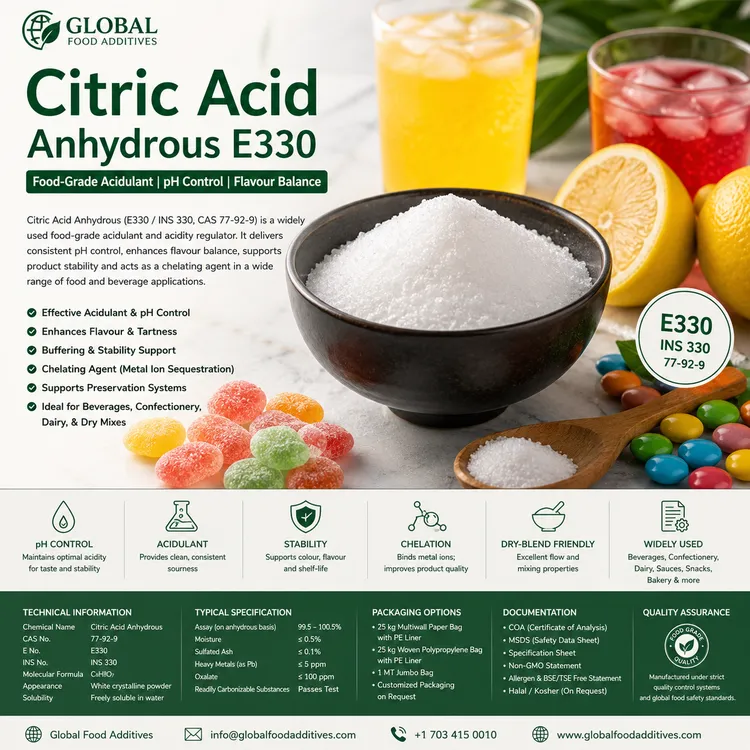
Product identity
| Product | Citric Acid Anhydrous |
|---|---|
| Common names | Citric acid E330, INS 330, anhydrous citric acid, food-grade citric acid, citric acid crystal |
| Category | Acidulants & Acidity Regulators |
| Function | Acidity regulator, acidulant, pH control agent, buffering ingredient and chelating support ingredient |
| E / INS number | E330 / INS 330 |
| CAS / identity | 77-92-9 for citric acid anhydrous; 5949-29-1 for citric acid monohydrate |
| Chemical description | 2-hydroxy-1,2,3-propanetricarboxylic acid without crystallisation water |
| Typical appearance | Colourless crystals or white crystalline powder, depending on grade and particle size |
| Typical form | Fine crystal, standard crystal, coarse crystal, granule or solution prepared from food-grade material |
| Industrial purchasing basis | Assay, water content, particle size, solution clarity, colour, sulphated ash, oxalate, heavy metals, microbiology, origin, certification and packaging |
Application fit
Citric Acid Anhydrous is evaluated where a manufacturer needs controlled acidity, bright sourness, fast pH adjustment, dry-blend stability or reduced moisture contribution.
- Carbonated beverages, still drinks, juices, nectars, syrups and concentrates
- Powdered drinks, instant beverages, effervescent tablets and sachets
- Confectionery, gummies, hard candy, jellies, chews and sour coatings
- Sauces, dressings, condiments, marinades and culinary bases
- Jams, fruit preparations, fillings, toppings and fruit systems
- Dairy systems, dairy alternatives, fermented products and desserts
- Bakery, leavening systems, fillings, glazes and dry premixes
- Processed fruits, vegetables, seafood, meat systems and canned products where permitted
- Seasonings, flavour systems, acid blends and industrial food ingredient premixes
Technical overview for manufacturers
Citric Acid Anhydrous is one of the most versatile acidulants in industrial food production. It provides a clean sour taste, reliable pH reduction, strong water solubility and broad compatibility with beverage, confectionery, culinary, fruit, dry mix and nutrition systems. In addition to direct acidity adjustment, it can help chelate trace metals, support antioxidant systems, improve flavour definition and contribute to microbial hurdle strategies when used as part of a validated formulation and process.
Functional value in food systems
pH control
Allows manufacturers to adjust finished-product pH for flavour, microbial hurdle design, preservative effectiveness, colour stability, protein behaviour and process consistency.
Flavour balance
Provides bright, clean sourness that supports citrus, berry, tropical fruit, cola, confectionery, culinary, dairy-style and fermented flavour systems.
Dry-blend performance
Because it has no crystallisation water, the anhydrous form is often selected for moisture-sensitive powders, dry beverage mixes, effervescent systems and acid premixes.
Chelation and stability
Can support formulation stability by complexing trace metal ions that may otherwise accelerate oxidation, discoloration, haze, flavour deterioration or vitamin loss.
Citric Acid Anhydrous versus Citric Acid Monohydrate
| Parameter | Citric Acid Anhydrous | Citric Acid Monohydrate |
|---|---|---|
| Water of crystallisation | Does not contain crystallisation water | Contains one mole of water per mole of citric acid |
| CAS reference | 77-92-9 | 5949-29-1 |
| Acid equivalence | Higher acid content per kilogram compared with monohydrate | Lower acid content per kilogram due to bound water |
| Typical use logic | Preferred for moisture-sensitive powders, effervescent systems, dry blends and formulations requiring high acid equivalence | Common in general food and beverage applications where monohydrate specification is accepted |
| Handling focus | Protect from humidity to avoid caking, moisture pickup and loss of dry-blend performance | Also requires dry storage, but naturally contains crystallisation water |
| Buyer action | Confirm conversion factor before replacing monohydrate in an approved recipe | Confirm whether the formulation and COA are based on monohydrate acid equivalence |
Grade selection guidance
| Manufacturing need | Grade point to confirm | Why it matters |
|---|---|---|
| Clear beverages and concentrates | Solution clarity, colour, insoluble matter, particle size and dissolution speed | Prevents haze, sediment, filtration issues and slow tank preparation. |
| Effervescent tablets and powders | Low moisture, particle-size match with bicarbonate, flowability, caking tendency and packaging barrier | Controls premature reaction, gas generation, tablet stability, reconstitution and shelf life. |
| Confectionery and sour coatings | Crystal size distribution, dusting, acid release, coating adhesion and mouthfeel | Controls sour impact, stickiness, surface stability and uniform acid perception. |
| Powdered drinks and dry blends | Particle size, dry-blend uniformity, moisture uptake, anti-caking strategy and dissolution speed | Supports consumer mixing, flavour balance, sachet stability and dosing accuracy. |
| Sauces, dressings and condiments | pH target, buffering capacity, salt compatibility, preservative system and flavour balance | Helps achieve stable acidity without excessive sourness or formulation imbalance. |
| Dairy and protein systems | Protein stability, acidification sequence, buffering system and process temperature | Reduces risk of protein precipitation, graininess, curdling or unstable texture. |
| Export production | Destination-market additive status, label wording, quality standard and certificate package | Prevents regulatory delays, customs issues and customer-approval problems. |
Processing and formulation considerations
- Acid equivalence: check conversion when switching between anhydrous and monohydrate grades because pH, titratable acidity and flavour can change.
- pH target: establish both target pH and acceptable production tolerance because small dosage changes can affect flavour, preservation and process behaviour.
- Buffering capacity: high-protein, mineral-rich, fruit, dairy, sauce and vegetable systems may require more acid than simple water trials suggest.
- Dissolution rate: select particle size according to tank size, mixing energy, water temperature, production time and filtration requirements.
- Dry-blend compatibility: test with bicarbonates, carbonates, minerals, flavours, colours, sweeteners and anti-caking agents in the final powder system.
- Moisture sensitivity: protect anhydrous grades from humidity because moisture pickup can cause caking, flow problems or premature reactions in effervescent systems.
- Preservative systems: pH affects sorbate, benzoate and other preservation strategies; validate microbial safety and shelf life through the manufacturer’s food safety process.
- Colour stability: anthocyanins, carmine, caramel colour, chlorophyll derivatives and other colour systems may shift when pH is adjusted.
- Protein behaviour: dairy, plant protein and meat systems can destabilise if acidification is too fast, too strong or added at the wrong process stage.
- Equipment compatibility: acidic solutions can increase corrosion risk in unsuitable materials; confirm plant material compatibility and cleaning procedures.
Application-specific technical notes
| Application | Primary value | Trial focus |
|---|---|---|
| Carbonated and still beverages | pH control, bright acidity, flavour lift and preservative support | Check pH, titratable acidity, sweetness balance, flavour release, clarity and storage stability. |
| Powdered drinks | Dry acid source, flavour brightness and fast reconstitution | Check particle-size match, dissolution, caking, sachet stability, hygroscopicity and consumer mixing. |
| Effervescent systems | Acid component for reaction with bicarbonate or carbonate systems | Control moisture, reaction speed, tablet hardness, gas release, packaging barrier and storage temperature. |
| Fruit preparations and jams | pH adjustment, gel system support, colour control and microbial hurdle support | Evaluate pectin behaviour, soluble solids, fruit buffering, colour retention and heat process. |
| Confectionery | Sour impact, sugar balance, acid sanding, pH control and flavour definition | Check acid addition point, crystal size, coating stability, stickiness, moisture pickup and shelf life. |
| Sauces and dressings | Acid balance, preservative support, emulsion stability and flavour adjustment | Test pH drift, salt level, hydrocolloid interaction, oil phase, heat process and packaged storage. |
| Dairy and dairy alternatives | Acidity adjustment, flavour balance and protein-system control | Validate acidification sequence, protein stability, mouthfeel, syneresis and culture performance where relevant. |
| Seasonings and savoury blends | Acid lift, flavour enhancement, pH effect after reconstitution and dry-blend uniformity | Check dusting, particle segregation, sourness distribution, caking and interaction with salt or flavour powders. |
Quality parameters to compare
Industrial purchasing should compare Citric Acid Anhydrous by specification compliance, moisture control, particle-size consistency and cost-in-use. A small difference in particle size, water content, clarity or caking tendency can affect plant handling, dissolution time, dust control, dry-blend stability, batch uniformity and finished-product quality.
| Parameter | What to request from supplier |
|---|---|
| Assay | Specification range, test method, COA result and whether reported on anhydrous basis. |
| Water / moisture | Water specification, loss on drying, moisture-control guidance and caking risk under expected storage conditions. |
| Particle size | Fine, standard, coarse or customised crystal size; sieve analysis, dusting tendency and dry-blend performance. |
| Solution quality | Clarity, colour, insoluble matter, turbidity and suitability for clear beverage or syrup systems. |
| Purity profile | Sulphated ash, oxalate, sulphate, chloride, readily carbonisable substances and other specification items relevant to the selected standard. |
| Heavy metals | Lead, arsenic, cadmium, mercury and destination-specific contaminant limits where applicable. |
| Microbiology | Total plate count, yeast and mould, coliforms, E. coli, Salmonella and buyer-specific microbiological requirements when requested. |
| Source and process | Fermentation origin, manufacturer identity, country of origin, raw material basis and change-notification policy where available. |
| Certifications | Halal, kosher, ISO, FSSC 22000, BRCGS, HACCP, GMP, non-GMO, vegan, vegetarian or other customer-required certificates. |
| Packaging | Bag weight, inner liner, moisture barrier, pallet configuration, batch coding, shelf life and storage conditions. |
Food safety, regulatory and labelling review points
Citric Acid Anhydrous is widely used as an acidulant and acidity regulator, but the final regulatory position depends on destination country, product category, purity standard, intended use, label wording and customer requirements. Buyers should confirm whether the product should be declared as “citric acid,” “acidity regulator,” “E330,” “acidulant,” “pH regulator” or another locally accepted ingredient name.
Food-grade status
Confirm that the material is supplied against an accepted food-grade specification such as FCC, EU, JECFA, national standard or customer specification.
Use-level control
Review whether the target market uses GMP, quantum satis, category-specific limits or finished-product standards for the intended application.
Label declaration
Confirm local ingredient-list wording, additive class name, E-number use, allergen statements, GMO status and acidity-regulator declaration requirements.
Claims and positioning
Validate “natural,” “fermentation-derived,” “non-GMO,” “vegan,” “halal,” “kosher” or clean-label claims against supplier documents and market rules.
Formulation development checklist
- Define the target function: pH reduction, tartness, buffering, preservative support, chelation, effervescence, dry-blend stability or flavour balance.
- Set the target pH and titratable acidity range for the finished product, not only for the water phase.
- Confirm whether the existing formulation is based on Citric Acid Anhydrous or Citric Acid Monohydrate acid equivalence.
- Select particle size according to mixing equipment, dissolution time, dust-control needs and application format.
- Prepare lab batches at multiple dosage levels and record pH, titratable acidity, flavour balance, dissolution time and process step.
- Test the acid in the full formula, including sweeteners, salts, proteins, colours, preservatives, minerals, flavours and hydrocolloids.
- For dry systems, test caking, flowability, particle segregation, humidity exposure and packaging barrier performance.
- Validate heat process, cold storage, ambient storage, packaging compatibility and pH drift during shelf life.
- Confirm final label declaration, additive status and customer claim requirements before commercial production.
- Approve the supplier only after the specification, COA, packaging, lead time, price, certification and logistics fit the project.
Documents to request
- Product specification or technical data sheet with assay, identity and particle-size information
- Certificate of analysis for available batch or representative lot
- Safety data sheet for handling, storage and transport review
- Food-grade declaration and additive-status statement for the destination market
- Origin statement, manufacturer information and fermentation/process declaration when available
- Allergen statement, GMO statement, gluten statement, vegan/vegetarian statement and irradiation statement
- Halal and kosher certificates when required by customer or destination market
- Heavy metal, oxalate, sulphated ash, chloride, sulphate and other impurity data according to buyer requirements
- Microbiological specification and recent microbiology results when required
- Shelf-life, storage conditions and opened-pack handling guidance
- Packaging details, inner liner, moisture barrier, net weight, gross weight and pallet configuration
- Market-specific regulatory statements, label guidance and customs documents when available
Packaging, storage and logistics
Citric Acid Anhydrous is normally supplied in food-grade bags, lined paper sacks, polyethylene-lined sacks, cartons, fibre drums, big bags or other industrial formats. Packaging should protect the material from moisture pickup, caking, contamination and physical crystal damage during storage and transport. Moisture protection is especially important when the material will be used in dry mixes, effervescent products or moisture-sensitive premixes.
Moisture protection
Confirm inner liner, bag material, humidity resistance, pallet wrapping and storage guidance because anhydrous citric acid can pick up moisture and cake under poor warehouse conditions.
Plant handling
Review bag weight, dusting, crystal size, flowability, bulk density, manual dosing, pneumatic transfer and sieve compatibility before plant approval.
Warehouse control
Store tightly closed in a cool, dry, clean and odour-free area, away from moisture, direct sunlight, strong bases, oxidising materials and incompatible chemicals.
Export readiness
Request packing list, batch list, certificate package, shelf-life remaining at shipment, origin documents and country-specific import documents before dispatch.
Commercial sourcing notes
Commercial evaluation should include both technical performance and supply reliability. Buyers should compare supplier capacity, lead time, minimum order quantity, particle-size availability, packaging options, price validity, Incoterms, payment terms, certification availability, origin restrictions and consistency of batch quality. For recurring production, request retained samples, batch-to-batch COA history and a change-notification commitment.
| Purchasing question | Why it matters |
|---|---|
| Is the recipe based on anhydrous or monohydrate citric acid? | Acid equivalence and cost-in-use differ, so substitution without conversion can change pH, sourness and moisture balance. |
| Which particle size is required? | Fine, standard and coarse crystals behave differently in dissolution, dusting, sour coating and dry blending. |
| Will the material be used in a moisture-sensitive product? | Effervescent tablets, dry beverage mixes and premixes require strong moisture-control packaging and storage. |
| Which quality standard applies? | FCC, EU, JECFA, national standards and customer specifications may require different documentation or limits. |
| Will the material be used in a clear beverage? | Solution clarity, colour and insoluble matter are more critical for clear drinks than for many opaque foods. |
| What certificates are available before shipment? | Missing halal, kosher, non-GMO, origin, COA or regulatory documents can delay customer approval and customs clearance. |
| What is the packaging and shelf-life remaining? | Moisture control, pallet condition and shelf-life remaining affect warehouse stability and production planning. |
How Global Food Additives supports sourcing
Global Food Additives, Inc. supports food manufacturers with practical sourcing coordination for Citric Acid Anhydrous and other acidulants, acidity regulators and buffering ingredients. Our team can help compare grade options by assay, particle size, application fit, moisture sensitivity, specification, documentation, packaging, lead time, certification and destination-market requirements. We can also coordinate sample discussions, supplier document review and quotation comparison against your current approved material or target specification.
How to request this product
Send the product name, required form, particle size, current specification if available, intended application, target pH or dosage, moisture sensitivity, quantity, destination country, packaging preference, expected shipment date and documentation requirements. If you already purchase Citric Acid Anhydrous, attach your existing specification, certificate of analysis, label declaration or benchmark sample details so supplier options can be compared more accurately.
| Best inquiry information | Example details to include |
|---|---|
| Application | Beverage, confectionery, dry mix, effervescent tablet, sauce, dressing, dairy product, fruit preparation, seasoning blend or premix. |
| Technical target | Target pH, titratable acidity, particle size, dissolution speed, crystal size, low-moisture requirement and clarity requirement. |
| Grade preference | Anhydrous crystal, fine powder, coarse crystal, FCC grade, EU grade, halal, kosher, non-GMO or supplier-recommended grade. |
| Commercial details | Sample quantity, first order quantity, annual volume, Incoterm, delivery date, destination port or country and payment preference. |
| Documentation | Specification, COA, SDS, origin, allergen, GMO, halal, kosher, heavy metals, microbiology, shelf-life and packaging documents. |
Useful answers
What is Citric Acid Anhydrous used for in food manufacturing?
Citric Acid Anhydrous is used for pH control, tart flavour development, acidity regulation, buffering, preservative support, chelation, effervescence and process stability in suitable food and beverage systems.
What is the difference between Citric Acid Anhydrous and Citric Acid Monohydrate?
Citric Acid Anhydrous does not contain crystallisation water, while Citric Acid Monohydrate contains one mole of water per mole of citric acid. This affects acid equivalence per kilogram, moisture contribution, assay basis and substitution calculations.
Can anhydrous and monohydrate citric acid be substituted directly?
Not without checking acid equivalence. If a formulation is approved with one form, switching to the other may change pH, titratable acidity, flavour, moisture balance and cost-in-use.
Why choose Citric Acid Anhydrous for dry mixes?
The anhydrous form is often selected for dry beverage mixes, effervescent systems and moisture-sensitive premixes because it has no crystallisation water and provides higher acid equivalence per kilogram.
Which particle size should be selected?
Fine grades dissolve quickly but may dust more. Coarse crystals can be useful for confectionery coatings and slower dissolution. The best grade depends on mixing equipment, application, dust control and dissolution target.
Which documents should be requested?
Buyers commonly request a technical data sheet, certificate of analysis, safety data sheet, food-grade statement, origin statement, allergen and GMO declarations, halal or kosher certificate if required, heavy metal data, shelf-life, storage and packaging details.
Can Global Food Additives source Citric Acid Anhydrous?
Global Food Additives can review sourcing options according to target specification, particle size, application, quantity, destination country, packaging preference and required documentation.
Is this product permitted in every country?
No. Food additive use, label declaration, maximum use level where applicable and product-category rules depend on destination-market regulations, supplier documentation and customer responsibility.
Tell us which Citric Acid Anhydrous grade or acidulant solution you need.
Send product name, grade, particle size, application, quantity, destination country, packaging preference, delivery term and required documents. Our team will review your inquiry and respond from orders@foodgradeadditives.com.
Your message has been received. You will be redirected to the home page.