
Crosslinked Sodium Carboxymethyl Cellulose E468
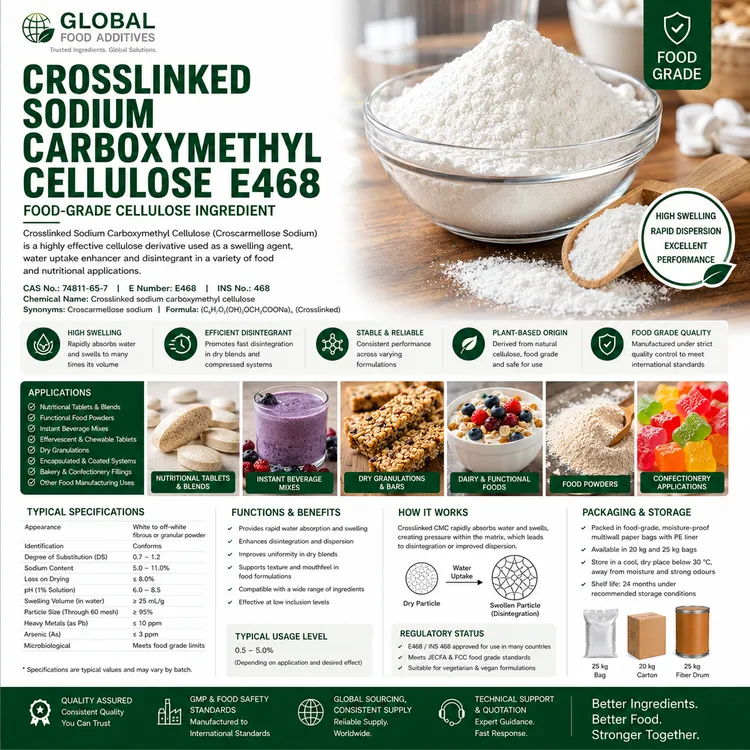
Crosslinked Sodium Carboxymethyl Cellulose, also known as E468, INS 468 or croscarmellose, is a modified cellulose ingredient used where controlled swelling, water uptake, disintegration, moisture management, bulking or dry-blend performance is required. Unlike regular soluble sodium carboxymethyl cellulose, the crosslinked structure makes the material less soluble while allowing it to absorb water and swell rapidly.
For industrial purchasing, this product should be specified by application, swelling capacity, particle size, moisture, degree of substitution, crosslinking profile, bulk density, pH, sodium content, microbiological quality, origin, packaging and regulatory documentation. This page is prepared for purchasing teams, R&D formulators, quality managers, regulatory specialists and import coordinators who need a technical basis for supplier comparison and quotation requests.
Product identity
| Product | Crosslinked Sodium Carboxymethyl Cellulose |
|---|---|
| Common names | Croscarmellose, sodium croscarmellose, crosslinked CMC, crosslinked sodium CMC, crosslinked cellulose gum |
| Category | Modified Starches, Fibres & Bulking Agents |
| Function | Swelling agent, water-uptake ingredient, disintegration aid, texture support, bulking component, moisture-management aid or carrier depending on grade and use |
| E / INS number | E468 / INS 468 |
| CAS / identity | 74811-65-7 |
| Chemical nature | Internally crosslinked sodium carboxymethyl cellulose; modified cellulose sodium salt with limited solubility and strong swelling behavior |
| Typical form | White to off-white powder, fine powder, granular grade or agglomerated flow-friendly grade |
| Main sourcing note | Specify whether the target is swelling, disintegration, moisture binding, texture support, dry blend performance or tablet breakdown before requesting offers. |
Application fit
Potential use areas may include the following, subject to grade suitability, destination-market permission, customer specification and application trials:
- Tableted foods, compressed nutrition formats and supplement-style food products
- Instant mixes, dry drink powders and powder systems requiring rapid hydration behavior
- Dry premixes where moisture uptake, bulking or dispersion support is required
- Soups, sauces, dressings and prepared foods where insoluble swelling behavior is useful
- Bakery, fillings and processed food systems requiring moisture management
- Meat, plant-based protein and prepared meal systems only after application-specific validation
- Carrier systems, agglomerated powders and functional blends where permitted
- Specialty formulations where regular soluble CMC does not provide the desired hydration profile
Technical overview for industrial buyers
Crosslinked Sodium Carboxymethyl Cellulose is not simply a higher-viscosity version of sodium carboxymethyl cellulose. Crosslinking changes the polymer network so that the material does not dissolve like conventional cellulose gum. Instead, it absorbs water, swells and supports disintegration or structure changes in the surrounding food matrix. This makes it valuable in applications where rapid water uptake, dispersion, swelling pressure or controlled breakup is required.
In a food factory, the practical performance of E468 depends on particle size, degree of crosslinking, substitution level, ionic environment, pH, water temperature, mixing energy, hydration time, soluble solids, fat level, protein system, salts and competing hydrocolloids. A grade that works well in a tablet or dry blend may not behave the same way in a sauce, soup, meat system or beverage powder. For this reason, application trials are essential before commercial approval.
How crosslinking changes functionality
Reduced solubility
Regular sodium carboxymethyl cellulose can dissolve and build viscosity. Crosslinked sodium carboxymethyl cellulose is designed to be much less soluble, so it contributes swelling and water uptake rather than forming a smooth soluble thickener solution.
Rapid swelling
The crosslinked cellulose network can take up water and expand. This swelling behavior is useful in disintegration, hydration and moisture-management systems where controlled breakup or expansion is required.
Particle-driven performance
Particle size and morphology strongly influence hydration speed, dusting, flow, blend uniformity, mouthfeel, sediment risk and disintegration efficiency. Supplier particle-size data should be reviewed before scale-up.
Matrix sensitivity
Sugars, salts, acids, proteins, fats, hydrocolloids and processing conditions can change water availability and swelling response. Performance should always be validated in the final product matrix.
E468 versus related cellulose ingredients
| Ingredient | Industrial difference | Purchasing implication |
|---|---|---|
| Crosslinked Sodium Carboxymethyl Cellulose E468 | Crosslinked, limited solubility, strong water uptake and swelling behavior. | Best reviewed for swelling, disintegration, moisture uptake and specialty texture functions rather than standard viscosity building. |
| Sodium Carboxymethyl Cellulose E466 | Water-soluble cellulose gum used for viscosity, suspension and emulsion stabilization. | More suitable when the primary target is smooth viscosity, suspension or stabilisation in sauces, drinks or dairy systems. |
| Microcrystalline Cellulose E460 | Insoluble cellulose used for bulking, anti-caking, suspension and texture support depending on grade. | Compare when insoluble fibre-like body, tableting support or particulate texture is required. |
| Methyl Cellulose / HPMC | Cellulose ethers with film-forming, thermal gelation or viscosity properties depending on grade. | Better suited for thermal gelation, plant-based meat texture, film formation or hydrocolloid viscosity systems. |
| Modified starches | Starch-based thickeners and stabilizers with heat, shear or freeze-thaw functionality. | Consider when the main target is viscosity, texture, water binding or process tolerance in cooked foods. |
Application matrix
| Food or process area | Typical technical objective | Key questions before sourcing |
|---|---|---|
| Tableted foods and compressed nutrition formats | Support rapid breakup, hydration and release of ingredients after contact with water or digestive fluids. | What tablet hardness, compression force, disintegration target, particle size and active ingredient load are required? |
| Instant drink powders and dry mixes | Support dispersion, hydration behavior, bulking and controlled water uptake. | Will the ingredient hydrate without lumps, sediment, excessive viscosity or gritty mouthfeel? |
| Soups and sauces | Provide specialty water uptake or texture contribution where a non-soluble swelling ingredient is desired. | Is the target swelling, particulate texture, moisture binding or viscosity? Would soluble CMC be more suitable? |
| Dressings and emulsified systems | Evaluate hydration and moisture-management effects in acidic or oil-containing matrices. | How does the grade interact with pH, salt, oil phase, emulsifier system and shear? |
| Bakery and fillings | Support moisture management, water uptake, structure and processing tolerance in selected systems. | Will the grade affect dough handling, crumb texture, filling stability, water activity or sensory profile? |
| Meat and plant-based protein products | Evaluate water uptake, texture contribution and moisture retention where permitted. | How does the grade perform with salt, phosphate, protein, fat, thermal processing and freeze-thaw exposure? |
| Carrier systems and premixes | Improve handling, bulking, dispersion or functional delivery in dry ingredient blends. | What particle-size match, bulk density, dust level, flow and segregation control are required? |
| Specialty food systems | Provide controlled swelling behavior not achievable with ordinary soluble cellulose gum. | Has the function been validated against alternative cellulose, starch or hydrocolloid systems? |
Grade selection considerations
Crosslinked Sodium Carboxymethyl Cellulose grades can differ significantly. The same E number does not guarantee the same swelling capacity, disintegration behavior, particle size, flow, sodium content, moisture profile or application performance. Industrial buyers should request detailed technical data and run comparative trials before changing supplier.
| Selection factor | Why it matters in production |
|---|---|
| Degree of crosslinking | Controls solubility, swelling profile, disintegration behavior and hydration speed. |
| Degree of substitution | Influences ionic character, hydration, sodium content, swelling and compatibility with salts or acids. |
| Particle size distribution | Affects hydration speed, tablet disintegration, dusting, flow, sediment, texture and blend uniformity. |
| Swelling capacity | Directly related to water uptake, disintegration force, moisture management and functional performance. |
| Moisture content | Controls shelf life, caking risk, powder flow, microbial robustness and hydration consistency. |
| Bulk density and tapped density | Important for tablet blending, sachet filling, premix dosing, hopper flow and container loading. |
| pH of dispersion | Useful for evaluating compatibility with acidified foods, dairy systems, beverage powders and sensitive ingredients. |
| Sodium content | Can matter in reduced-sodium formulations, nutrition panels and customer sodium targets. |
| Microbiological profile | Important for dry blends, nutrition products, sensitive food systems and supplier qualification. |
| Raw material source | May influence non-GMO, allergen, vegan, religious certification and sustainability documentation. |
Specification parameters to compare
Before approving a source, compare supplier specifications side by side and test the material under real processing conditions. The following parameters are commonly relevant for purchasing, QA and R&D review.
| Parameter | Why it matters |
|---|---|
| Identity and E468 confirmation | Confirms the material is Crosslinked Sodium Carboxymethyl Cellulose and not ordinary CMC, microcrystalline cellulose or another cellulose derivative. |
| Assay or purity description | Supports supplier comparison, regulatory documentation and food-grade approval. |
| Particle size distribution | Controls dispersion, swelling speed, tablet disintegration, dusting, mouthfeel and segregation risk. |
| Swelling volume or hydration index | Helps compare functional performance between suppliers and lots. |
| Loss on drying / moisture | Important for powder flow, caking, shelf life and microbiological stability. |
| pH of dispersion | Supports compatibility review for acidified systems, dairy, beverages, soups and sauces. |
| Water-soluble fraction | Useful to confirm crosslinking quality and distinguish the grade from soluble CMC. |
| Sodium chloride / sodium glycolate or process residues where applicable | May be part of food-grade purity review and supplier qualification depending on specification. |
| Heavy metals and elemental impurities | Required for food-grade compliance, sensitive applications and import clearance. |
| Microbiological limits | Important for dry foods, nutrition products, premixes, tablets and customer QA systems. |
| Bulk density and flow properties | Supports factory dosing, blending, compression, packaging and container-loading calculations. |
| Shelf life and storage conditions | Supports purchasing, warehouse rotation, export timing and quality assurance. |
Formulation and processing notes
- Confirm whether the target function is swelling, disintegration, moisture uptake, texture support, bulking or viscosity; E468 is not a direct substitute for soluble E466 cellulose gum.
- Evaluate hydration behavior at the real product pH, salt level, sugar level, fat level, protein level and processing temperature.
- For tableted foods, test compression force, tablet hardness, friability, disintegration time, dissolution profile and sensory breakdown.
- For dry blends, evaluate particle-size match, segregation risk, dusting, caking, hopper flow and sachet filling accuracy.
- For soups, sauces and dressings, test dispersion, swelling, viscosity impact, sediment, mouthfeel, pH drift and heat stability.
- For bakery and fillings, validate moisture retention, dough or batter handling, texture, water activity and finished-product shelf life.
- For meat or plant-based systems, test water binding, texture, thermal process tolerance, freeze-thaw behavior and compatibility with salt or phosphate systems.
- For clean-label or customer-sensitive projects, confirm whether the E number, cellulose wording and technological function are acceptable for the target market.
- Do not approve a grade based only on CAS number; swelling performance and particle size can change factory results significantly.
Hydration, swelling and disintegration testing
The most useful technical evaluation is often application-specific swelling behavior. Laboratory tests should compare how quickly the material takes up water, whether it forms lumps, how much it swells, whether it sediments, and how it behaves under shear. For compressed formats, disintegration time and tablet hardness are critical. For wet foods, the key questions are mouthfeel, particle perception, viscosity effect and moisture distribution.
Hydration testing should be done in the same water quality or product matrix used in the factory. Salt, acidity, sugar concentration, proteins, fats and hydrocolloids can all compete for water or change swelling behavior. A simple test in distilled water may not predict performance in soup, sauce, nutritional powder, meat system or beverage concentrate.
Water uptake
Measure swelling volume, hydration rate and water absorption under the intended pH, temperature and ionic strength. Compare several suppliers at equal dosage and equal particle size where possible.
Dispersion quality
Check whether the powder disperses uniformly or forms fish-eyes, clumps, floating particles or sediment. Mixing sequence and shear level can strongly affect results.
Disintegration performance
In compressed foods, test disintegration time, tablet hardness, friability, dissolution behavior and sensory perception after hydration or consumption.
Matrix compatibility
Validate performance in the real formula, including sugar, salt, acids, proteins, fats, fibres, flavours, minerals and other hydrocolloids.
Trial and validation recommendations
Laboratory screening
- Check appearance, odour, particle size, bulk density, flow and dispersion against the current reference material.
- Measure swelling, water uptake, pH, sediment and hydration behavior in water and in the actual food matrix.
- Compare E468 with soluble CMC, microcrystalline cellulose, starch or hydrocolloids if alternative functions are possible.
Pilot production
- Run the grade through real weighing, dry blending, mixing, hydration, heating, filling or compression conditions.
- Track dust, flow, segregation, lump formation, swelling speed, tablet disintegration and finished texture.
- Evaluate whether the ingredient affects flavour release, mouthfeel, appearance, viscosity or package stability.
Shelf-life testing
- Monitor caking, hydration consistency, sediment, texture, water migration and disintegration performance during storage.
- Test packaging under intended humidity, temperature and transport conditions.
- Confirm whether moisture-barrier packaging or a different particle-size grade is required.
Commercial approval
- Approve the exact supplier, product code, origin, specification, particle size, packaging and shelf life.
- Define incoming QC tests, retained sample procedure, lot traceability and supplier change-notification requirements.
- Keep approved COA, specification, trial records and regulatory confirmation for audits.
Documents to request
- Product specification or technical data sheet clearly identifying Crosslinked Sodium Carboxymethyl Cellulose / E468
- Certificate of analysis for available batch or representative lot
- Safety data sheet where applicable
- Food-grade declaration and compliance statement for the intended destination market
- Particle-size distribution, bulk density and flow data where available
- Swelling capacity, water uptake or disintegration performance data where available
- pH, moisture, sodium content, water-soluble fraction and purity-related parameters
- Origin statement, manufacturer information, shelf-life statement and recommended storage conditions
- Raw material source declaration, including cellulose source where required
- Allergen, GMO, vegan/vegetarian, irradiation and residual solvent statements when applicable
- Halal, kosher, ISO, HACCP, FSSC, BRCGS or other certification copies when required
- Heavy-metal, elemental impurity and microbiological declarations where required by buyer or regulation
- Packaging specification, bag size, pallet configuration and container loading information
- Market-specific food additive, label, import or customs declarations required by the destination country
Packaging, storage and logistics
Crosslinked Sodium Carboxymethyl Cellulose should normally be stored in original, tightly closed packaging in a clean, dry, cool and odour-free warehouse. Powder grades should be protected from moisture, damaged bags, condensation, strong odours and cross-contamination. Because hydration performance is linked to powder condition, opened bags should be resealed immediately and used according to the supplier's storage guidance.
Common industrial packaging may include multi-wall paper bags with inner liners, PE-lined bags, fibre drums or palletised export configurations depending on supplier and volume. For long-distance shipments, buyers should consider route climate, container condensation, pallet wrapping, desiccants where appropriate and warehouse humidity at destination. FIFO or FEFO stock rotation is recommended.
Regulatory and labeling review
Crosslinked Sodium Carboxymethyl Cellulose is identified as E468 / INS 468, but permitted use, technological function, maximum level and label declaration depend on destination-market rules and the final food category. Some customers may accept the E number, while others may require ingredient-name declaration or additional explanation of the cellulose-derived function.
Buyers should confirm whether E468 is permitted in the target food category, whether the intended function is allowed, how the ingredient should appear on the label, and whether customer standards allow modified cellulose ingredients. Export products should be reviewed for every destination country before formulation approval and shipment.
Technical purchasing notes
When reviewing Crosslinked Sodium Carboxymethyl Cellulose, compare the supplier specification against the intended food application, process conditions, target function, label expectations and local rules. For industrial purchasing, the most useful inquiry normally includes target grade, particle size, swelling requirement, physical form, packaging size, quantity, destination and document requirements.
If the target is a compressed food or tablet-style product, include tablet weight, compression force, hardness, disintegration target and active ingredient load. If the target is a dry mix, include particle-size requirements, humidity exposure, mixing process and dissolution expectations. If the target is soup, sauce, dressing, bakery or meat processing, include pH, salt level, heat process, water activity, texture target and storage conditions.
How to request this product
Send the product name, target grade or reference specification, particle-size preference, intended application, quantity, destination country, packaging preference, expected shipment date and required documents. If you already purchase Crosslinked Sodium Carboxymethyl Cellulose, attach or describe your current specification, label, certificate of analysis, particle-size requirement, swelling data or supplier product code so alternative sources can be compared more accurately.
Useful answers
What is Crosslinked Sodium Carboxymethyl Cellulose used for in food manufacturing?
Crosslinked Sodium Carboxymethyl Cellulose is reviewed for swelling, water uptake, disintegration, bulking, moisture management and specialty texture support. It may be relevant in compressed foods, dry premixes, instant systems and selected processed foods where permitted.
What does E468 mean?
E468 / INS 468 refers to Crosslinked Sodium Carboxymethyl Cellulose, also known as croscarmellose or sodium croscarmellose. Buyers should confirm the exact grade, food-grade status and permitted use in the destination market.
Is E468 the same as E466 cellulose gum?
No. E466 sodium carboxymethyl cellulose is generally a soluble cellulose gum used for viscosity and stabilization. E468 is crosslinked and is more associated with swelling, water uptake and disintegration than smooth viscosity building.
Can Crosslinked Sodium Carboxymethyl Cellulose be used as a thickener?
It should not be treated as a direct replacement for ordinary soluble CMC thickener. If the main target is viscosity, suspension or emulsion stability, E466 cellulose gum or another hydrocolloid may be more suitable. E468 should be selected when swelling or disintegration behavior is required.
Which grade should be used for tableted foods?
Tableted-food applications should evaluate particle size, swelling capacity, disintegration time, tablet hardness, friability, compression behavior, dosage and compatibility with other powdered ingredients. The correct grade should be confirmed through pilot compression trials.
Which grade should be used for dry mixes?
Dry mix applications usually require a grade selected for particle-size compatibility, flow, dust control, hydration behavior, caking resistance and blend uniformity. The material should be tested under the real mixing and reconstitution conditions.
Does Crosslinked Sodium Carboxymethyl Cellulose dissolve in water?
It is much less soluble than regular sodium carboxymethyl cellulose. It can absorb water and swell rather than forming a fully soluble smooth-viscosity solution. This is why grade selection and hydration testing are important.
Can Global Food Additives source Crosslinked Sodium Carboxymethyl Cellulose?
Global Food Additives can review sourcing options for Crosslinked Sodium Carboxymethyl Cellulose according to target specification, particle size, grade, quantity, destination, packaging and required documentation.
Which documents should be requested?
Buyers commonly request a technical data sheet, specification, certificate of analysis, safety data sheet, food-grade statement, origin statement, particle-size data, swelling data, microbiological data, shelf-life information, label and packing details, plus halal, kosher, allergen, GMO or vegan statements when required.
Is Crosslinked Sodium Carboxymethyl Cellulose permitted in every country?
No. Food additive use depends on destination-market rules, food category, technological function, use level, label requirements and buyer responsibility. Always verify current regulations and final product suitability before commercial use.
Tell us which Crosslinked Sodium Carboxymethyl Cellulose grade you need.
Send product names, target specifications, particle-size preference, swelling or disintegration requirement, application, quantity, destination country, packaging preference, delivery term and document requirements. Our team will review your inquiry and respond from orders@foodgradeadditives.com.
Your message has been received. You will be redirected to the home page.