
Dextrose Monohydrate
Dextrose Monohydrate, also known as D-glucose monohydrate or glucose monohydrate, is a food-grade crystalline carbohydrate used for sweetness, bulking, fermentation, browning, carrier performance, dry-blend handling, moisture interaction and process consistency. It is considered in bakery, confectionery, beverages, powdered drinks, sauces, dressings, soups, meat products, fermented foods, dry premixes, nutrition powders and industrial carbohydrate systems.
For industrial buyers, Dextrose Monohydrate should be evaluated as a functional carbohydrate rather than only as a commodity sugar. The correct supplier grade can affect sweetness profile, dissolution speed, fermentability, reducing-sugar activity, Maillard browning, hygroscopic behaviour, caking tendency, particle segregation, powder flow, microbial specification, source declaration, label wording and cost-in-use performance.
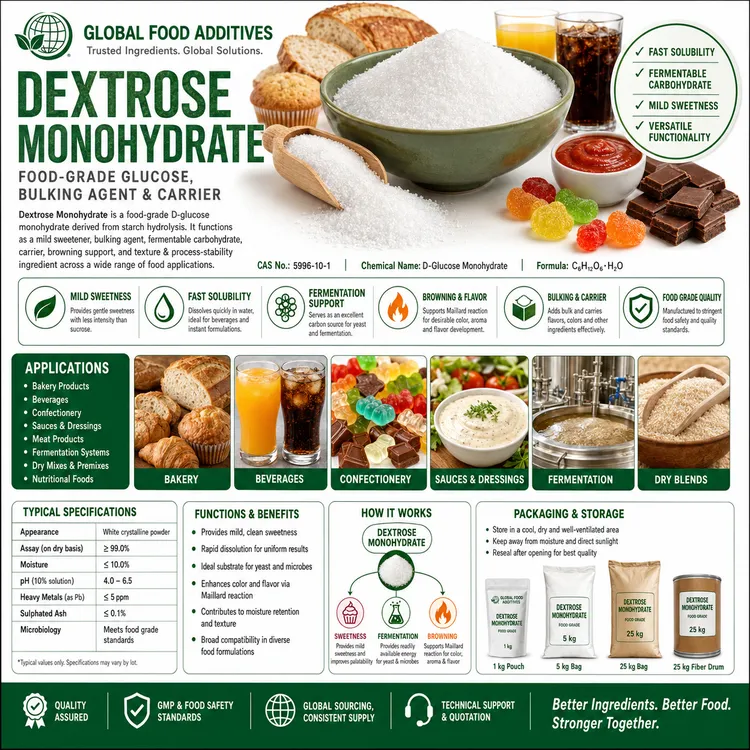
Product identity
| Product name | Dextrose Monohydrate |
|---|---|
| Common technical name | D-Glucose Monohydrate |
| Other names | Glucose Monohydrate; Hydrated D-Glucose; Dextrose Hydrate; Corn Sugar; Grape Sugar |
| Category | Modified Starches, Fibres & Bulking Agents |
| Functional class | Sweetener / bulking agent / fermentable carbohydrate / carrier / reducing sugar / process-stability ingredient |
| E / INS number | Confirm by destination market and supplier documentation; commonly handled as a food ingredient rather than a numbered additive |
| CAS / identity | 5996-10-1 |
| Chemical formula | C6H12O6·H2O |
| Molecular weight reference | Approximately 198.17 g/mol for D-glucose monohydrate |
| Carbohydrate type | Monosaccharide; reducing sugar; fermentable carbohydrate |
| Typical commercial form | White crystalline powder, fine powder, granule or agglomerated instant grade |
| Primary technical purpose | Sweetness, solids contribution, bulking, fermentation substrate, browning support, carrier function and dry-process stability |
Application fit
Dextrose Monohydrate is normally considered where formulators need fast-dissolving carbohydrate solids, controlled sweetness, fermentation support, browning, dry-blend carrier performance or economical bulk solids. Potential industrial use areas may include:
- Bakery products, biscuits, cakes, crackers, dough systems and yeast-fermented products
- Confectionery, gummies, compressed sweets, hard candies, fillings and chocolate-related systems
- Powdered beverages, instant drinks, electrolyte powders, nutrition powders and dry mixes
- Soups, sauces, dressings, marinades, seasonings and savoury dry blends
- Meat products, fermented sausages, curing systems and colour-development applications
- Brewing, fermentation, cultures, yeast growth and process-fermentation systems
Industrial function and formulation value
Dextrose Monohydrate supplies glucose solids in a crystalline, easy-to-dose form. In food manufacturing it can contribute sweetness, body, solids, freezing-point effect, fermentation substrate, reducing-sugar browning, flavour balance and carrier performance. It is often selected when a formulation needs a carbohydrate that dissolves readily, is directly fermentable by many microorganisms, and provides lower sweetness intensity than sucrose while still contributing solids and process functionality.
Because Dextrose Monohydrate is a reducing sugar, it can participate in Maillard browning with amino acids and proteins during heating. This can be useful in bakery crust colour, savoury sauces, meat systems and cooked flavours, but it must be controlled in light-coloured products, high-heat processes or long-storage systems where excessive browning is not desired.
Technical performance considerations
Sweetness and solids balance
Dextrose provides sweetness and carbohydrate solids but is typically less sweet than sucrose at the same solids level. This makes it useful where formulators need bulk, fermentable solids or browning support without making the finished product excessively sweet.
Fermentation substrate
Dextrose is readily used by yeasts and many food cultures, making it relevant in bakery fermentation, brewing, fermented meats, culture systems and process fermentation. Use level should be matched to fermentation rate, pH development, gas production and final flavour target.
Reducing-sugar browning
As a reducing sugar, dextrose can support Maillard browning and flavour development during baking, roasting, frying or cooking. The effect depends on heat exposure, pH, moisture, protein level, amino acid availability and storage conditions.
Dry-blend behaviour
Particle size, bulk density and moisture control influence powder flow, dosing accuracy, segregation, caking and dissolution speed. Agglomerated grades may be preferred for instant beverages, while fine grades may be preferred for uniform dry blends.
Typical manufacturing applications
| Application area | Technical role | Purchasing and formulation notes |
|---|---|---|
| Bakery and yeast-raised products | Supports yeast fermentation, dough conditioning, crust colour, flavour development and solids contribution. | Check yeast activity, proofing time, crust colour, crumb softness, water absorption, enzyme systems, salt level and desired sweetness. |
| Biscuits, cookies and crackers | Contributes reducing sugar for browning, flavour development, spread control and texture balance. | Evaluate with flour quality, pH, leavening system, fat level, baking profile, colour target and shelf-life crispness. |
| Confectionery and sweets | Provides carbohydrate solids, sweetness adjustment, crystallisation behaviour and texture control. | Review solubility, particle size, moisture, crystallisation, hygroscopicity, water activity, stickiness and compatibility with sucrose, glucose syrup, polyols and acids. |
| Powdered beverages and instant mixes | Functions as a bulking ingredient, sweetener, carrier and fast-dissolving carbohydrate source. | Check agglomeration, dissolution speed, dusting, caking, blend uniformity, flavour release, mineral interaction and packaging moisture barrier. |
| Soups, sauces and dressings | Balances sweetness, acidity, saltiness and savoury flavour while contributing solids and mild browning potential in cooked systems. | Evaluate with pH, heat process, starches, gums, proteins, spices, salt, preservatives and colour stability during shelf life. |
| Meat products and fermented meats | Can support fermentation, colour development, flavour balance and controlled microbial acidification in selected systems. | Confirm local meat-processing rules, culture requirements, target pH, nitrite/nitrate system, curing profile, water activity, process temperature and label declaration. |
| Fermentation and culture systems | Provides an accessible carbohydrate substrate for yeast, bacteria or controlled process fermentation. | Review microbial requirements, sterilisation or pasteurisation process, nutrient balance, pH profile, residual sugar and process reproducibility. |
| Nutrition powders and tablets | Can function as a carbohydrate source, carrier, compression aid or fast-dissolving bulk ingredient. | Check particle size, compressibility, mouthfeel, sweetness, dissolution, moisture sensitivity, allergen/GMO status and nutrition label requirements. |
Specification points to review before approval
Industrial buyers should compare supplier specifications against internal quality standards, application requirements, customer expectations and destination-market legislation. A robust technical review normally covers:
- Dextrose content: Confirms active D-glucose monohydrate content and supports recipe calculations, sweetness balance and solids contribution.
- Reducing sugar profile: Relevant for browning, fermentation performance and comparison with glucose syrup solids or maltodextrin systems.
- Moisture: Important for hydrate control, shelf life, caking tendency, powder flow and dry-blend stability.
- Ash and sulphated ash: Indicates mineral residue and helps compare supplier purity and process consistency.
- pH and acidity: Relevant for beverages, fermentation systems, culture performance, sauces and products sensitive to acid-base balance.
- Colour and solution clarity: Important for beverages, clear syrups, white powders, confectionery and light-coloured products.
- Particle size distribution: Affects dissolution speed, dusting, powder flow, segregation, mouthfeel and dry-blend uniformity.
- Bulk density: Relevant for dosing equipment, packaging volume, filling accuracy, hopper design and warehouse planning.
- Flowability and caking tendency: Critical for premixes, powders, silos, hoppers, automatic dosing and humid climates.
- Microbiology: Confirm total plate count, yeast and mould, pathogens and any category-specific microbiological expectations.
- Heavy metals and impurities: Review lead, arsenic, cadmium, mercury and supplier-specific impurity limits where required.
- Sulphur dioxide or sulphite status: Relevant when production route, refining aids, customer standards or local labelling rules require confirmation.
- Source material: Request corn, wheat, tapioca or other starch-source declaration when required for allergen, GMO, religious or customer claims.
- Dietary and customer documents: Confirm allergen, GMO, halal, kosher, vegetarian or vegan status where required by the finished product.
- Packaging and shelf life: Check bag type, liner, net weight, pallet configuration, storage condition and expiry or retest date format.
Regulatory and labelling review
Dextrose Monohydrate is commonly used as a food ingredient, carbohydrate or sugar source, but classification and label wording depend on the destination market, product category and final formulation. Before commercial use, the buyer should verify ingredient status, sugar declaration, nutrition labelling, allergen requirements, GMO policy, source-material declaration, customer standards and import requirements.
Depending on local rules, finished product labels may declare the ingredient as "dextrose", "glucose", "D-glucose", "dextrose monohydrate", "corn sugar" or a market-specific equivalent. In products positioned as reduced sugar, no added sugar, natural, organic, infant/child-oriented, sports nutrition, diabetic-oriented, low-carbohydrate or clean-label, additional regulatory and customer approval is recommended before launch.
Quality, storage and handling expectations
Storage
Store in tightly closed original packaging in a clean, dry, cool and well-ventilated area. Protect from moisture, damaged bags, direct sunlight, pests and odour contamination. Humidity control is important because dextrose powders can cake or lose flowability if exposed to moisture.
Handling
Powder handling should follow site procedures for hygiene, dust control and cross-contamination prevention. Use clean dosing equipment, controlled transfer systems and dedicated or properly cleaned tools where allergen, halal, kosher, vegetarian or vegan controls apply.
Incoming inspection
At goods receipt, verify product name, grade, batch number, net weight, packaging condition, shelf life, certificate of analysis and label information. Inspect for caking, moisture ingress, torn liners, pests, foreign odour or damaged pallets before release.
Traceability
Batch-level traceability should connect purchase order, supplier lot, certificate of analysis, warehouse receipt, internal material code, premix batch, production batch and finished-product lots. This supports customer audits, export compliance and recall-readiness programs.
Plant-trial and formulation guidance
Before full commercial approval, Dextrose Monohydrate should be evaluated in pilot or plant-scale trials using the same ingredient sequence, mixing equipment, water temperature, heat process, fermentation time, humidity exposure, packaging format and shelf-life conditions planned for commercial production. Laboratory screening can be useful, but it may not reveal all caking, browning, fermentation, mouthfeel, dissolution or dry-blend effects.
- Define the function: Confirm whether the target is sweetness, bulking, fermentation, browning, carrier use, water activity adjustment or cost optimisation.
- Match particle size: Select fine, crystalline, granular or agglomerated grade according to blending, dissolution, flowability and mouthfeel requirements.
- Validate dissolution: For beverages and sauces, test at real water temperature, mixing speed, solids level and ingredient order.
- Test fermentation performance: In yeast, culture or meat systems, measure gas production, pH drop, residual sugar and final flavour.
- Control browning: In heated products, compare colour, flavour and aroma after processing and during shelf life.
- Review caking behaviour: Store trial blends under realistic humidity, compression and warehouse conditions before approval.
- Check nutrition impact: Confirm sugar, carbohydrate and calorie declarations according to the target-market labelling rules.
Documents to request
For a professional food-manufacturing approval process, buyers should request documentation that supports identity, safety, compliance, traceability and customer claims. Typical document requirements include:
- Product specification or technical data sheet
- Certificate of analysis for the offered batch or representative lot
- Safety data sheet where applicable
- Food-grade statement and intended-use statement
- Origin statement, manufacturer statement and production-route declaration
- Raw-material source declaration, such as corn, wheat, tapioca or other starch origin where required
- Dextrose content, moisture, ash, pH, particle-size and bulk-density information
- Allergen statement and cross-contact information
- GMO status statement, if required by the destination market or customer
- Halal, kosher, vegetarian or vegan certificate or declaration, if applicable
- Heavy metals, microbiological and purity limits from the supplier specification
- Sulphur dioxide or sulphite declaration where relevant
- Nutrition information and carbohydrate/sugar declaration support where required
- Shelf-life, storage, packaging and pallet-configuration details
- Label draft, bag marking and batch-coding format
- Market-specific declarations required by the importing country, retailer or end customer
Commercial sourcing and logistics notes
Dextrose Monohydrate is typically purchased by industrial users according to grade, source, particle size, documentation package, batch availability, shipment destination, packaging format and cost-in-use performance. When comparing offers, buyers should not evaluate only the unit price. Dextrose content, particle size, flowability, caking behaviour, dissolution speed, source declaration, GMO status, documentation quality, lead time, regulatory suitability and plant performance can all affect the real commercial value of the material.
For export projects, buyers should confirm HS code guidance with their customs broker, required import permits, original document requirements, shelf-life remaining at dispatch, pallet treatment, container loading plan and whether the product requires special protection from humidity during transport.
How to request this product
To receive a more accurate quotation, send the product name, target specification, intended food application, annual or spot quantity, destination country, packaging preference, required delivery term, expected shipment date and requested documents. If you already purchase Dextrose Monohydrate, attach your current specification, supplier label, certificate of analysis, source-material requirement, particle-size requirement or benchmark sample details so alternatives can be compared more accurately.
Minimum inquiry details
- Product name: Dextrose Monohydrate / D-Glucose Monohydrate / CAS 5996-10-1
- Required grade and target specification
- Fine powder, crystalline, granular or agglomerated grade preference
- Required source material, particle size or GMO status, if known
- Quantity per shipment and annual forecast
- Destination country and delivery term
- Preferred packaging size and pallet requirements
- Required certificates and declarations
Helpful technical details
- Application type: bakery, beverage, confectionery, sauce, dressing, soup, meat, fermentation, dry premix or nutrition powder
- Target function: sweetness, bulking, fermentation, browning, carrier use, moisture control or dry-blend flow
- Current grade, source, particle size or supplier being used
- Process conditions: dry blending, hot process, cold dissolution, fermentation, baking, extrusion or tableting
- Need for halal, kosher, vegetarian, vegan, allergen, GMO or source-material documentation
- Any regulatory market, customer standard or retailer requirement to be matched
Useful answers
What is Dextrose Monohydrate used for in food manufacturing?
Dextrose Monohydrate is used as a food-grade D-glucose ingredient for sweetness, bulking, fermentation, browning, carrier performance, dry-blend handling, moisture interaction and process consistency. It may be evaluated in bakery, confectionery, beverages, powdered drinks, sauces, dressings, soups, meat products, fermentation systems and dry premixes. Exact suitability depends on grade, particle size, use level, process, label requirements, regulations and supplier documents.
Is Dextrose Monohydrate the same as glucose monohydrate?
Yes. Dextrose Monohydrate is commonly described as D-glucose monohydrate or hydrated D-glucose. Food buyers should confirm the exact grade, dextrose content, moisture, particle size, source material and specification from supplier documents.
Is Dextrose Monohydrate an additive or an ingredient?
In many markets, Dextrose Monohydrate is treated as a food ingredient, carbohydrate or sugar rather than a numbered food additive. However, classification, labelling and permitted use must be confirmed for the destination market, product category and final label strategy.
Which applications are most relevant?
Relevant applications may include bakery products, confectionery, powdered beverages, instant drinks, sauces, dressings, soups, seasonings, meat products, fermented foods, brewing or fermentation substrates, nutrition powders, tablet systems and dry premixes.
Which specification points are important?
Important specification points include dextrose content, reducing sugar profile, moisture, ash, sulphated ash, pH, acidity, conductivity, clarity or colour in solution, particle size, bulk density, flowability, caking tendency, microbiology, heavy metals, sulphur dioxide or sulphite where relevant, source material, allergen status, GMO status, packaging type, shelf life and storage conditions.
Which documents should be requested?
Buyers commonly request a technical data sheet or specification, certificate of analysis, safety data sheet where applicable, food-grade statement, origin statement, source-material declaration, allergen statement, GMO statement, halal or kosher documents if required, shelf-life information, storage guidance, nutrition information, label details and packaging configuration.
Is this product suitable for every food category?
No single ingredient is automatically suitable for every formulation or country. Dextrose Monohydrate use depends on product category, recipe function, sugar declaration, nutrition labelling, customer requirements, source material, process conditions and destination-market rules.
Tell us which food additive or ingredient you need.
Send product names, target specifications, quantity, destination country, packaging preference, delivery term, and document requirements. Our team will review your inquiry and respond from orders@foodgradeadditives.com.
Your message has been received. You will be redirected to the home page.