Fortification Nutrients
Folic Acid
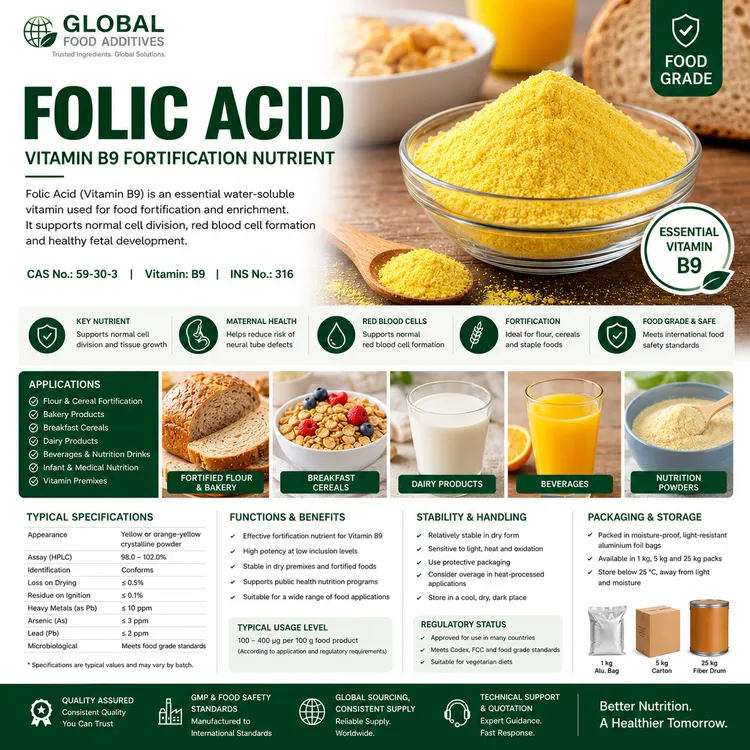
Folic Acid is the synthetic, stable Vitamin B9 form widely evaluated for food fortification, flour enrichment, nutritional premixes and fortified consumer products. For industrial buyers, the key purchasing questions are not only price and availability, but also assay, particle size, carrier system, blending uniformity, process retention, label-target calculation, regulatory permission and the quality of batch documentation.
CAS 59-30-3
Vitamin B9
C19H19N7O6
Fortification nutrient
Premix-ready options
Product identity
| Product | Folic Acid |
|---|
| Common names | Vitamin B9, folacin, pteroyl-L-glutamic acid, pteroylmonoglutamic acid |
|---|
| Category | Fortification Nutrients |
|---|
| Function | Vitamin enrichment ingredient / nutrient premix component / food fortification vitamin |
|---|
| E / INS number | Confirm by destination market and supplier documentation |
|---|
| CAS / identity | 59-30-3 |
|---|
| Molecular formula | C19H19N7O6 |
|---|
| Typical form | Fine powder, granule, beadlet, trituration, premix-ready dilution or solution grade |
|---|
Application fit
Potential use areas may include:
- Wheat flour, corn meal, pasta, rice and cereal enrichment
- Breakfast cereals, cereal bars and dry nutrition blends
- Milk powders, dairy beverages and fortified drink powders
- Infant, maternal, senior and medical foods where permitted
- Vitamin-mineral premixes and custom nutrient blends
- Dietary supplements and food supplement applications where locally allowed
Industrial value for food manufacturers
Folic Acid is selected when manufacturers need a controlled Vitamin B9 source for enrichment, public-health fortification programmes or nutrition-positioned foods. Its industrial value depends on accurate micro-dosing, strong premix design, validated analytical recovery and reliable supplier documentation. Because Folic Acid is used at very low inclusion levels, direct addition to a bulk food matrix is usually less practical than using a properly diluted premix or carrier-based trituration.
High-potency micronutrient
Folic Acid is typically dosed in microgram or milligram quantities. Industrial users must control weighing accuracy, dilution ratio, premix uniformity and analytical verification to avoid under-fortification or excessive addition.
Fortification programme fit
It is commonly evaluated for staple-food enrichment, including flour, grain products and cereal systems. Final use levels must follow the destination country's regulations and the specific food standard that applies to the finished product.
Premix compatibility
Folic Acid can be supplied as a pure powder or incorporated into vitamin-mineral premixes. Compatibility with iron salts, minerals, oxidising ingredients, moisture and carrier systems should be checked during development.
Label and claim support
Folate declaration, dietary folate equivalents, nutrient-content claims and population-specific positioning depend on local labelling law, serving size, analytical method and finished-product composition.
Commercial grade options
Buyers should not approve Folic Acid only by name. The commercial form must match the dosing process, product matrix and quality system. A high-assay powder may be suitable for premix manufacturing, while a diluted trituration or beadlet may be more practical for direct food production.
| Grade type |
Typical purchasing interest |
Technical points to verify |
| High-assay Folic Acid powder |
Vitamin premix manufacturers, supplement producers and facilities with accurate micro-dosing systems. |
Assay, identification, impurities, particle size, dusting, flowability, potency calculation and handling controls. |
| Premix-ready trituration |
Food factories that need easier dispersion and lower risk during micro-addition. |
Carrier type, dilution ratio, homogeneity, allergen status, GMO status, bulk density and label declaration. |
| Beadlet or coated grade |
Applications requiring improved handling, reduced dusting or better protection in challenging matrices. |
Coating composition, release profile, heat stability, compatibility with minerals and finished-product appearance. |
| Custom vitamin-mineral premix |
Flour mills, cereal producers, beverage manufacturers and nutrition brands requiring multi-nutrient fortification. |
Formulation target, nutrient overages, carrier, anti-caking system, particle distribution, COA format and regulatory review. |
Technical specification checkpoints
The supplier specification should be reviewed by procurement, quality assurance, R&D and regulatory teams before approval. The checkpoints below are practical review areas for industrial food and premix purchasing.
- Assay and potency
- Confirm assay range, calculation basis and analytical method. Lot-specific COA results should match the approved specification and the customer's fortification target.
- Identification
- Request identification by an accepted method such as HPLC, UV, IR or another supplier-declared validated method suitable for the grade.
- Particle size
- Particle size affects dusting, blending uniformity, segregation risk, solubility behaviour and distribution in dry premixes or flour enrichment systems.
- Loss on drying
- Moisture level can influence flowability, caking risk, stability and shelf-life performance, especially in humid logistics or open-bag production environments.
- Residue on ignition / ash
- Ash parameters support purity review and lot-to-lot consistency checks for high-assay vitamin material.
- Related substances
- Ask for impurity limits and method references where applicable. Vitamin quality specifications may include related compounds, degradation products or chromatographic purity criteria.
- Heavy metals and contaminants
- Review lead, arsenic, cadmium, mercury or other contaminant declarations according to destination-market rules and the buyer's internal food safety standard.
- Microbiology
- For food and nutrition applications, request microbiological parameters such as total plate count, yeast and mould, coliforms, E. coli and Salmonella where required.
- Carrier declaration
- For diluted, beadlet or premix forms, confirm every carrier, coating, anti-caking agent and processing aid because these ingredients may affect allergen, GMO, halal, kosher, vegan or label status.
- Shelf life and storage
- Confirm shelf life, retest period, recommended storage temperature, light protection, humidity control and resealing instructions for opened packaging.
Application guidance by food sector
Folic Acid performance must be validated in the finished product because processing, light, oxygen, moisture, pH, minerals and storage time can influence retained potency. Industrial formulations should include an analytical plan to confirm nutrient retention at production release and at the end of shelf life where claims or legal fortification levels apply.
Flour and grain enrichment
Folic Acid is commonly used in enriched flour and grain-based fortification systems. Uniform dispersion is critical because dosage is low and the carrier or premix must distribute evenly through large flour or grain batches.
Breakfast cereals and cereal bars
In extruded, baked or coated cereal systems, manufacturers should validate heat exposure, surface application, vitamin retention and compatibility with minerals, sugars and flavours.
Beverages and drink powders
For nutritional beverages, powdered drinks and instant mixes, check solubility, dispersion, colour impact, light exposure, pH, heat treatment and shelf-life potency.
Dairy and milk powder systems
In milk powders, fortified dairy beverages and dairy desserts, compatibility with minerals, proteins and thermal processes should be confirmed through pilot trials and retained-potency testing.
Infant, maternal and medical foods
These applications are highly regulated. Buyers should confirm permitted form, level, claim wording, contaminant limits, analytical requirements and documentation expectations before sourcing.
Vitamin-mineral premixes
Folic Acid may be incorporated into custom premixes with iron, zinc, B vitamins and other nutrients. Premix design should consider segregation risk, mineral reactivity, carrier choice and uniformity testing.
Premix and dosing considerations
| Technical factor |
Why it matters |
Practical buyer / R&D action |
| Micro-dosing accuracy |
Folic Acid is used at low dosage, so small weighing errors can create major concentration deviations. |
Use calibrated scales, controlled dispensing, premix dilution and batch reconciliation. |
| Blend uniformity |
Uneven distribution can produce non-compliant finished product, especially in flour, cereal and powder systems. |
Validate mixing time, blender load, carrier particle size, sampling locations and analytical uniformity. |
| Overage planning |
Processing and storage can reduce declared vitamin level over time. |
Set overage using retention studies, shelf-life data, legal maximums and finished-product label target. |
| Matrix compatibility |
Minerals, moisture, oxygen, light and high-temperature processes may affect retention. |
Test compatibility with iron salts, minerals, acids, colours, flavours and packaging conditions. |
| Analytical recovery |
Fortification verification depends on reliable laboratory results. |
Agree on test method, sample preparation, unit expression and acceptance range before commercial production. |
| Label calculation |
Folate may be declared differently depending on jurisdiction, such as folate, folic acid or dietary folate equivalents. |
Confirm declaration unit, conversion factor, serving size and claim threshold with regulatory experts. |
Comparison with related folate ingredients
Folic Acid should be compared with other folate forms according to regulatory status, stability, bioavailability expectations, label declaration, cost-in-use and target consumer group. Do not substitute one folate form for another without regulatory and formulation review.
| Ingredient form |
Typical industrial reason to evaluate |
Key difference to check |
| Folic Acid |
Common fortification and supplement form used in many enriched foods and premixes. |
Confirm permitted level, label declaration, overage, stability and local food standard. |
| Natural food folates |
Present naturally in foods such as vegetables, legumes and grains. |
Not equivalent to added folic acid for fortification control; bioavailability and stability differ. |
| 5-MTHF / methylfolate |
Used in some supplement and specialty nutrition applications. |
Different regulatory status, cost, conversion rules, stability and label declaration may apply. |
| Vitamin-mineral premix containing folic acid |
Preferred for large-scale food production where direct micro-dosing is impractical. |
Check premix homogeneity, nutrient overages, carrier, compatibility and country-specific formula approval. |
Quality assurance and supplier approval
For repeat purchasing, Folic Acid should be approved through a formal supplier qualification process. The buyer should maintain an approved specification, COA history, supplier questionnaire, traceability records, change-control expectations and analytical verification plan.
COA review
Check lot number, manufacturing date, expiry or retest date, assay, identification, loss on drying, impurities, heavy metals, microbiology and packaging condition before releasing material to production.
Traceability
Request traceability from manufacturer to shipment. For export orders, align invoice, packing list, certificate of origin, batch documents and container or pallet references.
Food safety system
Ask whether the production site operates under recognised food safety or quality systems such as HACCP, ISO 22000, FSSC 22000, BRCGS, IFS, GMP or another customer-accepted programme.
Change control
For long-term projects, confirm notification expectations for changes in manufacturing site, process route, specification limits, carrier system, packaging, allergen status or certification.
Regulatory and labelling notes
Folic Acid is regulated differently across markets. Some countries require mandatory fortification of selected staple foods, while others allow voluntary fortification or restrict specific product categories. Nutrient declarations, health claims, pregnancy-related messaging, dietary folate equivalent calculations and upper-level controls must be verified against the destination country's law before commercial use.
Buyer responsibility: Global Food Additives can support sourcing coordination and document collection, but the buyer remains responsible for confirming legal use, permitted dosage, final label wording, nutrient claims, serving-size calculations and suitability in the destination market.
Packaging, storage and logistics
Food-grade Folic Acid is normally supplied in protective packaging designed to minimise light, moisture and contamination exposure. Because the ingredient is high potency and used in very small amounts, warehouse controls, label clarity and batch segregation are important for safe industrial handling.
Typical packing
Supplier options may include drums, cartons, aluminium bags, foil-lined bags or smaller sealed packs depending on grade and quantity. Confirm net weight, inner liner, tamper evidence and pallet configuration.
Storage guidance
Store tightly closed in a cool, dry, clean area away from direct light, moisture, strong odours and incompatible materials. Reseal opened containers promptly and control warehouse humidity.
Handling controls
Use controlled dispensing, dust-minimising handling, clean tools and batch reconciliation. High-potency vitamins should be handled according to the site's hygiene and occupational safety procedures.
Export preparation
For international shipments, align product description, HS code guidance, origin certificate, shelf-life remaining, halal or kosher status, GMP or food safety certificates and destination-specific import documents.
Documents to request
- Product specification or technical data sheet
- Lot-specific certificate of analysis
- Safety data sheet where applicable
- Food-grade, GMP or intended-use statement
- Assay method and potency calculation basis
- Impurity profile or related-substances statement where applicable
- Country of origin and manufacturer information
- Shelf-life, expiry or retest-date statement
- Storage and handling instructions
- Packaging specification and pallet configuration
- Allergen, gluten, GMO, vegan, halal or kosher statement if required
- Heavy metals and contaminant declaration where required
- Microbiological specification
- Carrier, coating or anti-caking declaration for premix-ready grades
- Change-control or notification policy for repeat supply
- Market-specific declarations requested by the destination country
Important: product availability, permitted use, fortification levels, claims, labelling, dosage limits and documentation depend on supplier, origin, destination market, food category and customer responsibility. Buyers should verify regulatory status and final suitability before commercial use.
How to request this product
Send the product name, target assay, physical form, pure powder or premix-ready preference, required carrier system, quantity, destination country, preferred packaging, expected shipment date, Incoterms, application area and required documents. If you already purchase Folic Acid, attach or describe your current specification, COA, premix formula, target dosage, label declaration or finished-product standard so supplier options can be compared accurately.
Recommended inquiry format
Example: “We need food-grade Folic Acid, CAS 59-30-3, high-assay powder or premix-ready dilution, application: flour enrichment / cereal fortification / nutritional beverage, quantity: 100 kg trial or annual contract, destination: EU / GCC / USA / Africa, required documents: TDS, COA, SDS, allergen statement, GMO statement, halal certificate, origin certificate, microbiological specification and shelf-life declaration. Please quote FOB / CIF / CFR with lead time.”