
Gardenia Yellow
Gardenia Yellow is a plant-derived yellow to orange-yellow colour ingredient produced from Gardenia jasminoides fruit extract and selected by food manufacturers for natural colour development, shade standardisation, visual identity and clean-label colour programs. Industrial buyers normally evaluate Gardenia Yellow by colour value, hue angle, active pigment profile, carrier system, solubility, pH stability, heat stability, light sensitivity, microbiological quality and destination-market documentation.
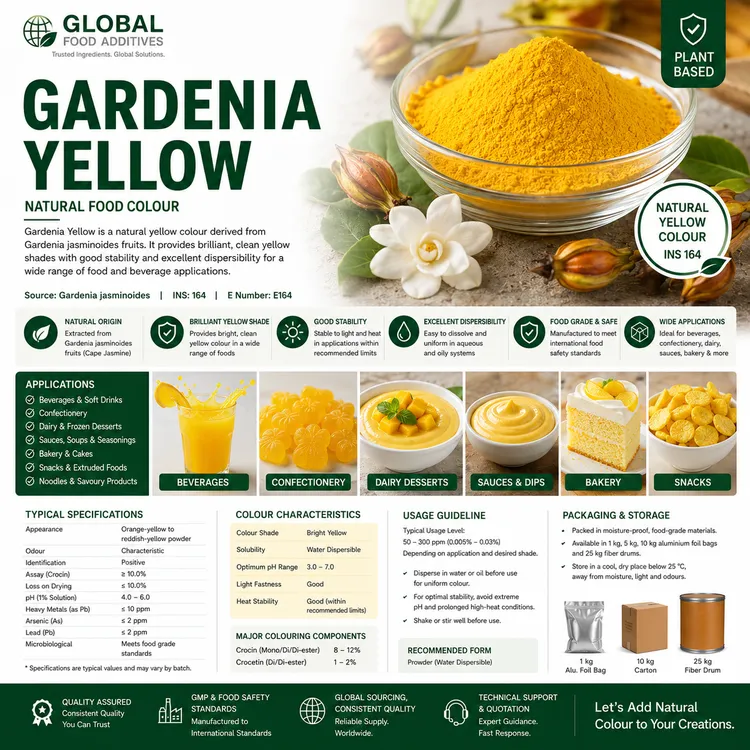
Product identity
| Product | Gardenia Yellow |
|---|---|
| Category | Colours & Colouring Foods |
| Function | Food colour, colouring food, colour standardisation ingredient and natural shade correction system |
| Botanical source | Gardenia jasminoides fruit extract, subject to supplier grade and origin |
| Pigment system | Crocin and crocetin-type carotenoid colour components, depending on extract profile |
| INS reference | INS 164 where recognised; E-number and approval status must be confirmed by destination market |
| CAS / identity | Gardenia jasminoides extract |
| Typical shade | Bright yellow to orange-yellow, depending on concentration, pH, matrix and process |
| Typical form | Powder, liquid concentrate, water-soluble extract, dispersion or application-specific blend |
| Key buying parameters | Colour value, absorbance, hue, carrier, solubility, moisture, ash, microbiology, heavy metals and regulatory documents |
Application fit
Potential use areas may include:
- Beverages, still drinks, instant drink powders and flavoured waters
- Confectionery, gummies, hard candies, jellies and coated sweets
- Dairy desserts, yogurts, custards, puddings and cream systems
- Bakery fillings, glazes, icings, decoration systems and snack coatings
- Sauces, dressings, seasonings, noodles and savoury prepared foods
- Fruit preparations, dessert toppings and yellow-orange shade correction
- Colour blends with curcumin, beta-carotene, paprika, annatto or safflower systems
Technical overview
Gardenia Yellow is used as a functional colour ingredient rather than a flavouring or nutritional claim ingredient. Its commercial value comes from its ability to deliver a clean yellow to orange-yellow visual tone in food systems where the manufacturer needs repeatable shade, transparent colour communication and documentation suitable for industrial approval. Depending on grade, Gardenia Yellow may be offered as a water-soluble powder, liquid extract, spray-dried powder, carrier-supported colour, dispersion or customised blend for a specific food matrix.
The colour contribution is associated with crocin and crocetin-type carotenoid pigments. These components can provide a vivid yellow-orange tone, but the final appearance is controlled by colour strength, dosage, base colour of the food, pH, dissolved solids, proteins, emulsifiers, minerals, preservatives, heat process, light exposure and packaging. For purchasing and formulation teams, the most important question is not simply whether the product is “natural”; it is whether the proposed grade gives the required shade, stability, cost-in-use and regulatory status in the target market.
Functional performance in formulation
Shade development
Gardenia Yellow can deliver a yellow to orange-yellow hue that is useful for citrus, mango, pineapple, peach, tropical fruit, egg-style, dairy, snack and savoury profiles. Shade depends on concentration, pH, background colour, solids level and whether the system is clear, cloudy, emulsified or opaque.
Colour standardisation
Industrial users often apply Gardenia Yellow to reduce batch-to-batch shade variation caused by natural raw materials, seasonal changes, thermal treatment or ingredient substitution. For consistent production, the colour should be dosed by colour value or absorbance, not only by weight.
Solubility and dispersion
Water-soluble grades are suitable for many beverages, syrups, desserts and aqueous systems. Oil-compatible or emulsified systems may require a different carrier or blend. Poor dispersion can create specks, ringing, sediment or inconsistent colour development in the finished product.
Stability control
Like many natural colourants, Gardenia Yellow should be evaluated under the exact process conditions. Heat, light, oxygen, pH, metal ions, preservatives and packaging can influence shade retention. Accelerated shelf-life tests are recommended before commercial launch.
Industrial application guidance
| Application area | Desired function | Grade selection focus |
|---|---|---|
| Beverages and drink bases | Clear or cloudy yellow tone, citrus shade, natural colour positioning | Water solubility, pH stability, clarity, sediment control, light stability and preservative compatibility |
| Confectionery | Bright colour, fruit identity, batch consistency and clean-label replacement | Heat exposure, sugar system, acid addition, gel matrix, colour strength and migration behaviour |
| Dairy desserts and yogurts | Yellow fruit tone, egg-style colour, visual standardisation and creamy appearance | Protein compatibility, pH, pasteurisation conditions, flavour neutrality and colour retention during chilled storage |
| Bakery and decoration systems | Yellow-orange shade in fillings, icings, glazes and toppings | Thermal process, water activity, fat content, carrier type, migration and storage stability |
| Sauces and savoury foods | Warm yellow tone, standardised appearance and colour correction | Salt level, acid level, emulsifiers, spices, heat treatment and packaging format |
| Snacks and seasonings | Powder coating colour, visual impact and shade alignment with flavour profile | Dry blend uniformity, carrier compatibility, dusting, humidity control and interaction with spices or minerals |
Specification parameters buyers should compare
A professional Gardenia Yellow inquiry should convert the colour requirement into measurable specification points. The supplier should identify the exact grade and provide test methods or limits for the most relevant parameters below.
| Parameter | Why it matters |
|---|---|
| Colour value / absorbance | Defines commercial strength and allows cost-in-use comparison between suppliers. |
| Hue and shade target | Determines whether the colour matches citrus, mango, pineapple, egg, dairy, snack or savoury visual profiles. |
| Botanical origin | Supports natural colour positioning, traceability and customer documentation. |
| Carrier system | Carrier ingredients affect label declaration, solubility, allergen review, GMO status and process behaviour. |
| Powder or liquid form | Influences dosing accuracy, storage, shelf life, handling, dusting, pumpability and production hygiene. |
| Solubility / dispersibility | Important for beverage clarity, uniform colour development, sediment prevention and powder premix performance. |
| pH stability | Critical for acidic drinks, dairy products, sauces, fruit preparations and confectionery systems. |
| Heat stability | Relevant for pasteurisation, UHT exposure, cooking, baking, syrup preparation and hot-fill processes. |
| Light and oxygen stability | Essential for transparent packaging, beverage shelves, ambient storage and long distribution chains. |
| Microbiological limits | Required for ready-to-eat products, beverage systems, dairy applications and customer food-safety approval. |
| Heavy metals and contaminants | Needed for retail specifications, export compliance and sensitive product categories. |
| Regulatory declarations | Confirms whether the colour can be used, labelled and claimed in the destination country and food category. |
Process handling and formulation notes
- Pre-dispersion: powders should normally be pre-dispersed in water or compatible liquid before addition to large production batches to avoid specks and incomplete colour release.
- Order of addition: add colour at a process point that gives sufficient mixing while avoiding unnecessary heat, light and oxygen exposure.
- pH validation: test the colour in the finished product pH, not only in water. Acidulants, buffers and minerals can affect the final shade and stability.
- Thermal process: validate shade after pasteurisation, cooking, baking, hot filling, retort or UHT exposure if these processes apply.
- Packaging effect: clear PET, glass, flexible packaging and opaque packaging can produce different shelf-life outcomes because of light exposure.
- Blending: Gardenia Yellow may be combined with other natural colours to create tailored yellow, orange or golden shades, but blend stability must be tested.
- Dosing: commercial comparison should be made by colour strength and finished-product appearance, not only by price per kilogram.
Colour-system comparison
| Colour option | Typical positioning | Key review point |
|---|---|---|
| Gardenia Yellow | Plant-derived yellow to orange-yellow colour system | Destination-market approval, colour value, pH stability, light stability and supplier documentation |
| Curcumin / turmeric colour | Natural yellow shade with strong colour impact | Light sensitivity, flavour impact, solubility format and legal use level |
| Beta-carotene | Yellow to orange carotenoid colour | Oil or water-dispersible format, oxidation stability and emulsion quality |
| Annatto | Yellow-orange dairy, snack and savoury colour | Application permissions, shade profile, protein interaction and regional labelling |
| Safflower yellow | Plant-derived yellow colour used in selected markets | Regulatory status, availability, cost-in-use and heat/light stability |
| Synthetic yellow colours | High-strength, consistent colour where permitted | Consumer positioning, label warnings, regional restrictions and customer policy |
Technical purchasing notes
When reviewing Gardenia Yellow, compare the supplier specification against the intended food application, process conditions, target shade, label expectations and local rules. The most useful industrial inquiry normally includes target colour strength, desired hue, physical form, carrier system, application matrix, pH, heat process, packaging size, quantity, destination and document requirements.
For repeat purchasing, buyers should create an approved-colour file that includes supplier name, product code, colour value, test method, recommended dosage range, carrier declaration, country of origin, shelf life, storage conditions, regulatory status, sample approval result and replacement-grade policy. This avoids reformulation risk when a colour name is the same but the grade, carrier or colour value is different.
Quality, safety and compliance review
Regulatory status
Gardenia Yellow should not be assumed permitted in every destination market. Confirm whether it is allowed for the exact food category, use level and label wording in the country of sale. INS references, national positive lists and customer policies may not be identical.
Label declaration
Depending on the jurisdiction and grade, label wording may differ between colour, colouring food, plant extract, natural colour or other permitted names. Confirm the required declaration before artwork approval.
Carrier and allergen review
Spray-dried and blended grades may contain carriers such as maltodextrin, starch derivatives, gums or emulsifiers. These should be checked for allergen status, GMO status, dietary suitability and customer restrictions.
Food-safety documentation
Common approval items include certificate of analysis, microbiological limits, heavy metals, residual solvents where applicable, pesticide statement, GMO statement, allergen statement, country of origin and shelf-life information.
Documents to request
- Technical data sheet or product specification with exact grade code
- Certificate of analysis for available batch or representative lot
- Safety data sheet where applicable
- Botanical origin and raw-material source statement
- Colour value, absorbance method, wavelength and test method details
- Carrier, diluent, solvent, stabiliser and processing aid declaration
- Solubility, pH range, heat stability and light stability guidance
- Microbiological specification and heavy metal limits
- Residual solvent, pesticide, contaminant and impurity statements where required
- Allergen, GMO, vegan/vegetarian, halal or kosher documents when required
- Country of origin, manufacturer information, shelf life and storage conditions
- Label recommendation and destination-market regulatory declaration
- Packaging details, net weight, pallet configuration and container loading information
Packaging and logistics considerations
Gardenia Yellow may be supplied in aluminium foil bags, cartons, fibre drums, plastic drums, jerrycans, HDPE containers or other light-protective packaging depending on whether the grade is powder or liquid. Buyers should confirm net weight, inner liner, oxygen and moisture protection, light barrier, storage temperature, shelf life, palletisation and container-loading conditions. For sensitive colour systems, unnecessary exposure to light, humidity, oxygen and high temperature during storage should be avoided.
Common purchasing risks
- Regulatory mismatch: the colour may be acceptable in one market but not approved, not labelled the same way or not permitted in the same food category in another market.
- Wrong colour value: a cheaper grade can require higher dosage, increasing cost-in-use and changing flavour, solids or label declaration.
- Carrier conflict: maltodextrin, starch, gum, emulsifier or solvent systems may not fit allergen, GMO, clean-label or customer requirements.
- Stability failure: heat, light, oxygen, pH or minerals can cause shade loss or colour shift during shelf life.
- Solubility issue: poor dispersion may cause specks, sediment, ringing, uneven colour or filtration problems.
- Insufficient documentation: missing origin, COA, allergen, GMO, contaminant or regulatory documents can delay customer approval and import clearance.
- Sample-to-bulk variation: pilot samples should be matched with the proposed commercial grade and test method before bulk approval.
How to request this product
Send the product name, required colour shade, colour strength or reference sample, powder or liquid preference, target application, finished product pH, heat process, packaging format, quantity, destination country, delivery term and required documents. If you already purchase Gardenia Yellow, attach your existing specification, label declaration, certificate of analysis or approved sample so alternatives can be compared by colour value, performance and compliance.
Useful answers
What is Gardenia Yellow used for in food manufacturing?
Gardenia Yellow is used for yellow to orange-yellow shade development, colour standardisation and natural colour positioning in suitable foods and beverages. It may be evaluated for beverages, confectionery, dairy desserts, sauces, bakery fillings, snacks and prepared foods, depending on regulations and grade performance.
What makes Gardenia Yellow different from synthetic yellow colours?
Gardenia Yellow is plant-derived from Gardenia jasminoides extract and is selected mainly for natural colour programs. Synthetic yellow colours are chemically different materials with different regulatory status, labelling requirements, consumer perception and technical performance.
Which specification matters most?
Colour value or absorbance is usually the first comparison point because it determines strength and cost-in-use. Buyers should also check hue, carrier system, solubility, pH stability, heat stability, light stability, microbiology, heavy metals and regulatory documents.
Can Gardenia Yellow be used in acidic beverages?
It may be suitable for selected acidic systems, but suitability must be tested in the finished beverage pH with the real process, preservatives, minerals, packaging and shelf-life conditions. Beverage trials should check clarity, sediment, light stability and shade retention.
Can Global Food Additives source Gardenia Yellow?
Global Food Additives can review sourcing options for Gardenia Yellow according to target shade, colour strength, physical form, carrier requirements, application, quantity, destination country, packaging and documentation requirements.
Which documents should be requested?
Buyers commonly request a technical data sheet, certificate of analysis, safety data sheet where applicable, botanical origin statement, carrier declaration, allergen/GMO statement, heavy metal limits, microbiological limits, shelf-life information, storage guidance, label recommendation and market-specific regulatory declarations.
Is Gardenia Yellow permitted in every country?
No. Food colour approval depends on destination-market rules, final food category, use level, label declaration and supplier documentation. Buyers should confirm local regulatory status before commercial use.
Tell us which food additive or ingredient you need.
Send product names, target specifications, quantity, destination country, packaging preference, delivery term, and document requirements. Our team will review your inquiry and respond from orders@foodgradeadditives.com.
Your message has been received. You will be redirected to the home page.