
Glucoamylase
Glucoamylase is a food-grade enzyme preparation used by manufacturers to convert starch, liquefied starch and dextrins into glucose-rich carbohydrate streams. It is especially valuable in industrial starch saccharification, glucose syrup production, brewing, distilling, bakery fermentation support and cereal-based processing where process yield, fermentable sugar generation, viscosity reduction and consistent conversion performance are important.
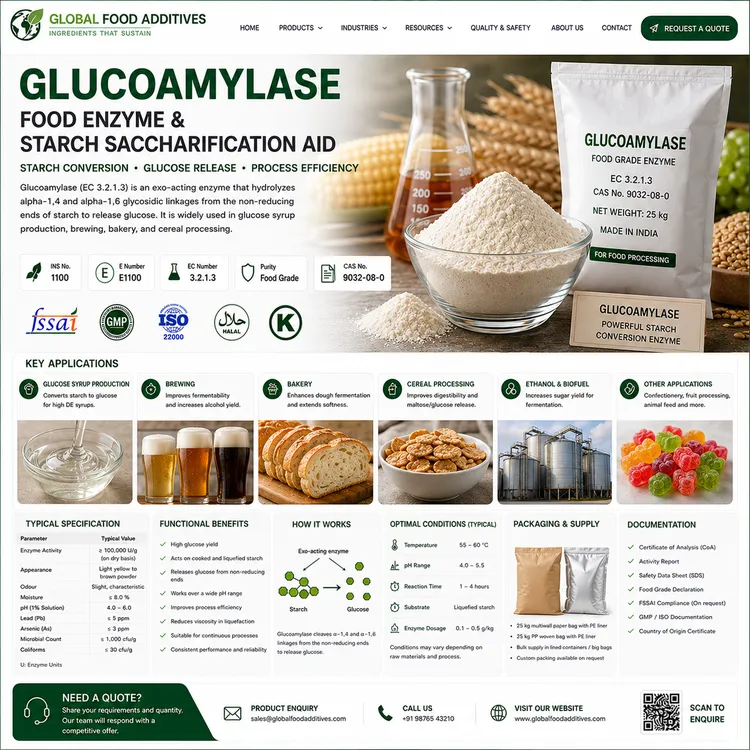
Product identity
| Product | Glucoamylase |
|---|---|
| Common synonyms | Amyloglucosidase, glucose amylase, glucan 1,4-alpha-glucosidase, gamma-amylase |
| Category | Enzymes & Processing Aids |
| Function | Food enzyme / starch saccharification enzyme / glucose release enzyme / processing aid |
| EC number | EC 3.2.1.3 |
| E / INS number | Confirm by destination market and supplier documentation |
| CAS / identity | 9032-08-0 |
| Typical form | Liquid enzyme preparation, powder, granule, coated granule or tablet preparation |
| Typical substrate | Liquefied starch, dextrins, maltodextrins, maltose and related glucans |
| Primary product | Glucose-rich carbohydrate stream, depending on process and substrate |
Application fit
Potential use areas may include:
- Starch saccharification and glucose syrup production
- Brewing and high-attenuation fermentation systems
- Distilling and alcohol-fermentation processes
- Bakery dough fermentation support
- Cereal, grain and malt-based processing
- Starch-containing sauces, fillings and prepared foods
- Starch-haze control in selected beverage or juice systems
- Industrial carbohydrate conversion and process optimisation
Technical overview
Glucoamylase is an exo-acting carbohydrase that releases glucose from the non-reducing ends of starch and dextrin chains. In practical food manufacturing, it is often used after starch gelatinisation and liquefaction, where alpha-amylase has already reduced starch viscosity and created shorter dextrin chains. Glucoamylase then converts these dextrins into glucose-rich syrup or fermentable sugar, depending on process conditions and conversion target.
The performance of Glucoamylase depends on substrate type, dry solids level, dextrose equivalent target, pH, temperature, calcium or mineral balance, enzyme dosage, holding time, mixing, microbial control and enzyme stability. Since enzyme preparations differ by source organism, formulation carrier, side activities and activity method, industrial buyers should compare products by process performance and not only by product name.
Functional performance in food systems
Starch saccharification
In glucose syrup and starch processing, Glucoamylase is used after liquefaction to increase glucose formation from dextrins. Conversion performance depends on substrate quality, dry solids, enzyme dosage, temperature, pH and residence time.
Fermentable sugar generation
In brewing, distilling and cereal-based fermentation, Glucoamylase can increase glucose availability for yeast or fermentation organisms. This may support higher attenuation, improved alcohol yield or controlled carbohydrate profile.
Dough and bakery support
In selected bakery systems, Glucoamylase can generate fermentable sugars from starch-derived dextrins, supporting yeast activity, crust colour, flavour development and softness. Dosage must be controlled to avoid excessive stickiness or texture defects.
Viscosity and dextrin reduction
By converting dextrins into glucose, Glucoamylase can help reduce residual carbohydrate complexity and support predictable viscosity, sweetness and solids behaviour in syrup, cereal and starch-containing systems.
Typical industrial applications
| Application area | Technical role | Purchasing notes |
|---|---|---|
| Glucose syrup and starch processing | Converts liquefied starch and dextrins into glucose-rich syrup during saccharification. | Check activity unit, pH range, temperature profile, recommended dosage, DE target, dry solids tolerance and side activity profile. |
| Brewing | Increases fermentable glucose and supports high attenuation or low-residual-carbohydrate beer styles. | Evaluate wort composition, mash programme, yeast performance, final gravity, alcohol yield, flavour impact and regulatory status. |
| Distilling and alcohol fermentation | Improves starch-to-glucose conversion for fermentation feedstock and alcohol yield. | Review substrate source, liquefaction process, saccharification time, fermentation temperature and enzyme deactivation requirements. |
| Bakery | Supports fermentable sugar release, yeast activity, crust colour and crumb softness in selected dough systems. | Trial dosage carefully because excess activity may create sticky dough, weak crumb or excessive sugar release. |
| Cereal and grain processing | Breaks down starch-derived dextrins in cereal slurries, malt-based products and grain preparations. | Check process pH, heat treatment, solids content, viscosity target and compatibility with alpha-amylase or pullulanase. |
| Beverage and juice systems with starch haze | May assist starch degradation where starch contamination or starch haze is present, usually as part of an enzyme system. | Confirm whether glucoamylase alone is suitable or whether alpha-amylase, pectinase or filtration aids are also required. |
| Prepared foods, sauces and fillings | Helps modify starch-derived carbohydrate behaviour where controlled conversion is desired. | Validate viscosity, sweetness, water activity, heat process, shelf life and enzyme inactivation in the final food matrix. |
Enzyme selection criteria
Industrial enzyme purchasing requires more than matching the product name. Two Glucoamylase products can perform differently because activity unit definitions, source organism, stabilisation system, carrier, concentration, pH tolerance, temperature tolerance and side activities may not be identical. Buyers should request the supplier’s activity method and trial the enzyme under real process conditions.
| Selection factor | Why it matters |
|---|---|
| Activity unit and test method | Activity values are not always interchangeable between suppliers. Confirm whether units are declared as AGU, GAU, AMG, U/g, U/mL or another supplier-specific method. |
| Recommended pH profile | Glucoamylase activity and stability depend strongly on process pH. The process should stay within the supplier’s recommended operating window. |
| Recommended temperature profile | Temperature affects reaction speed, enzyme stability and deactivation. High heat may denature the enzyme, while low temperature may slow conversion. |
| Substrate specificity | Performance varies depending on starch source, degree of liquefaction, dextrin profile, branch structure and dry solids content. |
| Side activities | Some commercial preparations may contain additional carbohydrase activities. These can be beneficial or undesirable depending on product target. |
| Physical form | Liquid enzymes are convenient for dosing systems, while powders or granules may be preferred for dry blends, premixes or export stability. |
| Carrier and stabiliser system | Carriers, salts, preservatives or stabilisers can affect label review, allergen assessment, compatibility and customer approval. |
| Source organism | Food manufacturers may need production-organism, fermentation, GMO, non-GMO, allergen, halal, kosher or regional regulatory declarations. |
Process design considerations
- Pre-treatment: starch normally requires gelatinisation and liquefaction before efficient Glucoamylase saccharification.
- Liquefaction quality: alpha-amylase performance influences dextrin chain length and downstream Glucoamylase conversion efficiency.
- pH control: pH should be adjusted and monitored at the actual process temperature and sampling point.
- Temperature control: reaction temperature affects saccharification rate, enzyme half-life and final glucose yield.
- Dry solids: high-solids systems can improve productivity but may increase viscosity, mixing demand and mass-transfer limitations.
- Holding time: residence time must be long enough to reach the required glucose or DE target without excessive process delay.
- Enzyme dosage: optimum dosage depends on activity, substrate, conversion target, process time and economic yield.
- Compatibility: confirm compatibility with alpha-amylase, pullulanase, protease, salts, preservatives, acids, cleaning residues and process aids.
- Deactivation: define whether the enzyme must be inactivated by heat, pH shift or downstream processing before packaging.
- Microbial control: saccharification systems with warm temperatures and high carbohydrate levels require hygienic design and time control.
Common enzyme system combinations
| Combination | Purpose | Industrial benefit |
|---|---|---|
| Alpha-amylase + Glucoamylase | Alpha-amylase liquefies starch; Glucoamylase saccharifies dextrins to glucose. | Improves viscosity reduction, conversion efficiency and glucose yield in starch processing. |
| Glucoamylase + Pullulanase | Pullulanase helps debranch alpha-1,6 linkages; Glucoamylase releases glucose from resulting chains. | Can improve dextrose yield and reduce residual branched dextrins in glucose syrup production. |
| Glucoamylase + Protease | Used in selected cereal, brewing or fermentation processes where protein breakdown supports process performance. | May improve nutrient availability, filtration, fermentation performance or process flow, depending on the matrix. |
| Glucoamylase + Baking enzymes | Used with amylases, xylanases or other dough enzymes in bakery systems. | Can support fermentation, crust colour, softness and dough handling when properly balanced. |
Technical purchasing notes
When reviewing Glucoamylase, compare the supplier specification against the intended food application, substrate, process conditions, activity unit, enzyme dosage, label expectations and destination-market rules. For industrial purchasing, the most useful inquiry normally includes target enzyme activity, application, current process pH and temperature, substrate type, processing time, physical form, packaging size, annual quantity, destination and document requirements.
For commercial approval, customers should test a representative enzyme sample under actual plant or pilot conditions. Important trial outputs include glucose formation, DE increase, final gravity in brewing, fermentation yield, viscosity reduction, residual dextrin level, sensory impact, process time, enzyme deactivation and cost-in-use. Activity on a certificate of analysis should be treated as a quality-control reference, not a replacement for plant validation.
Specification points to compare
| Parameter | Why it matters |
|---|---|
| Declared enzyme activity | Determines dosage, cost-in-use and batch-to-batch performance. Activity method must be clearly stated. |
| Activity unit definition | Different suppliers may use different analytical units, making direct comparison difficult without method details. |
| pH optimum and stability | Ensures the enzyme remains active during the planned saccharification or food process. |
| Temperature optimum and stability | Supports process design, reaction speed and deactivation planning. |
| Appearance and physical form | Important for dosing, storage, dust control, blending, pumpability and operator handling. |
| Carrier and formulation aids | Relevant for allergen review, label review, customer approval and compatibility with the finished food. |
| Source organism | Required for food enzyme approval, GMO assessment, halal or kosher review and customer specification. |
| Microbiological limits | Important for food safety, export documentation and sensitive food applications. |
| Heavy metals and contaminants | Supports regulatory compliance, import clearance and customer quality systems. |
| Shelf life and storage temperature | Enzyme activity can decline during storage if temperature, humidity or packaging conditions are not controlled. |
| Packaging integrity | Protects liquid preparations from leakage and dry preparations from moisture, dust release and contamination. |
| Batch traceability | Required for industrial QA systems, recalls, audits and customer approval programmes. |
Quality, safety and handling
Food enzyme preparations should be handled according to the supplier’s safety data sheet and plant hygiene procedures. Dry enzyme powders and aerosols may create occupational exposure concerns, so industrial users should control dust, avoid inhalation, use suitable ventilation and provide appropriate personal protective equipment. Liquid preparations should be handled to prevent splashing, leakage, cross-contamination and temperature abuse.
In production, enzyme residues and activity should be managed according to the intended process. Some applications rely on downstream heat treatment or pH change to inactivate the enzyme, while others require confirmation that no unwanted activity continues in the finished product. Deactivation requirements should be defined during product development and validated under the manufacturer’s actual process conditions.
Documents to request
- Product specification or technical data sheet
- Certificate of analysis for the available batch or lot
- Safety data sheet and handling guidance
- Declared enzyme activity, activity unit definition and analytical method
- Recommended dosage, pH range, temperature range and deactivation guidance
- Source organism and fermentation-origin statement
- GMO, non-GMO or genetically modified production organism declaration where required
- Food-grade, processing-aid or food-enzyme regulatory statement for the destination market
- Allergen, gluten, vegan, halal or kosher statements where required
- Microbiological limits, heavy metals and contaminant declarations
- Origin, manufacturer, shelf-life and recommended storage information
- Label draft, packaging details, net weight, gross weight and pallet configuration
- Commercial invoice, packing list, certificate of origin and export documents when applicable
Packaging, storage and logistics
Glucoamylase may be supplied as a liquid enzyme preparation, powder, granule, coated granule or tablet depending on supplier capability and application. Liquid grades are commonly selected for automated dosing and industrial saccharification systems, while dry forms may be preferred for dry blends, bakery premixes, export stability or compact storage.
Enzymes should be protected from excessive heat, moisture, direct sunlight, freezing where not permitted, contamination and long exposure to unsuitable warehouse conditions. Buyers should confirm recommended storage temperature, remaining activity at the end of shelf life, temperature-control needs during transport, pallet configuration, packaging compatibility and whether the product requires cold-chain, cool-chain or ambient shipment.
Industrial supplier qualification
For recurring purchases, supplier approval should include technical document review, representative sample testing, pilot trial, commercial trial and batch-to-batch comparison. Buyers may also request information about food safety certification, traceability, recall procedure, manufacturing site standards, allergen control, change-control policy and lead-time reliability. For enzyme products, change control is especially important because a change in production organism, carrier, activity method or stabilisation system may affect both processing performance and regulatory documentation.
How to request this product
Send the product name, target enzyme activity, application, substrate, process pH, process temperature, processing time, desired result, quantity, destination country, packaging preference, expected shipment date and required documents. If you already purchase Glucoamylase, attach or describe your existing specification, technical data sheet, certificate of analysis, label or activity unit so supplier options can be compared more accurately.
Best inquiry details
- Product name: Glucoamylase / Amyloglucosidase
- Required activity unit and minimum activity
- Application: starch syrup, brewing, bakery, distilling or other use
- Substrate type and dry solids level
- Process pH, temperature and holding time
- Liquid or dry enzyme preference
- Annual demand and first-order quantity
- Destination country and delivery term
- Required documents and certifications
Application questions to include
- Is starch already gelatinised and liquefied?
- Which alpha-amylase or pullulanase is used upstream?
- What glucose, DE or attenuation target is required?
- What is the expected processing time?
- Does the enzyme need to be deactivated before packaging?
- Are there allergen, GMO, halal, kosher or label restrictions?
- Will the product be used as a processing aid or declared ingredient?
Useful answers
What is Glucoamylase used for in food manufacturing?
Glucoamylase is used for starch saccharification, glucose release, brewing attenuation, distilling, bakery fermentation support, cereal processing and selected prepared-food applications where starch-derived dextrins must be converted into glucose or more fermentable sugars.
How does Glucoamylase differ from alpha-amylase?
Alpha-amylase mainly liquefies starch by cutting internal starch chains and reducing viscosity. Glucoamylase works from the non-reducing ends of starch and dextrin chains, releasing glucose. In many starch processes, alpha-amylase is used first and Glucoamylase is used afterward for saccharification.
Can Glucoamylase improve brewing or fermentation performance?
Yes, Glucoamylase can increase fermentable glucose availability in suitable brewing, distilling or cereal fermentation systems. The final result depends on mash composition, dosage, yeast performance, process time, temperature, pH and regulatory requirements.
Which documents should be requested?
Buyers commonly request a technical data sheet or specification, certificate of analysis, safety data sheet, enzyme activity method, source-organism statement, GMO or non-GMO declaration, allergen statement, shelf-life information, storage guidance, label and packing details, and destination-market regulatory declarations.
Can Global Food Additives source Glucoamylase?
Global Food Additives can review sourcing options for Glucoamylase according to target application, enzyme activity, grade, quantity, destination, packaging and required documentation.
Is this product permitted in every country?
No. Food enzyme use depends on destination-market rules, food category, processing-aid status, labelling requirements and buyer responsibility. Always verify regulatory status in the intended market before commercial use.
Tell us which food enzyme or ingredient you need.
Send product names, target specifications, enzyme activity, quantity, destination country, packaging preference, delivery term, and document requirements. Our team will review your inquiry and respond from orders@foodgradeadditives.com.
Your message has been received. You will be redirected to the home page.