
Kombucha Culture
Kombucha Culture is a symbiotic food fermentation culture used to produce kombucha-style beverages from sweetened tea, botanical infusions or selected beverage bases. It is commonly described as a SCOBY, a symbiotic culture of bacteria and yeast, and is evaluated by beverage manufacturers for controlled acidification, organic acid formation, flavour development, mild effervescence, sugar conversion, live culture positioning and fermentation consistency.
For industrial use, Kombucha Culture should be treated as a living process input rather than a standard dry ingredient. Performance depends on microbial composition, culture vitality, tea or substrate composition, sugar level, fermentation temperature, oxygen exposure, sanitation, fermentation time, pH endpoint, ethanol control, downstream filtration or pasteurization, packaging and cold-chain management.
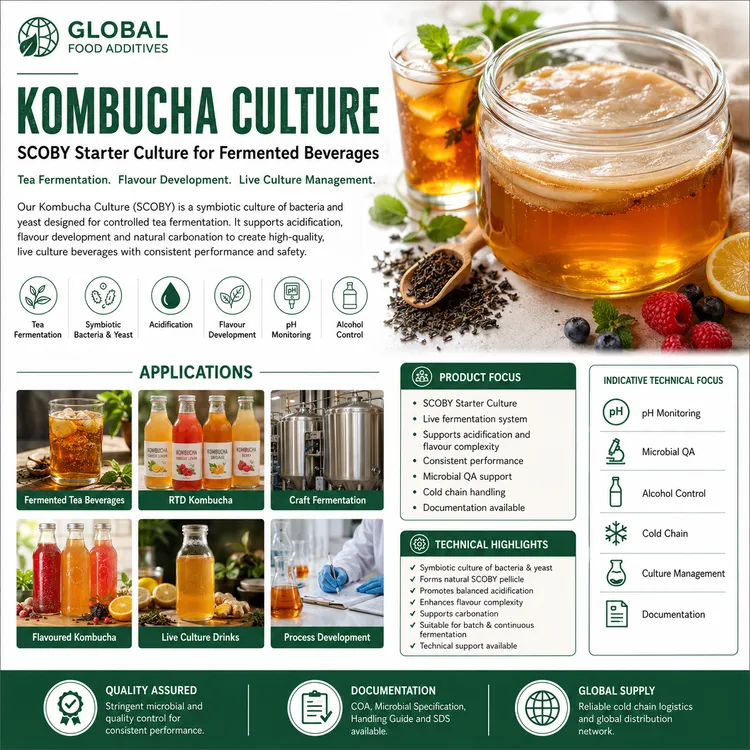
Product identity
| Product | Kombucha Culture |
|---|---|
| Common name | Kombucha SCOBY / symbiotic culture of bacteria and yeast |
| Category | Fermentation, Cultures & Bio-Protective Ingredients |
| Function | Fermentation, starter culture or bio-protective ingredient |
| E / INS number | Confirm by destination market and supplier documentation |
| CAS / identity | Symbiotic culture; not a single chemical substance |
| Typical culture organisms | Selected yeasts and acid-producing bacteria; exact genus, species and strain information should be confirmed by the supplier |
| Typical form | Liquid starter culture, SCOBY mat with starter liquid, freeze-dried culture, frozen culture, powder or application-specific blend |
| Typical substrate | Sweetened black tea, green tea, oolong tea, herbal infusion, botanical extract or formulated beverage base where culture compatibility is validated |
| Key process focus | pH decline, ethanol formation, acid profile, microbial purity, flavour profile, carbonation potential and shelf-life stability |
Application fit
Potential use areas may include:
- Ready-to-drink kombucha and fermented tea beverages
- Fermented green tea, black tea, oolong tea and botanical infusion bases
- Low-sugar, reduced-sugar and lightly sweetened fermented beverage concepts
- Fruit-flavoured kombucha, herb-infused beverages and sparkling fermented drinks
- Live culture beverage concepts where permitted by local regulations
- Post-fermentation flavour bases for non-alcoholic beverage development
- Controlled acidified beverage bases, vinegar-style drinks and culinary beverage ingredients
- Research, pilot-plant and scale-up fermentation programs
Technical overview
Kombucha fermentation is driven by a mixed microbial ecosystem. Yeasts convert part of the available sugar into ethanol and carbon dioxide, while acid-producing bacteria oxidize ethanol and other substrates into organic acids such as acetic and gluconic acids. The resulting beverage develops acidity, aroma complexity, tea-derived polyphenol transformation, light effervescence and the characteristic kombucha flavour profile.
The visible SCOBY mat is not the entire culture system. A large part of the fermentation activity exists in the starter liquid, which carries microorganisms, acids and metabolites that help lower initial pH and support controlled fermentation. For commercial production, both the culture biomass and the acidic starter liquid must be managed as critical process inputs.
Because Kombucha Culture contains living microorganisms, supplier-to-supplier performance can vary. Differences may appear in acidification speed, ethanol formation, cellulose mat formation, aroma profile, sugar utilization, tolerance to temperature, tolerance to preservatives, resistance to contamination and shelf-life behaviour. For this reason, industrial approval should include bench trials, pilot batches, analytical monitoring and finished-product stability testing.
Functional benefits in beverage systems
Controlled fermentation
A defined Kombucha Culture can support repeatable pH decline, sugar conversion, organic acid development and sensory consistency when process conditions are controlled.
Flavour complexity
Fermentation can create a layered profile with acidity, tea notes, fruit compatibility, light vinegar character, mild esters and fermentation-derived aromatic complexity.
Acidification and product stability
Organic acid formation lowers pH and can contribute to beverage stability, but pH control must be validated with good manufacturing practice and market-specific food safety requirements.
Live culture positioning
When the beverage remains unpasteurized or minimally processed, live culture positioning may be possible where permitted, but claims must be supported by viable count and regulatory review.
Application engineering guidance
| Application | Technical objective | Critical review points |
|---|---|---|
| Classic kombucha beverage | Create controlled tea fermentation with balanced acidity, residual sweetness, aroma and light effervescence. | Review tea type, sugar concentration, starter percentage, inoculation method, fermentation time, temperature, oxygen exposure, pH endpoint, alcohol formation and secondary fermentation. |
| Green tea or oolong kombucha | Develop a lighter, floral or delicate fermented tea profile. | Evaluate tea polyphenols, caffeine level, bitterness, colour stability, acid balance, aroma preservation and compatibility with fruit or botanical flavours. |
| Botanical and herbal kombucha | Create fermented botanical drinks with tea-like complexity or caffeine-controlled positioning. | Confirm culture compatibility because some herbs, essential oils, preservatives or polyphenols can inhibit microorganisms or change fermentation kinetics. |
| Low-sugar fermented beverages | Reduce residual sugar while maintaining fermentation activity and sensory balance. | Validate fermentable sugar availability, sweetener system, pH drop, alcohol formation, acidity, mouthfeel and post-fermentation stability. |
| Fruit-flavoured kombucha | Add fruit aroma, colour and sweetness after or during fermentation. | Check fruit pH, sugar contribution, microbial load, pulp sedimentation, colour stability, alcohol increase during storage and package pressure. |
| Sparkling kombucha | Develop carbonation through controlled secondary fermentation or force carbonation. | Validate bottle pressure, residual sugar, yeast activity, cold-chain control, alcohol rise, package strength and distribution temperature. |
| Pasteurized or stabilized kombucha | Improve shelf stability by stopping or reducing microbial activity. | Review heat process, flavour change, loss of live culture claims, package stability, residual sugar, alcohol control and label implications. |
| Hard kombucha | Develop alcoholic kombucha-style beverages where legally permitted. | Requires alcohol licensing, excise review, ABV testing, labeling approval, yeast management, fermentation control and market-specific alcohol beverage compliance. |
Fermentation control parameters
Commercial kombucha production requires defined process controls. The most important control points include substrate preparation, tea extraction, sugar concentration, cooling, inoculation, starter liquid percentage, sanitation, fermentation temperature, oxygen availability, vessel geometry, pH monitoring, titratable acidity, alcohol testing, contamination control, filtration, flavour addition, carbonation and packaging.
A typical process design includes preparation of sweetened tea, cooling to inoculation temperature, addition of acidic starter liquid and culture, aerobic primary fermentation, removal or transfer of culture biomass, blending or flavouring, optional secondary fermentation, carbonation, stabilization if required and finished-product release testing. The exact process should be validated for the target beverage and regulatory market.
Microbial ecology and culture composition
Kombucha cultures commonly include yeasts and acetic acid bacteria. Yeasts contribute sugar breakdown, ethanol generation and aromatic metabolites. Acetic acid bacteria contribute oxidation of ethanol into acids, cellulose formation and the characteristic acidic kombucha profile. Some cultures may also contain lactic acid bacteria or other organisms depending on the source and handling history.
For industrial sourcing, the buyer should not accept only the generic term “SCOBY” when a controlled commercial beverage is planned. The supplier should provide microbial identity information, safety review, viable count or activity information, contamination-control data and handling instructions. Where strain-level disclosure is commercially restricted, buyers should still request enough documentation for regulatory and food safety approval.
| Culture component | Typical role | Buyer review points |
|---|---|---|
| Yeasts | Convert fermentable sugars into ethanol, carbon dioxide and flavour-active metabolites. | Review ethanol production, fermentation speed, sugar tolerance, aroma profile, sediment formation and post-bottling activity. |
| Acetic acid bacteria | Oxidize ethanol and sugars into organic acids and may contribute to cellulose mat formation. | Review oxygen requirement, acidification rate, acetic acid level, gluconic acid formation, cellulose formation and final sensory balance. |
| Starter liquid | Provides acidified inoculum and active microbial population for predictable fermentation start. | Review pH, titratable acidity, inoculation percentage, microbial load, handling temperature and shelf life. |
| SCOBY mat | Visible cellulose-rich culture biomass associated with traditional kombucha production. | Review cleanliness, texture, colour, foreign matter, contamination risk, storage liquid and transfer procedure. |
| Freeze-dried or frozen blend | Provides a more standardized and easier-to-distribute culture format. | Review reactivation protocol, viable count, fermentation lag time, storage temperature and recovery in the target substrate. |
Alcohol, acidity and shelf-life management
Alcohol management is one of the most important industrial considerations in kombucha. During fermentation, yeasts may generate ethanol, and ethanol level can continue to change during storage if live microorganisms and fermentable sugars remain in the packaged beverage. If a product is sold as non-alcoholic, low-alcohol or alcoholic, the producer must verify the applicable legal thresholds and testing method in the destination market.
Acidity must also be managed carefully. Low pH contributes to the characteristic taste and microbial stability of kombucha, but excessive acidity can create harsh flavour, consumer discomfort, packaging compatibility issues and quality complaints. Producers should monitor both pH and titratable acidity because pH alone does not describe total acid load or sensory sourness.
| Control parameter | Why it matters | Typical industrial control |
|---|---|---|
| pH | Indicates acidification and contributes to product safety and sensory profile. | Measure during fermentation, before flavouring, before packaging and during shelf-life testing. |
| Titratable acidity | Reflects total acid level and better predicts sourness than pH alone. | Set product-specific release range and monitor fermentation endpoint. |
| Ethanol / ABV | Affects regulatory classification, label status, distribution and consumer suitability. | Use validated alcohol testing before release and after shelf-life abuse conditions. |
| Residual sugar | Influences taste, ongoing fermentation, carbonation, alcohol rise and package pressure. | Measure before packaging and adjust with process control, stabilization or cold chain. |
| Dissolved oxygen | Supports acetic acid bacteria but can affect flavour oxidation and process repeatability. | Control vessel design, headspace, agitation and filling process. |
| Package pressure | Critical for sparkling products and live-culture beverages. | Validate carbonation, secondary fermentation, closure type and distribution temperature. |
Specification and quality-control parameters
For industrial purchasing, Kombucha Culture should be evaluated by microbial identity, fermentation performance, safety controls and logistics requirements. The supplier specification should provide enough detail for QA, R&D, production and regulatory review.
Identity and culture data
- Product name and culture format
- SCOBY, liquid starter, freeze-dried, frozen or culture concentrate identity
- Microbial genera, species and strain information where available
- Single culture, mixed culture or traditional SCOBY description
- Culture carrier or medium components
- Traceability of master culture and production batch
Fermentation performance
- Recommended inoculation rate
- Fermentation temperature range
- Expected pH curve and target endpoint
- Expected titratable acidity development
- Ethanol formation profile under defined conditions
- Substrate compatibility with tea, sugar and botanicals
Food safety controls
- Pathogen absence statement according to supplier scope
- Limits for coliforms, E. coli, Salmonella, yeast and mould where applicable
- Foreign matter and visual quality criteria for SCOBY mat formats
- Allergen and cross-contact declaration
- GMO, irradiation and nanomaterial statements where required
- Contamination-control and hygiene handling instructions
Handling and logistics
- Storage temperature and shelf life
- Cold-chain or frozen shipment requirement
- Moisture and oxygen protection for dry formats
- Starter-liquid ratio and reactivation protocol
- Package size, dose format and batch coding
- Customs documentation for microbial cultures where required
Processing and plant-scale notes
Scaling kombucha from laboratory to plant level requires more than increasing batch size. Oxygen transfer, vessel geometry, surface area, liquid depth, temperature gradients, sanitation, starter percentage and mixing practices can all change fermentation kinetics. A culture that performs well in a small jar may behave differently in a large stainless-steel fermentation vessel.
Commercial facilities should define standard operating procedures for tea brewing, sugar dissolution, cooling, inoculation, culture transfer, fermentation monitoring, sensory approval, filtration, flavour addition, carbonation, packaging and cleaning. Sanitation is critical because kombucha fermentation is intentionally non-sterile after inoculation and relies on controlled culture dominance, low pH and good hygiene to prevent contamination.
Compatibility with ingredients and processing aids
| Ingredient or process factor | Possible effect on culture | Practical review |
|---|---|---|
| Tea type | Polyphenols, caffeine, minerals and extraction strength affect flavour and microbial activity. | Test black, green, oolong, herbal and blended teas separately under the same fermentation conditions. |
| Sugar source | Fermentability affects acid, ethanol, carbonation and residual sweetness. | Validate sucrose, glucose, fructose, cane sugar, fruit juice and alternative sweetener systems. |
| Fruit juice or puree | Adds sugars, acids, colour, aroma and microbial load. | Check alcohol rise, package pressure, sedimentation, colour change and microbial stability. |
| Botanicals and spices | Some plant extracts, essential oils or antimicrobial compounds can inhibit fermentation. | Run compatibility trials before using herbs, spices, essential oils, hops or high-polyphenol extracts. |
| Preservatives | Can suppress culture activity and change live culture positioning. | Confirm whether preservation is used before or after fermentation and whether live culture claims remain appropriate. |
| Pasteurization | Improves stability but may inactivate live microorganisms. | Validate flavour impact, microbial reduction, label claims and residual fermentation risk. |
| Filtration | Can reduce biomass, yeast sediment and live counts. | Check pore size, turbidity, culture count, carbonation stability and sensory profile. |
| Cold chain | Slows fermentation and helps control alcohol and pressure in live products. | Validate abuse testing at elevated temperature and define distributor handling requirements. |
Analytical and validation approach
Industrial kombucha validation should include both microbiological and chemical analysis. R&D and QA teams commonly monitor pH, titratable acidity, soluble solids, residual sugar, ethanol, organic acids, carbonation, turbidity, yeast and bacterial counts, pathogen absence, sensory profile, package pressure and shelf-life stability.
Finished-product validation should include release testing and shelf-life testing under intended and abuse conditions. If the product is sold as a live culture beverage, viable count testing and claim substantiation may be required. If the product is sold as non-alcoholic or low-alcohol, alcohol testing should be performed throughout shelf life because ethanol can increase after packaging if fermentable sugars and active microorganisms remain.
Regulatory and labeling review
Kombucha Culture is usually reviewed as a microbial food culture or fermentation starter rather than a conventional chemical additive. Regulatory status depends on the culture, intended beverage category, alcohol level, pH, heat treatment, live culture claims, probiotic claims, label wording, destination country and whether the final beverage is sold as non-alcoholic, low-alcohol or alcoholic.
Claims such as “raw,” “live,” “probiotic,” “detox,” “gut health,” “functional,” “non-alcoholic,” “alcohol-free” or “naturally fermented” should be reviewed carefully. Some claims require analytical support, consumer safety review or market-specific approval. Producers should also confirm whether caffeine, residual sugar, alcohol, carbonation pressure or pasteurization status affects label requirements.
Industrial purchasing notes
When reviewing Kombucha Culture, compare the supplier specification against the intended beverage, process conditions, target flavour, alcohol-control strategy, label expectations and local rules. Price should be assessed together with culture reliability, fermentation speed, cold-chain cost, documentation quality and supplier technical support.
| Purchasing factor | Why it matters |
|---|---|
| Culture format | Liquid starter, SCOBY mat, freeze-dried culture and frozen culture differ in handling, shipping, reactivation and process repeatability. |
| Microbial identity | Culture composition affects flavour, acidification, ethanol formation, cellulose formation and regulatory review. |
| Fermentation performance | pH curve, acid development, sugar conversion and ethanol profile determine production time and product quality. |
| Alcohol control | Critical for non-alcoholic positioning, label status, taxation, distribution and consumer suitability. |
| Cold-chain requirement | Live cultures may lose activity or change composition if stored outside recommended conditions. |
| Documentation package | Complete specifications, COA, microbial identity, allergen, GMO, origin and regulatory documents reduce approval delays. |
| Technical support | Supplier guidance can reduce trial time for fermentation endpoint, alcohol control, shelf-life stability and contamination prevention. |
Documents to request
- Product specification or technical data sheet with culture identity and intended application
- Certificate of analysis for available batch or lot
- Microbial identity statement, including genus, species and strain information where available
- Viable count, activity or fermentation-performance statement
- Recommended inoculation rate and fermentation protocol
- pH curve, titratable acidity data and ethanol formation profile where available
- Food-grade statement and destination-market regulatory declaration
- Safety data sheet where applicable
- Allergen, GMO, irradiation and nanomaterial statements where required
- Pathogen absence, microbiological purity and contamination-control statements
- Origin, manufacturer, production site and change-control information
- Storage condition, shelf life, cold-chain and permitted temperature-excursion information
- Halal, kosher, vegan or vegetarian suitability statement where commercially required
- Packaging details, dose format, starter-liquid ratio and batch coding
- Label declaration guidance and market-specific compliance statement
- Application protocol, troubleshooting guide and scale-up recommendations where available
How to request this product
Send the product name, target beverage application, culture format, batch size, annual quantity, destination country, storage capability, packaging preference, expected shipment date and required documents. If you already use a Kombucha Culture, attach or describe your current culture specification, fermentation protocol, pH target, alcohol target, tea base, starter ratio, fermentation time and certificate of analysis so supplier options can be compared more accurately.
For faster technical review, include the tea or substrate type, sugar level, fermentation temperature, desired pH endpoint, target titratable acidity, alcohol limit, live culture claim requirement, pasteurization or filtration plan, carbonation method, shelf-life target, distribution temperature, required certifications and whether you need a starter culture for laboratory trial, pilot plant or commercial production.
Useful answers
What is Kombucha Culture used for in food manufacturing?
Kombucha Culture is used as a fermentation starter for kombucha-style beverages and fermented tea drinks. It supports acidification, flavour development, sugar conversion, mild effervescence, organic acid formation and live culture positioning where permitted.
What is a SCOBY?
SCOBY means symbiotic culture of bacteria and yeast. In kombucha production, the culture may include yeast, acetic acid bacteria and other microorganisms depending on the supplier and culture history. The visible mat and the acidic starter liquid both contribute to fermentation.
Can Global Food Additives source Kombucha Culture?
Global Food Additives can review sourcing options for Kombucha Culture according to culture format, application, fermentation target, activity, quantity, destination, packaging, storage conditions and required documentation.
Which documents should be requested?
Buyers commonly request a technical data sheet, product specification, certificate of analysis, microbial identity statement, viable count or activity statement, safety data sheet where applicable, origin statement, allergen declaration, GMO declaration, shelf-life information, storage instructions and packing details.
Why is alcohol testing important in kombucha?
Kombucha fermentation can produce ethanol, and ethanol may continue to change after packaging if live microorganisms and fermentable sugars remain. Alcohol testing is important for label status, regulatory classification, distribution and shelf-life validation.
Is Kombucha Culture permitted in every country?
No. Use depends on destination-market rules, beverage category, culture status, alcohol level, pH, label requirements, live culture claims and buyer responsibility. Final regulatory suitability should be verified before commercial use.
Can Kombucha Culture be used with herbal infusions?
It may be possible, but culture compatibility must be validated. Some herbs, botanicals, essential oils, preservatives or high-polyphenol ingredients can inhibit fermentation or change acid and alcohol development.
What should be checked before switching Kombucha Culture suppliers?
Check culture format, microbial identity, viable count, pH curve, acid profile, ethanol formation, flavour profile, storage conditions, shelf life, allergen status, GMO status, regulatory documents and performance in the finished beverage.
Tell us which food additive or ingredient you need.
Send product names, target specifications, quantity, destination country, packaging preference, delivery term and document requirements. For Kombucha Culture, please also include the beverage application, culture format, target pH, alcohol limit, fermentation temperature, batch size, storage conditions and required certificates. Our team will review your inquiry and respond from orders@foodgradeadditives.com.
Your message has been received. You will be redirected to the home page.