
Maltogenic Amylase
Maltogenic Amylase is a food enzyme used by industrial bakeries, flour improver manufacturers, bakery premix producers and starch processors for controlled starch modification, crumb-softness retention, bakery anti-staling, maltose release, dough and batter optimization, and texture management. It is most frequently evaluated in bread, buns, rolls, tortillas, flatbreads, cakes, frozen dough, par-baked products and long-shelf-life bakery systems.
Unlike a generic “amylase” reference, Maltogenic Amylase should be specified by enzyme identity, activity method, source organism, thermal profile, pH range, carrier system, dosage window and intended application. The correct grade can help extend softness and eating quality, while an unsuitable or overdosed grade can create sticky crumb, gummy texture, weak slicing, excessive sweetness, poor bite or unstable processing.
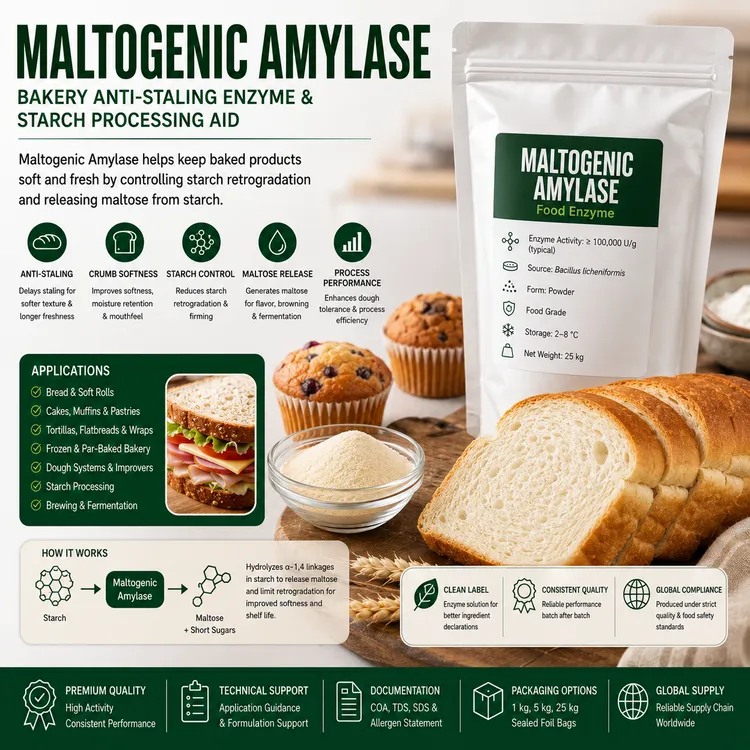
Product identity
| Product | Maltogenic Amylase |
|---|---|
| Other names | Maltogenic alpha-amylase; glucan 1,4-alpha-maltohydrolase; 1,4-alpha-D-glucan alpha-maltohydrolase |
| Category | Enzymes & Processing Aids |
| Function | Food enzyme / processing aid for manufacturing performance |
| Enzyme class | Starch-acting amylolytic enzyme; commonly associated with EC 3.2.1.133 depending on supplier identity |
| E / INS number | Confirm by destination market and supplier documentation |
| CAS / identity | Enzyme preparation; exact enzyme and production strain must be confirmed on supplier documentation |
| Typical source | Microbial fermentation-derived enzyme; source organism and production organism are supplier-specific |
| Typical form | Enzyme powder, granulate, coated granule, tablet, liquid preparation or bakery premix blend |
| Primary technical target | Controlled starch modification for bakery softness, shelf life, maltose release and texture management |
Application fit
Potential use areas may include:
- Bread, pan bread, sandwich bread, buns, rolls and soft bakery products
- Tortillas, flatbreads, wraps, steamed bread and flexible bakery systems
- Cakes, muffins, sponge products and batter-based baked goods
- Frozen dough, par-baked bread, bake-off products and chilled dough systems
- Bakery improvers, flour treatment blends and dry premixes
- Cereal processing, maltose generation and controlled starch hydrolysis
- Brewing and adjunct processing where starch conversion profile is relevant
- Long-shelf-life bakery programs requiring validated anti-staling performance
Technical overview
Maltogenic Amylase is a starch-modifying enzyme used to hydrolyze alpha-1,4 glucosidic linkages in starch-related substrates, producing a maltose-rich hydrolysis profile under suitable conditions. In bakery systems, the enzyme acts mainly on gelatinized starch during baking or heat processing, modifying amylose and amylopectin fragments in a way that can reduce crumb firming during storage.
Bakery staling is not simply drying. A major contributor is starch retrogradation, where gelatinized starch molecules gradually realign and recrystallize during storage, causing crumb hardening, loss of resilience and reduced eating quality. Maltogenic Amylase is therefore commonly selected as an anti-staling tool because it can alter starch structure and slow the rate at which crumb firmness develops.
Industrial performance depends on enzyme activity, thermal stability, pH optimum, substrate availability, flour quality, damaged starch level, sugar level, fat system, emulsifier system, proofing, baking temperature, internal crumb temperature, moisture content, packaging and storage conditions. The same enzyme grade may perform differently in white pan bread, tortillas, sweet buns, frozen dough and cake batters.
How Maltogenic Amylase creates value
Crumb softness retention
Helps slow crumb firming in bread and soft bakery products by modifying starch behavior during storage, supporting a softer eating profile over shelf life.
Anti-staling performance
Supports extended freshness in packaged bakery products, tortillas, buns and par-baked systems when dosage, baking profile and packaging are properly optimized.
Controlled maltose release
Generates maltose-rich fragments from starch, which can influence sweetness, fermentation support, crust colour and flavour development depending on the recipe.
Process flexibility
Can support industrial bakery programs by improving eating quality after distribution, freezing, thawing, reheating or extended ambient storage.
Application engineering guidance
| Application | Typical technical objective | Key formulation review points |
|---|---|---|
| Pan bread and sandwich bread | Maintain soft crumb, reduce firming, improve resilience and support consumer freshness perception. | Review flour strength, damaged starch, proofing, baking profile, emulsifiers, shortening, sugar, moisture, packaging and target shelf life. |
| Buns and rolls | Support soft bite, flexible crumb and shelf-life softness after packaging and distribution. | Validate dosage with sugar, fat, milk solids, dough conditioners, proof time, bun size, cooling and slicing conditions. |
| Tortillas and flatbreads | Improve flexibility, reduce cracking, delay firming and support rollability during storage. | Check flour, fat, gums, leavening, water activity, hot pressing, cooling, packaging, antimycotic system and reheating behavior. |
| Cakes and muffins | Support moist crumb, softness, resilience and extended eating quality. | Evaluate batter viscosity, sugar, fat, emulsifier, starch, egg solids, baking temperature, water activity and package oxygen/moisture control. |
| Frozen dough | Improve softness and eating quality after freeze-thaw and final bake-off. | Validate yeast survival, proofing tolerance, freezing rate, storage time, bake-off profile, enzyme carryover and final texture. |
| Par-baked and bake-off products | Support freshness after partial baking, frozen or chilled storage and final baking. | Review first-bake endpoint, internal temperature, enzyme activity window, freezing or chilling, final bake and retail shelf life. |
| Bakery premixes and improvers | Provide standardized enzyme activity within dry bakery blends. | Check carrier, dilution, blend uniformity, dust control, compatibility with oxidants, emulsifiers, other enzymes and shelf-life activity retention. |
| Starch processing and cereal systems | Generate maltose-rich syrups, dextrins or controlled starch hydrolysates where applicable. | Review substrate, pH, temperature, calcium requirement if applicable, reaction time, enzyme inactivation, DE target and downstream filtration. |
| Brewing and adjunct processing | Support fermentable sugar development or starch conversion profile in selected mash systems. | Validate with mash temperature, pH, cereal adjunct, endogenous malt enzymes, wort fermentability and final flavour profile. |
Mechanism and process factors
Maltogenic Amylase acts on starch-related substrates and can remove maltose units from starch chains under suitable conditions. In bakery systems, activity is usually most relevant after starch gelatinization begins, because gelatinized starch is more accessible to enzyme action than native starch granules. The enzyme's useful activity window is therefore tied to dough heating rate, internal crumb temperature and thermal stability of the specific enzyme grade.
Anti-staling performance is a balance. Too little activity may provide no measurable shelf-life improvement. Too much activity may create sticky crumb, gumminess, weak structure, poor slicing or excessive softness. The best dosage depends on product type, flour, process and target shelf life, and should be confirmed through texture analysis and sensory testing over the full commercial storage period.
| Process factor | Why it matters | Industrial control |
|---|---|---|
| Enzyme activity method | Activity units are not always comparable between suppliers. | Compare activity by supplier method and validate by application trial. |
| Thermal profile | Determines whether enzyme acts during dough heating and when it is inactivated. | Check optimum temperature, stability range, bake profile and crumb-core temperature. |
| pH range | Activity depends on product pH and dough or slurry conditions. | Validate in bread, sourdough, sweet dough, tortillas, cakes or starch slurries separately. |
| Flour damaged starch | Higher damaged starch can increase enzyme-accessible substrate. | Monitor flour specification and adjust improver system when flour changes. |
| Bake profile | Heating rate and final crumb temperature control enzyme action and inactivation. | Validate tunnel oven, rack oven, deck oven and par-bake processes separately. |
| Water activity and moisture | Influence crumb firming, enzyme effects and shelf-life texture. | Measure finished moisture, water activity and package moisture migration. |
| Packaging | Softness retention depends on moisture retention and storage environment. | Validate packaging film, cooling time, sealing, storage temperature and distribution abuse. |
Enzyme selection criteria
Food manufacturers should select Maltogenic Amylase according to application, not only price or declared activity. Bakery anti-staling grades are often optimized for action during baking and inactivation after the desired starch modification. Starch-processing grades may prioritize a different pH, temperature or maltose-generation profile. A liquid grade may be ideal for plant dosing systems, while a coated granule may be preferred for dry improver blends and dust reduction.
Bakery grade
- Optimized for crumb softness and shelf-life freshness
- Designed for dough or batter systems
- Validated by texture profile and sensory testing
- Often supplied in diluted or standardized bakery-improver form
Starch-processing grade
- Selected for maltose generation and controlled hydrolysis
- Requires pH, temperature and reaction-time control
- May require enzyme inactivation step
- Should be matched to substrate and DE or sugar profile target
Liquid preparation
- Useful for automated dosing and liquid improver systems
- Requires storage-temperature and preservative review
- May need agitation before dosing
- Check pump compatibility and dosage accuracy
Granulated or coated form
- Useful for dry premixes and flour improvers
- Can reduce dust exposure in production
- Improves handling and blend uniformity
- Carrier and anti-caking system must match label requirements
Specification and quality-control parameters
For industrial purchasing, Maltogenic Amylase should be compared by declared activity, test method, application performance and documentation. Enzyme activity units may vary by supplier method, substrate, pH, temperature and reporting basis, so direct numeric comparison can be misleading without application trials.
Identity and activity
- Product name and enzyme type
- Declared activity and activity unit definition
- Activity method, substrate, pH and temperature
- EC number or enzyme nomenclature where available
- Source organism and production organism statement
- Side activities such as alpha-amylase, protease or glucoamylase where relevant
Physical properties
- Appearance, colour and odour
- Powder, granulate, tablet or liquid form
- Particle size distribution for dry grades
- Bulk density and flowability
- Dusting potential and occupational handling guidance
- Carrier, diluent, stabilizer or preservative information
Performance properties
- Optimum pH and pH stability range
- Optimum temperature and thermal stability
- Recommended dosage range by application
- Inactivation conditions where available
- Bakery anti-staling data or texture-test results where available
- Compatibility with flour improvers, emulsifiers and other enzymes
Food safety controls
- Total plate count, yeast and mould
- Coliforms, E. coli, Salmonella and other specified pathogens where required
- Heavy metals and elemental impurities
- Mycotoxin or unwanted-metabolite statements where relevant to production organism
- Allergen and cross-contact declaration
- GMO, halal, kosher, vegan or vegetarian suitability where commercially required
Bakery trial design and validation
Bakery approval should include controlled trials at several dosages, compared against a blank control and the current commercial enzyme or improver if available. The trial should use production flour, actual process conditions and final packaging. Texture should be measured over the intended shelf life, not only on the day of baking.
| Validation area | Why it matters | Recommended review |
|---|---|---|
| Day-0 texture | Confirms the enzyme does not make the product too weak, sticky or gummy immediately after baking. | Check crumb firmness, resilience, slicing, chew and sensory profile after cooling. |
| Storage texture | Measures anti-staling effect over the commercial shelf life. | Run texture profile analysis or crumb firmness testing at day 1, 3, 5, 7 and target shelf life. |
| Crumb structure | Excessive enzyme activity can weaken cell walls or create sticky crumb. | Review crumb grain, gumminess, resilience, slicing and mechanical damage. |
| Moisture migration | Softness perception depends on moisture retention and redistribution. | Measure moisture, water activity, package humidity and crust-softening behavior. |
| Sensory quality | Consumers judge freshness by softness, aroma, bite and aftertaste. | Use trained panel or consumer comparison against approved standard. |
| Process robustness | Industrial lines vary in proof time, bake temperature and cooling. | Test across normal process variation and distribution temperature abuse. |
Compatibility with bakery ingredients
Maltogenic Amylase is usually used as part of a broader bakery improver system. It may be combined with emulsifiers, oxidants, xylanases, fungal alpha-amylase, lipases, proteases, glucose oxidase, hydrocolloids, reducing agents, ascorbic acid, monoglycerides, DATEM, SSL, enzymes and flour treatment agents where permitted. Each combination should be evaluated because enzymes can interact strongly in dough and baked crumb.
| Ingredient or condition | Possible interaction | Practical review |
|---|---|---|
| Alpha-amylase | Can increase dextrin formation and fermentable sugars. | Balance against stickiness, crust colour and crumb gumminess. |
| Xylanase | Can improve dough handling and loaf volume by modifying arabinoxylans. | Validate combined effect on dough tolerance, volume and crumb softness. |
| Emulsifiers | Can support softness and crumb structure alongside anti-staling enzymes. | Review with monoglycerides, DATEM, SSL or enzyme-based emulsifier replacement systems. |
| Fats and oils | Influence starch-protein structure, softness and mouthfeel. | Validate in low-fat, high-fat, laminated and enriched dough systems separately. |
| Sugars and syrups | Affect water activity, yeast fermentation, browning and enzyme-accessible starch. | Check sweetness, crust colour, stickiness and shelf-life texture. |
| Preservatives | Can affect yeast activity and finished-product shelf life but not usually enzyme activity directly. | Review calcium propionate, sorbates, vinegar systems and clean-label antimycotics where permitted. |
| Frozen storage | Changes yeast activity, dough structure and final crumb softness. | Run frozen dough trials over the actual frozen shelf life. |
Processing and handling notes
Dry enzyme products should be handled carefully to reduce dust exposure. Enzymes are proteins and may cause respiratory sensitization in occupational settings if inhaled repeatedly. Granulated or coated grades can reduce dusting risk, but production teams should still follow supplier safety guidance, ventilation recommendations and personal protective equipment procedures.
Liquid enzyme products require attention to storage temperature, microbial preservation, agitation, dosing accuracy and shelf-life activity retention. Frozen or chilled enzyme preparations should be transported and stored according to supplier instructions. Enzyme activity may decline if material is exposed to heat, moisture, incompatible pH or extended storage beyond recommended conditions.
Regulatory and labeling review
Maltogenic Amylase is typically reviewed as a food enzyme or processing aid, but regulatory treatment depends on destination market, production organism, manufacturing process, enzyme activity, food category and whether the enzyme remains active or technically functional in the finished product. Some markets require specific food-enzyme approvals, production-strain documentation or processing-aid declarations.
Label declarations vary by jurisdiction. Depending on local rules and the finished food, the enzyme may be declared as “enzyme,” “amylase,” “maltogenic amylase,” “processing aid,” or may not require declaration if it qualifies as a processing aid. Buyers should verify the correct label wording and whether the supplier's production organism, carrier and any processing aids are acceptable in the target market.
Special attention is required for non-GMO positioning, organic certification, halal, kosher, vegan claims, allergen declarations, and “clean label” statements. Enzyme production by microbial fermentation can involve complex upstream processing, so buyer approval should include full documentation, not only a generic product name.
Industrial purchasing notes
When reviewing Maltogenic Amylase, compare the supplier specification against the intended application, process conditions, target softness, label expectations and local rules. For industrial purchasing, the most useful inquiry normally includes target enzyme activity, activity method, application, dosage range, physical form, carrier, packaging size, quantity, destination and required documents.
| Purchasing factor | Why it matters |
|---|---|
| Declared activity and method | Activity units are supplier-specific and may not be directly interchangeable. |
| Thermal stability | Determines the activity window during baking, starch gelatinization and enzyme inactivation. |
| Source organism | Affects regulatory review, GMO declaration, allergen assessment and customer acceptance. |
| Side activities | Unwanted protease, glucoamylase or other activities can change dough and finished texture. |
| Carrier and dilution system | Important for label review, allergen status, premix uniformity, dusting and dosage accuracy. |
| Physical form | Liquid, powder, granule and coated grades differ in dosing, storage and worker exposure. |
| Application data | Bakery trials, crumb-firmness data and shelf-life studies reduce formulation risk. |
| Documentation package | Complete food-enzyme, allergen, GMO, halal, kosher, microbiology and regulatory documents reduce approval delays. |
Documents to request
- Product specification or technical data sheet with enzyme identity and intended applications
- Certificate of analysis for available batch or lot
- Declared activity, activity unit definition and analytical method
- EC number or enzyme nomenclature statement where available
- Source organism, production organism and production-strain declaration
- Food-enzyme regulatory statement for the destination market
- Recommended dosage range by application
- Thermal stability, pH profile and inactivation information where available
- Side activity statement, including alpha-amylase, glucoamylase, protease or lipase where relevant
- Carrier, diluent, stabilizer, preservative and anti-caking information
- Safety data sheet where applicable
- Allergen, gluten, GMO, irradiation and nanomaterial statements where required
- Halal, kosher, vegan or vegetarian suitability documents where commercially required
- Microbiological limits and pathogen absence statement
- Heavy metals and contaminant limits
- Mycotoxin or unwanted metabolite statement where relevant to production organism
- Shelf-life, storage condition and temperature-excursion guidance
- Packaging details, net weight, inner liner, pallet configuration and batch coding
- Label declaration guidance and market-specific compliance statement
- Application trial data, bakery shelf-life data or troubleshooting guide where available
How to request this product
Send the product name, target application, desired enzyme activity or reference specification, physical form, dosage target, quantity, destination country, packaging preference, expected shipment date and required documents. If you already purchase Maltogenic Amylase, attach or describe your existing supplier grade, activity unit, certificate of analysis, formulation, dosage and target shelf-life result so supplier options can be compared more accurately.
For faster technical review, include the final product type, flour specification, process temperature, bake profile, target shelf life, packaging format, crumb-softness target, other enzymes in the formula, improver system, required certifications, preferred non-GMO or fermentation status, annual consumption estimate and whether you need a laboratory sample, pilot quantity or commercial shipment.
Useful answers
What is Maltogenic Amylase used for in food manufacturing?
Maltogenic Amylase is used as a food enzyme for controlled starch modification, bakery anti-staling, crumb-softness retention, maltose release, dough and batter optimization, cereal processing, starch conversion and selected brewing applications. It is especially important in packaged bakery products where shelf-life softness is a key quality target.
How does Maltogenic Amylase help bread stay soft?
It modifies gelatinized starch during baking and can reduce the rate of crumb firming during storage. The effect depends on flour, recipe, baking profile, dosage, enzyme stability, packaging and storage temperature.
Is Maltogenic Amylase the same as alpha-amylase?
No. Maltogenic Amylase is a specific amylolytic enzyme with a maltose-producing action pattern, while standard alpha-amylase products may have different hydrolysis behavior, temperature stability and dough effects. Supplier identity and activity method should be confirmed.
Can Maltogenic Amylase be overdosed?
Yes. Excess activity may cause sticky crumb, gummy texture, weak slicing, excessive softness, sweetness changes or poor eating quality. Dosage should be optimized with real bakery trials and shelf-life testing.
Can Global Food Additives source Maltogenic Amylase?
Global Food Additives can review sourcing options for Maltogenic Amylase according to target application, enzyme activity, activity method, source organism, physical form, quantity, destination, packaging and required documentation.
Which documents should be requested?
Buyers commonly request a technical data sheet, product specification, certificate of analysis, declared activity and method, source organism statement, food-enzyme regulatory declaration, safety data sheet where applicable, allergen declaration, GMO declaration, microbiological limits, shelf-life information and packing details.
Is Maltogenic Amylase permitted in every country?
No. Food enzyme use depends on destination-market rules, production organism, food category, processing-aid status, label requirements and buyer responsibility. Final regulatory suitability should be verified before commercial use.
What should be checked before switching Maltogenic Amylase suppliers?
Check declared activity, activity method, source organism, production organism, thermal stability, pH profile, side activities, carrier, allergen status, GMO status, microbiological limits, regulatory documents, shelf life and finished-product performance.
Tell us which food additive or ingredient you need.
Send product names, target specifications, quantity, destination country, packaging preference, delivery term and document requirements. For Maltogenic Amylase, please also include the bakery or starch application, target enzyme activity, source-organism requirement, preferred physical form, dosage target, process temperature and required certificates. Our team will review your inquiry and respond from orders@foodgradeadditives.com.
Your message has been received. You will be redirected to the home page.