
Milk Protein Concentrate
Milk Protein Concentrate, commonly known as MPC, is a food-grade dairy protein ingredient used for protein enrichment, dairy solids standardization, texture development, emulsification, foaming, gelation, water binding and nutritional formulation. It is valued in industrial food manufacturing because it delivers both casein and whey proteins in a milk-derived protein system while reducing lactose relative to standard milk solids as protein concentration increases.
MPC is not a single universal ingredient. Commercial grades vary by protein content, lactose content, mineral profile, heat treatment, solubility, hydration behavior, flavor, microbiological quality and application performance. Industrial buyers should specify the required protein grade, application, processing conditions, target label declaration and destination-market documentation before comparing quotations.
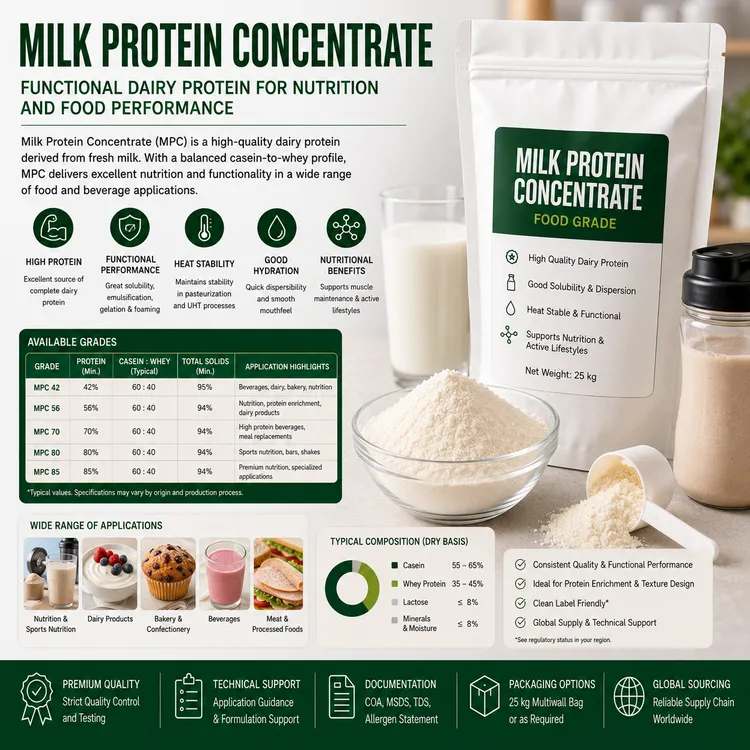
Product identity
| Product | Milk Protein Concentrate |
|---|---|
| Common abbreviation | MPC |
| Category | Proteins, Texturizers & Functional Ingredients |
| Primary function | Dairy protein ingredient for protein enrichment, texture design, water binding, gelation, emulsification, foaming and dairy solids standardization |
| Typical grades | MPC 42, MPC 56, MPC 70, MPC 80, MPC 85 and supplier-specific protein grades |
| E / INS number | Normally handled as a dairy ingredient rather than a universal E-number additive; confirm by destination market and supplier documentation |
| CAS / identity | Dairy protein ingredient derived from milk |
| Protein system | Contains casein and whey proteins in a milk-derived ratio, subject to processing method and grade |
| Typical form | Spray-dried powder, agglomerated instant powder or customized dry blend |
| Key purchasing basis | Protein on dry basis, lactose, fat, ash, moisture, solubility, heat stability, flavor, microbiology, origin, allergen status and documentation |
Application fit
Potential use areas may include:
- High-protein beverages, ready-to-drink shakes and dairy-based drinks
- Nutrition powders, sports nutrition, medical nutrition and meal replacement products
- Yogurt, fermented dairy, dairy desserts, puddings and cream systems
- Cheese systems, processed cheese, recombined dairy products and dairy solids standardization
- Bakery, confectionery, fillings, protein bars and cereal applications
- Meat products, processed meats and hybrid animal / dairy protein systems
- Ice cream, frozen desserts and aerated dairy systems
Technical profile for manufacturers
Milk Protein Concentrate is typically produced by concentrating milk proteins while removing part of the water, lactose and minerals. Ultrafiltration and diafiltration are commonly associated with MPC production because membrane separation can retain larger protein structures while allowing smaller molecules such as water, lactose and soluble minerals to pass through. The concentrated stream is then commonly evaporated and spray dried into a powder.
The functional value of MPC comes from its complete dairy protein system. Casein contributes water binding, structure, heat-stable micellar behavior, viscosity and gelation potential. Whey proteins contribute nutritional quality, emulsification, foaming, heat-set gelation and interactions with other proteins during processing. The balance of these components makes MPC useful in high-protein dairy foods, beverage systems, powders, bars, cheese applications and texture-building formulations.
| Technical factor | Industrial relevance |
|---|---|
| Protein content | Defines grade, nutritional contribution, cost-in-use and dosage. Higher-protein MPC normally contains lower lactose and higher protein density. |
| Casein-to-whey profile | Influences viscosity, gelation, heat response, mouthfeel, emulsification, foaming and cheese functionality. |
| Lactose content | Important for low-lactose positioning, Maillard browning risk, sweetness, carbohydrate labeling, caking behavior and nutritional calculations. |
| Mineral / ash content | Affects flavor, buffering capacity, heat stability, hydration, pH behavior, protein interactions and beverage stability. |
| Solubility and dispersibility | Critical for ready-to-drink beverages, instant powders, nutrition shakes and high-protein systems where sediment or lumping is unacceptable. |
| Heat stability | Important for UHT beverages, retorted nutrition products, hot-filled systems, dairy desserts and processed cheese applications. |
| Hydration behavior | Higher-protein MPC grades can hydrate slowly. Poor hydration may cause graininess, sediment, viscosity drift or processing inconsistency. |
| Flavor profile | MPC should normally provide a clean dairy flavor. Cooked, oxidized, stale, cheesy or animal notes can affect premium applications. |
| Microbiological quality | Critical for infant, medical, nutrition, beverage and dairy applications. Spore levels may matter in heat-treated products. |
| Allergen status | Milk protein is a major allergen in many markets and must be managed through labeling, segregation and documentation. |
Common commercial MPC grades
Commercial MPC grades are often identified by approximate protein percentage. Exact composition varies by supplier, processing method and specification. Buyers should compare protein on a dry basis, lactose, fat, ash, moisture, solubility, microbiology and sensory quality before approval.
| Grade family | Typical purchasing logic | Common application direction |
|---|---|---|
| MPC 42 | Moderate protein concentration with higher lactose and dairy solids contribution. | Dairy standardization, bakery, desserts, recombined dairy, cheese systems and cost-sensitive protein enrichment. |
| MPC 56 | Mid-range protein grade balancing functionality, dairy solids and price. | Yogurts, dairy desserts, beverages, processed cheese, sauces and nutrition blends. |
| MPC 70 | Higher protein density with lower lactose than lower-grade MPCs. | High-protein beverages, nutrition powders, bars, dairy systems and protein-fortified foods. |
| MPC 80 | High-protein grade often selected when protein density and lactose reduction are important. | Sports nutrition, medical nutrition, high-protein dairy drinks, RTD shakes, dry mixes and premium protein products. |
| MPC 85 | Very high protein concentration requiring careful hydration and solubility evaluation. | High-protein nutrition systems, low-carbohydrate dairy formulations, specialized powders and protein-dense applications. |
| Instantized / agglomerated MPC | Improved wetting and dispersion compared with standard powder. | Retail protein powders, instant drinks, dry blends, sachets and applications requiring rapid reconstitution. |
| Heat-stable or application-specific MPC | Supplier-developed grade designed for process tolerance. | UHT beverages, retort nutrition, processed cheese, high-protein dairy drinks and demanding thermal processes. |
Functional roles in food systems
MPC can contribute both nutritional protein and functional structure. Depending on grade and processing conditions, it can influence viscosity, body, opacity, water retention, emulsion stability, aeration, gel formation, heat stability and eating quality. Formulators should evaluate MPC as an active protein system, not only as a protein number on a nutrition panel.
| Functional role | What MPC can support | Typical evaluation method |
|---|---|---|
| Protein enrichment | Raises protein content in beverages, yogurts, powders, bars, desserts and nutrition products. | Protein assay, nutrition calculation, serving claim review and sensory evaluation. |
| Water binding | Improves moisture retention, body, reduced syneresis and texture stability. | Centrifuge test, syneresis measurement, water activity, texture analysis and storage trial. |
| Gelation | Supports heat-set or acid-induced protein network formation in dairy and dessert systems. | Gel strength, viscosity curve, pH profile, thermal process trial and sensory texture. |
| Emulsification | Helps stabilize fat droplets in dairy drinks, sauces, meat emulsions and high-protein systems. | Droplet size, creaming, oil separation, viscosity, heat stability and shelf-life testing. |
| Foaming and aeration | Contributes to air incorporation and foam stabilization in whipped desserts, ice cream and aerated systems. | Overrun, foam stability, meltdown test, density and storage behavior. |
| Dairy solids standardization | Adjusts protein-to-solids balance in cheese, yogurt, recombined dairy and fermented products. | Yield, fermentation behavior, texture, whey-off, pH development and finished composition. |
| Mouthfeel and body | Builds creamy texture, opacity and fullness in reduced-fat or high-protein dairy systems. | Sensory panel, rheology, viscosity, texture analyzer and consumer-style application trial. |
Application guidance by industry
High-protein beverages and RTD shakes
In ready-to-drink beverages, MPC can provide dairy protein enrichment with a clean flavor and creamy mouthfeel. The main technical challenge is maintaining solubility, heat stability, low sediment, stable viscosity and acceptable flavor after pasteurization, UHT processing or retort treatment.
- Key requirements: hydration, heat stability, low sediment, low viscosity drift, clean dairy flavor and stable pH.
- Common partners: stabilizing salts, carrageenan, cellulose gum, pectin, phosphates, flavors, sweeteners and mineral systems.
- Critical tests: UHT / retort trial, sediment, gelation, age thickening, protein stability, flavor stability and shelf-life viscosity.
Nutrition powders and sports nutrition
In protein powders, MPC contributes high-quality dairy protein, slow and fast protein fractions, creamy mouthfeel and dairy taste. Instantized or agglomerated MPC may be preferred where fast wetting and easy shaker-cup dispersion are required.
- Key requirements: protein density, instant dispersibility, low foam where required, neutral flavor and low caking.
- Common partners: whey protein, caseinate, cocoa, flavors, sweeteners, lecithin, vitamins, minerals and anti-caking systems.
- Critical tests: wettability, dispersibility, sediment, powder flow, bulk density, flavor, caking and finished nutrition compliance.
Yogurt, fermented dairy and dairy desserts
In yogurt and fermented dairy, MPC can increase protein, improve body, reduce whey separation and support a thicker, creamier texture. Fermentation behavior must be checked because protein concentration, buffering capacity and mineral profile can affect acidification rate and final texture.
- Key requirements: smooth hydration, low graininess, fermentation compatibility, body, syneresis control and clean flavor.
- Common partners: skim milk powder, whey protein, starch, pectin, gelatin, cultures, stabilizers and sweetener systems.
- Critical tests: fermentation curve, pH endpoint, viscosity, whey-off, spoonability, graininess and shelf-life texture.
Cheese, processed cheese and recombined dairy
MPC can be used to standardize protein, improve yield, adjust casein content and support texture in cheese and recombined dairy systems. Grade selection should consider mineral balance, casein functionality, hydration, heat treatment and compatibility with emulsifying salts.
- Key requirements: casein functionality, melt behavior, stretch, sliceability, yield, water binding and flavor neutrality.
- Common partners: emulsifying salts, milk fat, butter, whey proteins, caseinates, cultures, enzymes and stabilizers.
- Critical tests: melt, firmness, shred, slice, oiling-off, stretch, pH, moisture, yield and storage texture.
Bakery, confectionery and protein bars
In bakery and confectionery, MPC can support protein enrichment, browning, structure, moisture control and dairy flavor. In protein bars, it can contribute nutritional value and texture, but high-protein systems require careful control of water activity, hardening, sweetness, fat phase and humectants.
- Key requirements: protein claim support, flavor, browning control, bar softness, water activity and texture stability.
- Common partners: whey proteins, collagen, fibers, polyols, syrups, fats, cocoa, flavors, humectants and emulsifiers.
- Critical tests: bake stability, Maillard browning, bar hardening, water activity, sensory texture and shelf-life firmness.
Meat systems and hybrid protein foods
MPC can provide water binding, emulsification and protein enrichment in selected meat, poultry, seafood or hybrid protein systems. Because MPC is dairy-derived, it changes allergen status and may not be suitable for products positioned as dairy-free or vegan.
- Key requirements: water binding, emulsion stability, cook yield, texture, neutral flavor and allergen management.
- Common partners: meat proteins, soy or pea proteins, phosphates, starches, fibers, hydrocolloids, salts and fats.
- Critical tests: cook yield, purge, sliceability, bite, emulsion stability, freeze-thaw behavior and label review.
Specification checklist for purchasing
For industrial sourcing, MPC quotations should be compared by composition, function and documentation. A lower price per kilogram may not be economical if the grade hydrates poorly, creates sediment, fails heat stability, carries unwanted flavor, has high microbiological risk or lacks required dairy import documentation.
| Specification area | Recommended buyer requirement |
|---|---|
| Protein content | Request protein percentage, dry-basis calculation, analytical method and tolerance. Confirm whether the grade is MPC 42, 56, 70, 80, 85 or another specification. |
| Moisture | Important for shelf life, caking, microbial stability, powder flow and commercial comparison. |
| Lactose | Request lactose level for carbohydrate labeling, low-lactose positioning, Maillard browning risk and product stability. |
| Fat | Confirm fat content because it affects nutrition, oxidation risk, flavor, powder stability and formulation calculations. |
| Ash / minerals | Relevant for heat stability, buffering, flavor, mineral labeling, pH behavior and beverage performance. |
| pH and titratable acidity | Useful for dairy systems, beverages, fermented products and protein stability review. |
| Solubility / dispersibility | Request solubility index, dispersibility method, wettability and recommended hydration conditions, especially for high-protein drinks and powders. |
| Heat stability | Define required performance under pasteurization, UHT, retort, hot fill or cooking conditions. |
| Microbiology | Total plate count, coliforms, yeast and mold, E. coli, Salmonella, Staphylococcus aureus, Bacillus spores and thermophilic spores where relevant. |
| Contaminants | Heavy metals, antibiotic residues, melamine statement, dioxin / PCB statement, pesticide residues where required and other market-specific requirements. |
| Allergen status | Milk allergen declaration is mandatory in many markets. Confirm cross-contact with soy, gluten, egg, nuts or other allergens when required. |
| Origin and dairy status | Request country of origin, manufacturing site, species source, veterinary health documents and dairy export eligibility for the destination market. |
| Certifications | Halal, kosher, ISO, FSSC 22000, BRCGS, non-GMO, organic suitability or other certificates depending on buyer and market. |
| Packaging and shelf life | Bag type, liner, net weight, pallet configuration, shelf life, storage conditions and moisture protection. |
Hydration and processing guidance
MPC powders, especially high-protein grades, can hydrate more slowly than lower-protein dairy powders. Hydration behavior depends on particle size, heat history, mineral balance, protein concentration, agglomeration, storage age and mixing conditions. Poor hydration may appear as sediment, lumping, sandy mouthfeel, delayed viscosity increase or inconsistent heat stability.
Recommended hydration protocol
- Use the supplier's recommended water temperature and mixing method as the starting point.
- Add powder gradually into a strong vortex to reduce lump formation.
- Allow sufficient hydration time before heat treatment or homogenization.
- Control pH, mineral salts and stabilizers before final thermal processing.
- Measure viscosity after hydration and again after heat treatment and storage.
- For RTD beverages, confirm stability through pilot-scale heat processing before commercial approval.
Common processing issues
- Lumping or floating powder during hydration
- Incomplete protein hydration causing sediment
- Age thickening in high-protein beverages
- Heat-induced gelation or coagulation during UHT or retort processing
- Grainy mouthfeel in yogurt, dessert or beverage systems
- Excessive viscosity at high protein concentration
- Maillard browning in heat-treated systems containing lactose and reducing sugars
- Flavor instability caused by oxidation or poor storage conditions
Heat stability, pH and mineral balance
High-protein dairy systems are sensitive to pH, calcium activity, phosphate balance, stabilizing salts, heat treatment and total solids. MPC may perform very differently in neutral pH beverages, acidified drinks, fermented dairy, processed cheese and retorted nutrition products. Formulators should test the exact grade in the final process instead of assuming interchangeability between MPC suppliers.
| Process factor | Why it matters |
|---|---|
| pH | Protein charge and stability change with pH. Acidic systems may require different stabilizers or protein strategies than neutral beverages. |
| Calcium and minerals | Mineral balance affects protein interactions, heat stability, viscosity, gelation and sediment risk. |
| Heat treatment | Pasteurization, UHT, retort and hot-fill conditions can affect protein aggregation, cooked flavor and viscosity. |
| Homogenization | Can improve fat dispersion and mouthfeel but may change protein interactions and viscosity. |
| Total solids | High solids increase viscosity and can intensify hydration, heat stability and processing challenges. |
| Stabilizer system | Hydrocolloids, phosphates, citrates and emulsifiers should be selected based on protein level, pH and heat process. |
| Storage temperature | Can influence viscosity drift, sediment, flavor stability, microbial control and shelf-life performance. |
Regulatory, allergen and labeling considerations
MPC is a milk-derived protein ingredient. It should be handled as a milk allergen wherever applicable. It is not suitable for vegan or dairy-free products. If the ingredient is used in plant-forward, hybrid, sports nutrition or protein-fortified products, the label declaration, allergen statement, protein claim, dairy claim, lactose claim and origin claim should be reviewed according to destination-market rules.
| Regulatory question | Buyer action |
|---|---|
| How should the ingredient be declared? | Request supplier label recommendation and verify whether the local declaration is “milk protein concentrate,” “milk protein,” “dairy protein” or another permitted term. |
| Does it trigger allergen labeling? | Yes, in many markets milk is a regulated allergen. Confirm local allergen wording, bolding and cross-contact requirements. |
| Can protein claims be made? | Protein claims depend on finished-product protein content, serving size, quality method and local nutrition labeling rules. |
| Can lactose claims be made? | Do not assume lactose-free or low-lactose status. Request lactose specification and verify destination-market claim thresholds. |
| Are dairy import documents needed? | Many countries require health certificates, veterinary documents, origin documents or establishment approval for dairy ingredients. |
| Is halal or kosher required? | Certification must match the exact grade, manufacturing site and supply chain. |
Quality, safety and compliance documents to request
- Product specification or technical data sheet with protein grade and composition
- Certificate of analysis for available batch or representative lot
- Food-grade declaration and destination-market compliance statement
- Safety data sheet where applicable for handling, storage and transport review
- Nutrition data including protein, lactose, fat, ash, moisture and energy values
- Milk allergen declaration and cross-contact statement
- Country of origin, manufacturing site information and traceability documentation
- Veterinary health certificate, dairy export certificate or sanitary certificate where required
- Microbiological specification and lot-specific microbiological results
- Antibiotic residue statement, melamine statement and contaminant declarations where required
- Halal, kosher, non-GMO, organic suitability or other certificates when required
- Shelf-life statement, storage conditions and retest policy
- Packaging details, net weight, gross weight, pallet configuration and container loading information
- Recommended label declaration and application-specific processing guidance
Packaging, storage and handling
Milk Protein Concentrate is normally supplied as a spray-dried powder in food-grade multiwall bags with inner liners, cartons, drums or big bags depending on supplier and volume. MPC should be protected from moisture, oxygen exposure, heat, direct sunlight, strong odors and pest contamination. Because dairy powders can absorb moisture and develop caking or flavor deterioration, warehouse control is a critical part of quality management.
| Common packaging | Typically 20 kg or 25 kg bags; smaller packs, cartons, drums or big bags may be available depending on grade and supplier. |
|---|---|
| Storage conditions | Store sealed in a cool, dry, clean and odor-free warehouse. Follow supplier recommendations for temperature and relative humidity. |
| Moisture control | Protect from humidity to reduce caking, lactose crystallization, lumping and reduced dispersibility. |
| Odor control | Dairy powders can absorb odors; keep away from spices, chemicals, solvents and strongly aromatic materials. |
| Shelf life | Supplier-specific. Request shelf-life statement, retest policy and storage condition limits before order confirmation. |
| Handling | Use hygienic powder handling, dust control and allergen segregation for milk-containing ingredients. |
| Logistics | Confirm HS code, origin, dairy certificate needs, pallet configuration, container loading and destination import requirements. |
Technical purchasing notes
When reviewing Milk Protein Concentrate, compare the supplier specification against the intended food application, process conditions, target protein level, label expectations and local rules. For industrial purchasing, the most useful inquiry normally includes target MPC grade, protein content, application, heat process, solubility requirement, packaging size, quantity, destination and document requirements.
Cost comparison should be based on cost-in-use and finished-product performance rather than price per kilogram alone. A higher-priced grade may be more economical if it hydrates faster, reduces sediment, improves heat stability, provides cleaner flavor, supports higher protein claims or prevents production losses during scale-up.
How to request this product
Send the product name, target MPC grade, protein percentage, application, target function, quantity, destination country, packaging preference, expected shipment date and required documents. If you already purchase Milk Protein Concentrate, attach or describe your existing specification, certificate of analysis, nutrition target, label declaration, processing conditions or trial result so supplier options can be compared more accurately.
Recommended RFQ information
- Product name: Milk Protein Concentrate / MPC
- Target grade: MPC 42, MPC 56, MPC 70, MPC 80, MPC 85 or supplier-specific grade
- Required function: protein enrichment, heat stability, gelation, water binding, emulsification, foaming, dairy standardization or texture building
- Application: beverage, yogurt, cheese, dairy dessert, powder, protein bar, bakery, confectionery, meat system or other use
- Processing conditions: hydration temperature, pasteurization, UHT, retort, fermentation, homogenization, baking, freezing or pH range
- Composition requirements: protein, lactose, fat, ash, moisture, pH, solubility and microbiological limits
- Label requirements: milk allergen wording, protein claim, lactose claim, halal, kosher, non-GMO or origin claim
- Quantity: sample quantity, first commercial order and annual forecast
- Destination: country, port, incoterm and dairy import documents required
- Packaging: bag size, big bag requirement, pallet format or warehouse handling preference
- Documentation: TDS, COA, food-grade declaration, allergen, origin, health certificate, microbiology, contaminant statements, halal, kosher, shelf life and packaging details
- Commercial requirement: target price basis, shipment date, payment term and preferred delivery schedule
Useful answers
What is Milk Protein Concentrate used for in food manufacturing?
Milk Protein Concentrate is used for protein enrichment, texture design, water binding, gelation, emulsification, foaming, dairy solids standardization and clean-label dairy protein formulation. Exact suitability depends on grade, application, process, regulations and supplier documents.
Is Milk Protein Concentrate plant-based or dairy-free?
No. Milk Protein Concentrate is derived from milk and contains milk protein. It is not vegan, plant-based or dairy-free. If used in hybrid foods, milk allergen labeling and dairy claim rules must be checked before commercial launch.
Which MPC grade should I request?
The correct grade depends on the product and process. Lower-protein grades may be suitable for dairy solids standardization and cost-sensitive foods. Higher-protein grades such as MPC 70, MPC 80 or MPC 85 are often evaluated for high-protein beverages, powders and nutrition products, but they require careful hydration and heat stability testing.
Can Global Food Additives source Milk Protein Concentrate?
Global Food Additives can review sourcing options for Milk Protein Concentrate according to target protein grade, application, origin, quantity, destination, packaging and required documentation.
Which documents should be requested?
Buyers commonly request a technical data sheet, product specification, certificate of analysis, food-grade declaration, allergen statement, origin statement, dairy health certificate where required, microbiological results, nutritional information, shelf-life information, label recommendation and packaging details.
Is this product permitted in every country?
No. Dairy ingredient use depends on destination-market rules, food category, allergen labeling, protein claims, import documentation and buyer responsibility. Buyers should verify regulatory status and final suitability before commercial use.
Tell us which food additive or ingredient you need.
Send product names, target specifications, quantity, destination country, packaging preference, delivery term, and document requirements. Our team will review your inquiry and respond from orders@foodgradeadditives.com.
Your message has been received. You will be redirected to the home page.