
Nitrous Oxide E942
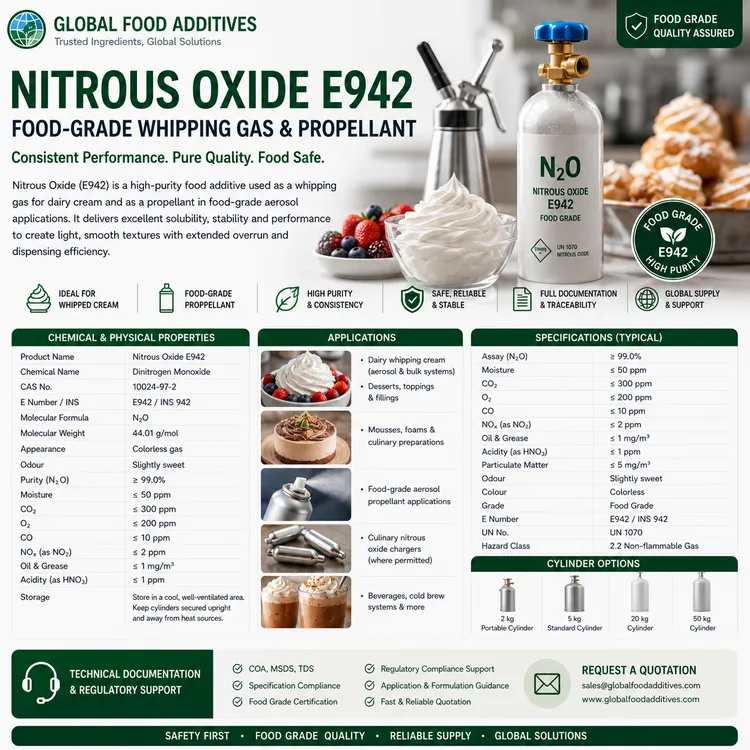
Nitrous Oxide is a food-grade gas used primarily as a whipping gas and aerosol propellant in suitable food applications such as whipped cream, dessert toppings, culinary foams and pressurized dispensing systems. This page is prepared as an industrial sourcing and specification-review guide for food manufacturers, distributors, dairy processors, hospitality suppliers and packaging teams that need food-grade Nitrous Oxide E942 with correct purity, cylinder format, valve compatibility, safety documentation and destination-market compliance.
Product identity
| Product | Nitrous Oxide |
|---|---|
| Common names | Nitrous Oxide E942, N2O, food-grade nitrous oxide, whipping gas, cream propellant |
| Category | Packaging Gases & Beverage Gases |
| Function | Whipping gas, aerosol propellant and food dispensing gas |
| E / INS number | E942 |
| CAS / identity | 10024-97-2 |
| Chemical formula | N2O |
| Typical form | Liquefied compressed gas in cartridges, cylinders, cylinder bundles or bulk supply |
| Typical use format | Pressurized cream systems, food aerosol systems, foam dispensers and industrial dispensing lines where legally permitted |
| Procurement focus | Food-grade status, purity, impurity limits, cylinder traceability, valve compatibility, SDS, transport compliance and misuse-prevention controls |
Application fit
Potential food-use review areas may include:
- Whipped cream and dairy cream dispensing systems
- Sweet cream toppings and dessert aeration
- Culinary foams and controlled food-service dispensing
- Food aerosol propellant applications where permitted
- Industrial filling of approved cream chargers or food gas cartridges
- Specialty bakery, pastry and confectionery topping systems
- Hospitality, catering and dairy-processing supply chains
Industrial role in food applications
Nitrous Oxide E942 is most often selected for pressurized whipping and food aerosol applications. In cream systems, the gas dissolves into the fat-containing liquid under pressure. When the valve is opened, the pressure drop releases gas bubbles and creates foam structure. This makes Nitrous Oxide technically different from common modified-atmosphere gases such as nitrogen and carbon dioxide. It is usually evaluated for solubility, expansion, foam texture, dispensing consistency, valve performance, flavor neutrality, food-grade compliance and cylinder safety.
Functional performance in cream and foam systems
The performance of Nitrous Oxide depends on how the gas interacts with fat, protein, emulsifiers, stabilizers, pressure, temperature and dispensing hardware. In whipped cream, good performance requires suitable cream fat content, correct temperature, clean valves, stable emulsification, compatible stabilizers and controlled gas dose. Poor results may come from warm product, low fat, excessive stabilizer, poor filling accuracy, blocked nozzles, incorrect cartridge size, leaking seals or unsuitable cylinder pressure.
Whipping and aeration
Nitrous Oxide supports foam formation by dissolving into the cream phase under pressure and expanding during dispensing. The resulting texture depends on cream composition, gas dose and dispensing equipment.
- Supports volume expansion in whipped cream systems
- Helps create smooth, fine foam when the formulation is balanced
- Requires chilled product for best foam stability
- Should be validated with the exact dispenser, valve and nozzle
Flavor neutrality
Food-grade Nitrous Oxide is selected partly because it can provide dispensing performance without adding acidic carbonation notes. It should be compared for odor, taste neutrality and impurity profile before production approval.
- Important for dairy cream, sweet toppings and delicate desserts
- Gas impurities can affect sensory quality
- Supplier specification should include relevant impurity limits
- Finished product should be tested after storage and dispensing
Pressure and dispensing control
Dispensing quality depends on correct pressure, fill weight, cartridge or cylinder size, regulator setting, valve design and product temperature. Factory trials should define acceptable output rate, overrun and foam collapse limits.
- Confirm cylinder pressure and regulator compatibility
- Check valve connection and thread standard
- Measure output consistency across the full pack life
- Monitor leakage, seal integrity and residual gas
Food safety and hygiene
Nitrous Oxide does not replace hygienic manufacturing, refrigeration or shelf-life validation. Cream and dairy systems still require microbiological control, sanitation, cold-chain management and validated shelf life.
- Maintain clean filling and dispensing equipment
- Control product temperature before and after filling
- Validate shelf life under real distribution conditions
- Follow HACCP controls for dairy and ready-to-eat products
Application guidance by use case
| Use case | Technical objective | Key evaluation points |
|---|---|---|
| Whipped cream dispensers | Generate smooth foam, controlled expansion and consistent dispensing | Cream fat, temperature, stabilizer system, cartridge size, dispenser volume, valve seal, nozzle design and storage time |
| Industrial cream aerosol filling | Fill pressurized dairy or dessert topping cans with correct propellant dose | Gas purity, pressure control, can rating, valve crimping, fill accuracy, leak testing, microbiology and shelf-life validation |
| Pastry and dessert production | Controlled foam output for dessert service or filling applications | Foam stability, collapse time, sensory quality, product temperature, hygiene and service conditions |
| Food-service cartridges | Small-format gas supply for approved culinary dispensers | Cartridge net fill, food-grade declaration, compatibility, labeling, local restrictions and misuse-prevention controls |
| Bulk or cylinder supply | Support larger filling operations or industrial dispensing systems | Cylinder size, valve standard, regulator compatibility, delivery frequency, hazardous goods documentation and site safety controls |
| Food aerosol systems | Propel approved food products from pressurized packaging | Can compatibility, product viscosity, emulsion stability, propellant dose, nozzle spray pattern, temperature exposure and regulations |
Specification review points for buyers
Industrial buyers should evaluate Nitrous Oxide by more than product name and price. The most useful comparison includes food-grade status, purity, impurity limits, cylinder format, fill quantity, valve standard, certificate type, transport classification, shelf-life or retest date, regulatory declaration and supplier quality system. For food applications, buyers should also confirm that the gas grade is intended for food use, not industrial, medical, automotive or technical non-food use.
| Review area | What to check |
|---|---|
| Food-grade status | Request a food-grade declaration, E942 statement or food gas compliance document suitable for the destination market. |
| Purity | Confirm minimum N2O purity and test method. Compare against customer specification and local food-gas expectations. |
| Impurity profile | Review limits for moisture, oxygen, nitrogen, carbon dioxide, carbon monoxide, nitric oxide, nitrogen dioxide, ammonia, oil residues or other relevant impurities. |
| Fill certificate | Confirm whether the supplier can provide a batch certificate, cylinder fill certificate, lot traceability or certificate of analysis. |
| Cylinder or cartridge format | Define cartridge size, cylinder capacity, bundle format, net fill, returnable or disposable model and local cylinder ownership rules. |
| Valve compatibility | Confirm valve type, thread standard, regulator compatibility, pressure rating and country-specific connection requirements. |
| Equipment compatibility | Check compatibility with cream dispensers, filling heads, aerosol valves, pressure regulators, hoses, seals and safety relief systems. |
| Regulatory status | Verify permitted food categories, labeling requirements, propellant declaration rules, import rules and any local sales restrictions. |
| Responsible distribution | Confirm controls for legitimate food-industry use, customer qualification, age or channel restrictions where applicable and prevention of non-food misuse. |
Safety and handling considerations
Nitrous Oxide is supplied as a pressurized liquefied gas and must be handled by trained personnel using suitable equipment. It is not flammable, but it can support combustion under certain conditions and must be kept away from oil, grease, incompatible materials, excessive heat and ignition hazards. Cylinders and cartridges should be protected from physical damage, stored upright where required, secured against falling, used only with compatible regulators and kept in well-ventilated areas.
Compressed-gas controls
- Secure cylinders and protect valves from impact
- Use only compatible regulators, hoses and fittings
- Do not expose cylinders or cartridges to excessive heat
- Check for leaks using approved leak-detection methods
- Train operators in gas shutoff and emergency procedures
Ventilation and exposure
- Use in well-ventilated production or filling areas
- Avoid accumulation in confined spaces
- Review workplace exposure limits and monitoring requirements
- Install extraction or ventilation where repeated filling occurs
- Document incident response for leaks or accidental release
Oxidizer precautions
- Keep away from oil, grease and combustible contamination
- Use oxygen-clean or gas-compatible equipment where specified
- Do not modify valves, cartridges or cylinder connections
- Separate from incompatible chemicals and heat sources
- Follow supplier SDS and transport label instructions
Food-chain controls
- Approve only food-grade gas suppliers
- Verify cylinder identity before connection
- Retain gas certificates and traceability records
- Prevent cross-use with non-food or technical gas sources
- Control distribution to legitimate food-industry channels
Production and dispensing control points
Food manufacturers using Nitrous Oxide should define measurable process controls. In cream systems, these may include product temperature, fat content, total solids, stabilizer level, gas dose, fill weight, can or dispenser pressure, leak rate, foam overrun, dispense rate, microbiological release and sensory shelf life. In industrial aerosol filling, the process should also include valve crimp checks, pressure testing, net content verification, lot coding, line clearance and finished-pack quarantine until quality release.
| Control point | Industrial purpose |
|---|---|
| Gas identity verification | Prevents connection of wrong gas type or non-food grade gas to the production line. |
| Product temperature | Supports gas solubility, foam quality, microbiological control and dispensing consistency. |
| Gas dose / fill amount | Controls pressure, overrun, product yield, output rate and finished-pack safety. |
| Valve and seal integrity | Prevents leakage, pressure loss, contamination and inconsistent dispensing. |
| Foam overrun | Measures expansion and helps compare gas performance, formulation and equipment settings. |
| Leak testing | Critical for pressurized containers, aerosol cans, dispensers and cartridge systems. |
| Microbiological release | Confirms food safety for dairy, cream and ready-to-eat dessert applications. |
| Shelf-life validation | Verifies product stability, foam performance and sensory quality through the intended distribution period. |
Technical purchasing notes
When reviewing Nitrous Oxide, compare the supplier specification against the intended food application, process conditions, target function, label expectations and local rules. For industrial purchasing, the most useful inquiry normally includes target grade, purity requirement, application, physical supply form, cylinder or cartridge size, valve type, quantity, destination, delivery term and required documentation.
Documents to request
For a food manufacturer, distributor, hospitality supplier or importer, documentation is a critical part of Nitrous Oxide purchasing. Requirements vary by country and customer audit standard, but industrial buyers commonly request the following:
- Product specification or technical data sheet
- Food-grade declaration, E942 statement or food-gas compliance declaration
- Certificate of analysis, fill certificate or cylinder traceability statement
- Safety data sheet for Nitrous Oxide
- Origin, manufacturer, filler or filling-site information where available
- Purity and impurity profile, including relevant nitrogen oxide impurities where specified
- Cylinder, cartridge, bundle or tank details with net fill and valve standard
- Transport classification and hazardous-goods shipping documents
- Shelf-life, retest date, storage and handling information where applicable
- Label draft, packaging details and pallet configuration
- Halal, kosher or other market-specific declarations where required
- Customer qualification or responsible-distribution documentation where applicable
- Market-specific declarations required by the destination country
Packaging and logistics options
Nitrous Oxide logistics are more complex than standard dry ingredients because the product is a pressurized liquefied gas. Supply may involve small food-service cartridges, refillable cylinders, disposable cylinders, cylinder bundles or bulk supply depending on the application, country and supplier network. Buyers should confirm hazardous-goods transport requirements, cylinder return rules, storage limits, valve standards, labeling language, import permissions and unloading conditions before ordering.
| Supply format | Typical use | What to confirm |
|---|---|---|
| Food-service cartridges | Small dispensers and approved culinary whipping applications | Net fill, compatibility, food-grade declaration, local sales rules, packaging count and responsible distribution controls. |
| Small cylinders | Commercial kitchens, hospitality or small filling operations | Cylinder size, valve connection, regulator requirement, deposit/return model and delivery frequency. |
| Industrial cylinders | Food aerosol filling, dairy plants or larger dispensing systems | Gas purity, cylinder traceability, valve standard, pressure regulator compatibility and site safety controls. |
| Cylinder bundles | Higher-volume production lines | Bundle capacity, manifold connection, forklift handling, ventilation and emergency shutoff access. |
| Bulk or tank supply | Large-scale continuous operations where available | Tank installation, permits, telemetry, refill logistics, safety distances and supplier service support. |
Regulatory and labeling review
Nitrous Oxide may be declared as Nitrous Oxide, N2O, E942, propellant or packaging/whipping gas depending on local rules, product type and label format. Buyers should verify whether the gas is permitted for the intended food category, whether it is considered a propellant or processing aid, whether carry-over declaration is required, whether cartridge sales are restricted and whether finished-product labeling must mention pressurized packaging or handling instructions.
Regulatory checks
- Destination-country food additive or propellant status
- Approved food categories and use conditions
- Label declaration requirements for E942 or propellant use
- Import rules for compressed or liquefied gas
- Local restrictions on cartridge or cylinder distribution
Finished-pack checks
- Pressurized container warning language where required
- Storage temperature and handling instructions
- Net quantity and dispense instructions
- Allergen and dairy declarations for the food product
- Responsible-use and non-inhalation warnings where applicable
Environmental and sustainability considerations
Nitrous Oxide is a greenhouse gas, so industrial users should minimize unnecessary releases, leaks and venting. A responsible sourcing program should include leak prevention, correct cylinder handling, planned inventory control, recovery or return practices where available, responsible disposal of empty cartridges and supplier communication about cylinder lifecycle, recycling and transport efficiency.
- Use correct equipment to reduce leakage and product loss
- Train operators to close valves and disconnect safely
- Track cylinder returns and avoid unnecessary venting
- Choose appropriate pack size to reduce waste and expired stock
- Recycle empty steel cartridges or cylinders through approved channels where available
How Global Food Additives can support
Global Food Additives, Inc. supports food manufacturers, distributors and industrial buyers with practical sourcing coordination for food-grade gases and additives. For Nitrous Oxide E942, our team can help review the target specification, identify suitable supply options, collect supplier documents, clarify cylinder and valve requirements, check logistics feasibility and coordinate quotation details for international buyers.
- Food-grade gas specification and documentation review
- Supplier comparison by purity, cylinder format, valve standard and destination
- Coordination of SDS, CoA, fill certificate and food-grade declarations
- Support for cream, dessert, aerosol and dispensing-system inquiries
- Packaging, palletization, shipment and export-document coordination
- Responsible-distribution communication for legitimate food applications
How to request this product
Send the product name, target grade or reference specification, application, quantity, destination country, packaging preference, cylinder or cartridge format, valve type, expected shipment date and required documents. If you already purchase Nitrous Oxide, attach or describe your existing specification, label, certificate of analysis, cylinder photo, valve connection, regulator type and consumption history so supplier options can be compared accurately.
For R&D and QA teams
- Target food application and finished-product category
- Required purity and impurity limits
- Current gas grade, benchmark supplier or certificate
- Equipment type, dispenser model, filling line or aerosol valve system
- Foam overrun, dispensing rate or shelf-life target
- Food-grade, regulatory and quality documentation requirements
For purchasing and logistics teams
- Required trial, monthly or annual quantity
- Preferred cartridge, cylinder, bundle or bulk supply format
- Valve standard, regulator requirement and cylinder return model
- Destination country, port, delivery address and Incoterms
- Hazardous-goods, import and storage requirements
- Required lead time, shipment schedule and document package
Useful answers
What is Nitrous Oxide used for in food manufacturing?
Nitrous Oxide E942 is mainly discussed as a food-grade whipping gas and aerosol propellant for cream, dessert toppings, culinary foams and suitable food dispensing systems. Exact suitability depends on grade, equipment, application, regulations and supplier documents.
Is Nitrous Oxide a carbonation gas?
No. Carbon dioxide is the usual carbonation gas. Nitrous Oxide is generally reviewed for whipping, foaming or aerosol propellant functions. It should not be specified as a carbonation gas unless an application specialist and local rules support that use.
Is Nitrous Oxide the same as nitrogen for MAP?
No. Nitrogen is commonly used as an inert packaging gas for oxygen displacement. Nitrous Oxide has different properties, applications and safety considerations and is more commonly associated with food propellant and whipping systems.
Which documents should be requested?
Buyers commonly request a product specification, food-grade declaration, E942 statement, certificate of analysis or fill certificate, safety data sheet, cylinder traceability, valve details, origin information, shelf-life or retest information, transport documents and market-specific declarations.
What should I specify when requesting a quote?
Provide the required grade, purity, application, cartridge or cylinder format, valve type, quantity, destination country, delivery term, required documents and any equipment details. If replacing an existing supplier, share the current certificate and cylinder or valve information.
Is Nitrous Oxide permitted in every country?
No. Food additive and gas-propellant use depends on destination-market rules, food category, packaging type, sales channel, label requirements, local restrictions and buyer responsibility. Always verify local compliance before import or commercial use.
Can Nitrous Oxide be handled like an ordinary ingredient?
No. It is a pressurized liquefied gas and must be handled according to the supplier safety data sheet, compressed-gas rules, hazardous-goods transport requirements and workplace safety procedures.
Can Global Food Additives source Nitrous Oxide?
Global Food Additives can review sourcing options for Nitrous Oxide E942 according to target specification, application, quantity, destination, cylinder format, valve requirement, packaging and required documentation.
Tell us which food-grade gas or additive you need.
Send product names, target specifications, quantity, destination country, packaging preference, delivery term, and document requirements. For Nitrous Oxide E942, please include intended food application, required purity, cylinder or cartridge format, valve type, equipment details and any local compliance requirements. Our team will review your inquiry and respond from orders@foodgradeadditives.com.
Your message has been received. You will be redirected to the home page.