
Nutritional Yeast Flakes
Nutritional Yeast Flakes are food-grade inactive yeast flakes used in industrial food manufacturing for savory, cheesy and umami flavor development, plant-based formulation, seasoning design, nutrition positioning and optional B-vitamin fortification. This page is prepared as a technical sourcing and specification-review guide for buyers who need the right flake size, flavor profile, fortified or unfortified grade, microbiological quality, allergen documentation, packaging format and destination-market label support.
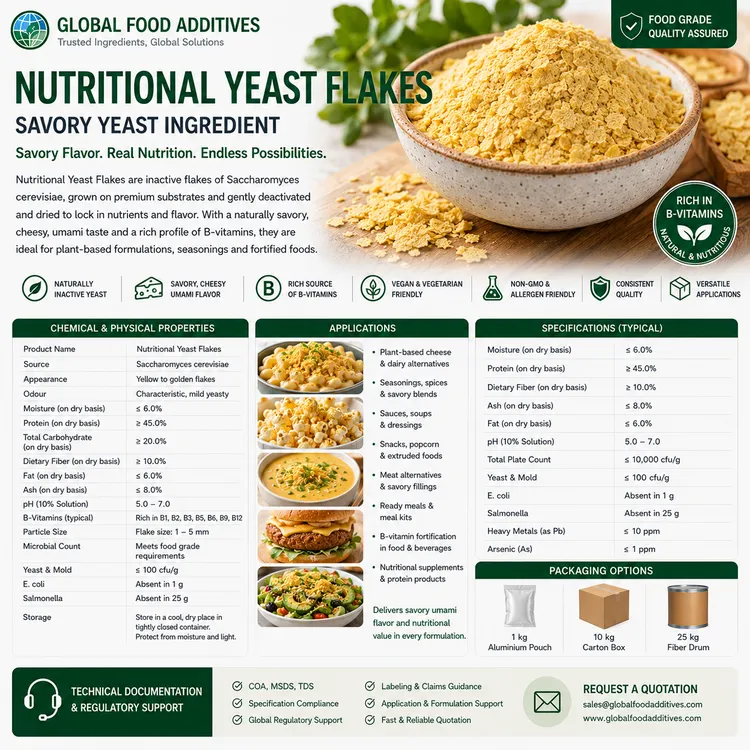
Product identity
| Product | Nutritional Yeast Flakes |
|---|---|
| Common names | Nutritional yeast, inactive yeast flakes, deactivated yeast flakes, savory yeast flakes, nooch |
| Typical biological source | Yeast-derived ingredient, commonly from Saccharomyces cerevisiae |
| Category | Fermentation-Derived Functional Ingredients |
| Function | Savory flavor ingredient, vegan cheese-note builder, umami enhancer, seasoning base, protein contributor and optional B-vitamin source |
| E / INS number | Usually treated as a food ingredient; confirm by destination market and supplier documentation |
| CAS / identity | Yeast-derived; supplier and market specific |
| Typical form | Yellow flakes, fine flakes, powder, granules or blended seasoning base |
| Typical status | Inactive / deactivated; not normally used as a live starter culture |
| Main sourcing concern | Flavor consistency, vitamin fortification, microbiological quality, gluten/allergen status, GMO status, heavy metals, packaging barrier and label suitability |
Application fit
Potential use areas may include:
- Plant-based cheese alternatives, sauces and spreads
- Seasoning blends, snack coatings and savory toppings
- Soups, sauces, dips, gravies and ready-meal components
- Bakery toppings, crackers, breads and savory biscuits
- Meat alternatives, vegetarian patties and protein systems
- Nutrition products, meal replacements and high-protein blends
- Retail condiments, table seasonings and vegan recipe ingredients
Industrial function and value
Nutritional Yeast Flakes are selected when a food manufacturer needs a label-friendly yeast-derived ingredient that contributes savory, nutty, cheesy and umami notes. In plant-based foods, the ingredient is widely reviewed for vegan cheese-style flavor, dairy-free sauce body, seasoning complexity and masking of beany or cereal notes from plant proteins. In dry systems, it can act as a visible flake, powder flavor base, carrier ingredient or seasoning component. In fortified grades, nutritional yeast may also contribute B-complex vitamins, but vitamin claims require verified analytical data and market-specific label review.
Inactive yeast versus yeast extract and starter cultures
Food buyers should specify exactly which yeast-derived ingredient they need. Nutritional Yeast Flakes contain whole inactive yeast material and are valued for flavor, color, nutrition and flake appearance. Yeast extract is usually more soluble and concentrated in savory compounds such as peptides, amino acids and nucleotides. Active yeast is intended for fermentation or leavening. Starter cultures and bio-protective cultures are live microorganisms selected for defined fermentation performance. These products are not direct substitutes.
| Ingredient type | Main industrial role | Buyer note |
|---|---|---|
| Nutritional Yeast Flakes | Savory flakes, vegan cheese notes, nutrition positioning and seasoning use | Usually inactive; compare flavor, flake size, vitamin fortification and microbiology. |
| Yeast extract | Concentrated umami, savory depth and salt-reduction support | More soluble and intense; may have different label declaration and flavor impact. |
| Active dry yeast | Fermentation, dough leavening and CO2 production | Requires viable cells and fermentation performance data. |
| Starter culture | Controlled fermentation, acidification, flavor development or bioprotection | Requires strain identity, viable count, storage controls and application-specific performance data. |
| Autolyzed yeast | Savory flavor development and process flavor base | Often used for soups, sauces, seasonings and meat-style flavors. |
Flavor and formulation profile
Nutritional Yeast Flakes can provide a mild to strong savory profile depending on supplier, raw material, drying conditions and fortification system. Typical descriptors include cheesy, nutty, brothy, roasted, cereal, creamy and umami. The final sensory result depends on dosage, salt level, acidity, fat level, spices, acids, sweeteners, plant proteins and heat treatment. Industrial buyers should compare samples in the actual finished product rather than only tasting flakes dry.
Cheese-style flavor building
Nutritional yeast is frequently used in dairy-free cheese sauces, vegan cheese powders, dips and spreads. It can contribute savory dairy-like notes when combined with acids, salt, fats, starches, emulsifiers, hydrocolloids and natural flavors.
- Useful in vegan cheese sauces and dry cheese-style seasonings
- Often combined with lactic acid, citric acid, salt and fat systems
- Can improve depth in dairy-free cream sauces
- Requires sensory validation for bitterness or excessive yeast notes
Umami and salt-reduction support
The savory character of nutritional yeast can help improve perceived fullness in reduced-salt or plant-based formulations. It should be used as part of a broader flavor system, not as a direct one-to-one salt replacement.
- Supports brothy, roasted and savory flavor depth
- Can help mask plant protein notes
- Works well with herbs, spices, onion, garlic and natural flavors
- Salt-reduction claims require sensory and regulatory review
Nutrition positioning
Nutritional yeast may contribute protein, fiber and naturally occurring or added B vitamins. Fortified grades may contain added thiamin, riboflavin, niacin, folic acid, vitamin B6 or vitamin B12 depending on supplier formulation.
- Request full nutritional profile per 100 g and per serving
- Confirm fortified versus unfortified status
- Check vitamin assay method and overage strategy
- Review nutrition claims in the final product, not only in the ingredient
Visual and texture role
Flakes can provide visible identity and rustic appearance in seasonings, toppings and retail products. Powders may be preferred for smooth sauces, blends and industrial dosing.
- Large flakes improve visual identity
- Fine flakes disperse more easily in blends
- Powder grades support smoother sauces and dips
- Granules may improve flow and reduce dusting
Application guidance by food category
| Application | Industrial purpose | Key evaluation points |
|---|---|---|
| Plant-based cheese alternatives | Cheesy, savory and nutty notes with label-friendly identity | Flavor intensity, acidity, fat compatibility, melt behavior, starch/hydrocolloid system, color and bitterness risk |
| Snack seasonings | Umami, cheese-style notes, powder bulk and visible flake identity | Particle size, adhesion to oil-coated snacks, salt level, moisture, caking, flowability and seasoning uniformity |
| Soups, sauces and gravies | Savory body, broth depth, dairy-free creaminess and flavor complexity | Solubility, dispersibility, heat stability, sedimentation, color, pH and interaction with starches or gums |
| Plant-based meat systems | Masking of beany notes, roasted depth and savory base flavor | Protein source, fat system, spice blend, heat process, color, water activity and finished-product label declaration |
| Bakery and crackers | Savory topping, dough inclusion, visible flakes and flavor enhancement | Baking temperature, browning, flake color, flavor retention, moisture, dough handling and surface adhesion |
| Nutrition products | Protein contribution, B-vitamin fortification and savory nutrition positioning | Vitamin levels, serving contribution, flavor masking, powder flow, allergen status, label claims and shelf-life stability |
| Retail condiments and table seasonings | Vegan savory topping and consumer-recognizable ingredient identity | Flake size, color consistency, shaker performance, caking, packaging barrier and consumer preparation instructions |
Fortified versus unfortified grades
Nutritional Yeast Flakes may be sold as fortified or unfortified grades. Fortified grades contain added vitamins and are often used when the buyer wants stronger nutrition positioning. Unfortified grades may be preferred when a cleaner ingredient declaration, specific sensory profile or avoidance of added vitamins is important. The buyer should not assume vitamin B12 is present unless the supplier specification and certificate confirm it.
Fortified grades
- May include added B-complex vitamins depending on supplier formula
- Can support nutrition-positioned products when regulations allow
- Require vitamin assay data and label-support documentation
- May have a stronger yellow color or distinct vitamin note
Unfortified grades
- Rely on naturally occurring yeast nutrients
- May offer simpler positioning in some formulations
- Usually not suitable for vitamin B12 claims unless analytical data support it
- Can differ in flavor, color and nutrient density from fortified grades
Claim controls
- Check local thresholds for source of protein, high protein and vitamin claims
- Calculate contribution in the finished serving size
- Confirm vitamin stability through processing and shelf life
- Maintain documentation for added nutrient forms and assay methods
Label review
- Confirm whether declaration should be nutritional yeast, inactive yeast, yeast flakes or another local term
- Declare added vitamins according to destination-market rules
- Review vegan, gluten-free, non-GMO and allergen statements
- Confirm whether nutrient fortification changes product classification
Technical purchasing notes
When reviewing Nutritional Yeast Flakes, compare the supplier specification against the intended food application, process conditions, flavor target, label expectations and local rules. For industrial purchasing, the most useful inquiry normally includes target grade, fortified or unfortified status, flake size, flavor benchmark, nutritional profile, physical form, packaging size, quantity, destination and document requirements.
Specification parameters to request
A reliable industrial quotation should include a specification that allows R&D, QA, regulatory and purchasing teams to compare grades objectively. The following parameters are commonly useful when evaluating Nutritional Yeast Flakes:
| Parameter | Why it matters |
|---|---|
| Yeast source and inactive status | Confirms ingredient identity and distinguishes nutritional yeast from active yeast, starter cultures and yeast extract. |
| Fortified / unfortified status | Determines vitamin contribution, label declaration, cost-in-use and nutrition claim potential. |
| Vitamin profile | Important for B-vitamin claims, fortified product development and nutrition facts calculation. |
| Protein content | Supports nutrition positioning and comparison between suppliers. |
| Moisture | Affects shelf life, caking, microbial stability, powder flow and packaging selection. |
| Particle size / flake size | Controls appearance, mouthfeel, dispersibility, dusting, seasoning uniformity and retail visual identity. |
| Color | Important for cheese-style applications, seasoning blends and batch-to-batch consistency. |
| Flavor profile | Central purchasing criterion; compare cheesy, nutty, brothy, roasted, bitter and yeasty notes in the final application. |
| Bulk density | Affects dosing, packaging, container loading, dry blending and filling equipment calibration. |
| Microbiological limits | Essential for food safety approval, especially in ready-to-eat, low-moisture or post-process applications. |
| Heavy metals | Relevant for customer specifications, import checks and food safety approval. |
| Allergen and gluten status | Important for vegan, gluten-free, allergen-controlled and plant-based products. |
| GMO status | Required for non-GMO positioning and customer-specific documentation. |
| Certifications | Halal, kosher, vegan, ISO, FSSC 22000, BRCGS, organic or non-GMO certifications may be required by the buyer. |
Processing and formulation considerations
Nutritional Yeast Flakes are easy to use in many dry applications, but industrial performance still depends on particle size, moisture, mixing order, fat level, salt level, acidity and heat process. In sauces and dips, flakes may require hydration or milling for smoothness. In snack seasonings, oil adhesion, electrostatic behavior, caking and sieve size should be tested. In bakery applications, heat can change flavor intensity and color, so final sensory evaluation should be carried out after the full process.
Dry blending
- Check flake breakage during mixing
- Monitor segregation with salt, spices and powders
- Control dusting and electrostatic behavior
- Validate flow through hoppers, augers and fillers
Hydrated systems
- Define hydration temperature and mixing time
- Use powder grades where smooth texture is required
- Check sedimentation or visible particles in sauces
- Validate viscosity impact with starches, gums and proteins
Heat processing
- Review flavor retention after baking, cooking or pasteurization
- Monitor browning and color shift in high-heat applications
- Check vitamin retention if fortified claims are planned
- Run shelf-life testing after the actual production process
Sensory validation
- Compare supplier samples in the finished formulation
- Check for bitterness, yeastiness or cereal aftertaste
- Confirm dosage with consumer or trained-panel testing
- Evaluate flavor after storage, not only at day zero
Quality, storage and handling
Nutritional Yeast Flakes are typically handled as a low-moisture dry ingredient. Store in closed original packaging, protected from moisture, pests, strong odors, direct sunlight and excessive heat. Because yeast flakes can absorb odors and moisture, warehouses should use clean, dry and food-grade storage practices. Open bags should be resealed or transferred to suitable closed containers to reduce caking, flavor loss and contamination risk.
Incoming inspection
- Check product name, lot number, net weight and label consistency
- Inspect bag integrity, odor, color, foreign matter and caking
- Compare certificate of analysis against purchase specification
- Confirm fortified status, vitamin profile and shelf life
- Retain samples according to the factory quality plan
Factory handling
- Use dust-control procedures during dumping and dosing
- Control humidity in storage and production areas
- Avoid cross-contamination with allergens or strong odors
- Use first-expired, first-out stock rotation
- Validate sieve, magnet and foreign-body controls where applicable
Application testing
- Run bench trials at the intended use level
- Compare flavor against target benchmark
- Measure seasoning adhesion or sauce smoothness where relevant
- Check shelf-life stability under actual packaging conditions
- Confirm final nutrition and label contribution after processing
Scale-up controls
- Confirm feeder performance and powder or flake flow
- Monitor batch-to-batch color and flavor variation
- Adjust mixing time to avoid excessive flake breakage
- Document pilot and production trials before commercial conversion
- Review label and nutrition calculation after final formula lock
Packaging and logistics options
Nutritional Yeast Flakes may be supplied in multiwall paper bags, PE-lined bags, foil-lined bags, cartons, drums, big bags or retail-ready packaging depending on supplier, grade and order size. Packaging should protect the flakes from moisture, light, oxidation, odor pickup and excessive mechanical damage. For export shipments, pallet type, fumigation status, container loading, moisture protection and label language should be confirmed before shipment.
| Packaging item | What to confirm |
|---|---|
| Bag or carton size | Common industrial options may include 5 kg, 10 kg, 15 kg, 20 kg, 25 kg or supplier-specific pack sizes. |
| Barrier protection | Moisture, oxygen and odor protection are important for flavor, color, flowability and vitamin stability. |
| Flake protection | Confirm whether the packaging and palletization minimize flake breakage during transport. |
| Pallet configuration | Confirm bags or cartons per pallet, pallet dimensions, stretch wrapping, corner protection and maximum stack height. |
| Label requirements | Confirm product name, fortified status, batch number, net weight, origin, shelf life, storage instructions and destination-language requirements. |
| Container conditions | Use clean, dry, odor-free containers or trucks suitable for food-grade dry ingredients. |
Documents to request
Buyers should request a complete document package before approving a new Nutritional Yeast Flakes supplier. Documentation needs vary by destination country, customer audit standard and final application, but the following documents are commonly requested:
- Product specification or technical data sheet
- Certificate of analysis for available batch or lot
- Safety data sheet where applicable
- Food-grade declaration or ingredient suitability statement
- Inactive / deactivated yeast statement where required
- Fortified or unfortified declaration
- Nutritional profile, including protein, fiber and vitamin values where applicable
- Vitamin B12, folic acid or B-complex assay data when claims are planned
- Origin, manufacturer and production-site information
- Allergen statement and gluten status declaration
- GMO statement or non-GMO certificate if required by the buyer
- Halal, kosher, vegan, vegetarian or other market-specific declarations where applicable
- Heavy metals, microbiological limits and contaminant statements
- Shelf-life, storage conditions and recommended handling information
- Label draft, packaging details, net weight, pallet configuration and loading quantity
- Market-specific declarations required by the destination country
Regulatory and buyer responsibility
Nutritional Yeast Flakes are typically reviewed as a food ingredient rather than a live culture or standardized E-number additive. However, classification, permitted use, label declaration, fortification rules, nutrition claims and import requirements vary by destination market. Buyers should verify whether the ingredient can be declared as nutritional yeast, inactive yeast, yeast flakes, yeast seasoning or another local term. Vitamin and protein claims should be supported by finished-product calculations and local regulatory review.
How Global Food Additives can support
Global Food Additives, Inc. supports food manufacturers and distributors with practical sourcing coordination for food-grade yeast-derived ingredients, flavors, functional ingredients and additives. For Nutritional Yeast Flakes, our team can help review the target specification, identify suitable supply options, collect supplier documents, clarify logistics constraints and coordinate quotation details for international buyers.
- Specification and documentation review before quotation
- Supplier comparison based on flavor profile, flake size, fortified status, certifications and destination market
- Coordination of allergen, gluten, GMO, origin, vitamin and contaminant declarations
- Support for plant-based, seasoning, snack, sauce, bakery and nutrition product inquiries
- Packaging, palletization, shipment and export-document coordination
How to request this product
Send the product name, target grade or reference specification, quantity, destination country, packaging preference, expected shipment date and required documents. If you already purchase Nutritional Yeast Flakes, attach or describe your existing specification, label, certificate of analysis, flavor benchmark, flake size, fortified status, vitamin targets and application so supplier options can be compared more accurately.
For R&D and QA teams
- Target application and finished-product category
- Current nutritional yeast grade or benchmark sample
- Desired flavor profile: cheesy, nutty, brothy, roasted or mild
- Required flake size, powder form or seasoning blend format
- Fortified or unfortified requirement and vitamin targets
- Processing temperature, packaging format, shelf-life target and sensory expectations
For purchasing teams
- Required trial, monthly or annual quantity
- Preferred bag size, carton size, pallet size or big bag requirement
- Destination country, port, delivery address and Incoterms
- Required certifications and document package
- Vegan, gluten-free, non-GMO, halal, kosher or customer-specific requirements
- Target price structure, lead time and shipment schedule
Useful answers
What are Nutritional Yeast Flakes used for in food manufacturing?
Nutritional Yeast Flakes are typically used for savory flavor development, vegan cheese notes, umami enhancement, seasoning blends, plant-based foods, sauces, dips, snacks, bakery toppings and nutrition-positioned formulations. Exact suitability depends on grade, application, process, regulations and supplier documents.
Are Nutritional Yeast Flakes a live starter culture?
No. Nutritional Yeast Flakes are usually inactive or deactivated yeast flakes. They are not normally used for fermentation performance, acidification, leavening or probiotic activity. Buyers needing active yeast or starter cultures should request those products separately.
What is the difference between nutritional yeast and yeast extract?
Nutritional yeast is usually a whole inactive yeast ingredient sold as flakes, granules or powder. Yeast extract is more concentrated in soluble savory compounds and is often used as a stronger umami flavor ingredient. They can differ in taste, solubility, label declaration and cost-in-use.
Is vitamin B12 always present in nutritional yeast?
No. Vitamin B12 is typically associated with fortified grades. Buyers should not assume B12 is present unless the supplier specification, certificate of analysis and nutrition documentation confirm the level and analytical basis.
Can Nutritional Yeast Flakes be used in vegan products?
Often yes, because nutritional yeast is yeast-derived and commonly used in vegan foods. However, buyers should request vegan declarations and confirm that carriers, fortification nutrients and processing aids meet the target market or customer standard.
Can Nutritional Yeast Flakes be used in gluten-free products?
Possibly, but gluten-free use depends on raw material controls, production environment, testing and supplier documentation. Buyers should request gluten status declarations, test results and certification where required.
Which documents should be requested?
Buyers commonly request a technical data sheet or specification, certificate of analysis, safety data sheet where applicable, nutritional profile, fortified or unfortified declaration, inactive yeast statement, allergen statement, gluten status, GMO statement, origin statement, microbiology, heavy metals, shelf-life information, label draft and packing details.
What should I specify when requesting a quote?
Provide the target application, flavor profile, flake size or powder requirement, fortified or unfortified status, vitamin targets if any, quantity, destination country, packaging preference, delivery term, required certifications and document package. If replacing an existing grade, share the current specification and certificate of analysis.
Can Global Food Additives source Nutritional Yeast Flakes?
Global Food Additives can review sourcing options for Nutritional Yeast Flakes according to target specification, flavor profile, flake size, fortified status, quantity, destination, packaging and required documentation.
Tell us which food additive or ingredient you need.
Send product names, target specifications, quantity, destination country, packaging preference, delivery term, and document requirements. For Nutritional Yeast Flakes, please include target application, flavor profile, flake size or powder requirement, fortified or unfortified status, vitamin targets if any, packaging format and required certifications. Our team will review your inquiry and respond from orders@foodgradeadditives.com.
Your message has been received. You will be redirected to the home page.