
Pectin Methylesterase Food Enzyme
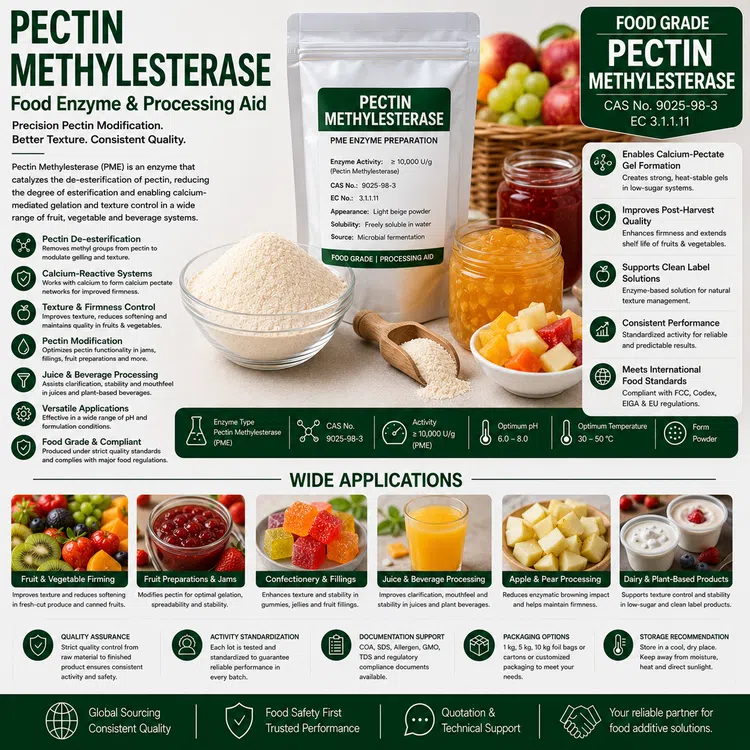
Pectin Methylesterase, often abbreviated as PME, is a food enzyme and processing aid used to modify pectin by removing methyl ester groups. This controlled de-esterification can increase calcium reactivity, change pectin functionality, support plant-tissue firmness, influence juice or puree behavior and help design specific texture or clarification outcomes in fruit, vegetable and plant-based processing.
This page is prepared for juice processors, fruit and vegetable processors, pectin technologists, beverage companies, R&D teams, QA departments, purchasing managers and importers who need a practical technical starting point for enzyme activity comparison, process-condition review, supplier documentation and quotation requests.
Product identity
| Product | Pectin Methylesterase |
|---|---|
| Common references | PME, pectinesterase, pectin methyl esterase, pectin pectylhydrolase |
| Category | Enzymes & Processing Aids |
| Function | Food enzyme / processing aid for pectin de-esterification, calcium-reactive texture control and manufacturing performance |
| E / INS number | Confirm by destination market and supplier documentation |
| CAS / identity | 9025-98-3 |
| EC number | EC 3.1.1.11 |
| Main reaction | De-esterification of methylated pectin, producing lower-methoxyl pectin structures and methanol as a reaction product |
| Typical form | Liquid enzyme preparation, powder, granulate, coated granulate, tablet or application-specific enzyme blend |
| Main buying issue | PME activity, source organism, side activities, calcium interaction, pH/temperature range, methanol-management review and regulatory status must match the application |
Application fit
Potential use areas may include:
- Fruit and vegetable texture modification
- Firming of diced, sliced or processed plant tissues
- Calcium-assisted structure development
- Juice, puree and mash processing
- Pectin modification and pectin functionality adjustment
- Plant-based and fruit-preparation systems
- Tomato, citrus, apple, berry and vegetable processing
- Specialty enzyme programs with polygalacturonase, pectin lyase or cellulase control
Industrial functionality overview
Pectin Methylesterase modifies the esterification pattern of pectin rather than simply breaking pectin chains into smaller fragments. By removing methyl ester groups, PME creates more free carboxyl groups on the pectin backbone. These groups can interact with calcium ions and form calcium pectate networks, which may strengthen plant tissue, increase firmness, alter gel behavior or change the way pectin responds to other enzymes.
In controlled food processing, PME can be useful when the target is not complete pectin breakdown but targeted pectin restructuring. This makes it different from general pectinase preparations designed mainly for depectinization, viscosity reduction or juice clarification. PME grade selection requires careful review of enzyme purity, side activities, source organism, calcium level, process pH, process temperature, reaction time and inactivation conditions.
Functional benefits by application
Fruit and vegetable firming
In fruit and vegetable processing, controlled PME treatment can increase calcium-reactive pectin and support firmer texture in selected diced, sliced, blanched, canned, frozen or heat-processed plant tissues. The approach is especially relevant where the processor wants better bite, less softening, improved shape retention or reduced breakdown during thermal processing.
- Can support firmer plant tissue when calcium and process conditions are controlled.
- May improve shape retention in fruit or vegetable pieces.
- Can reduce texture loss during blanching, cooking, freezing or retort exposure.
- Requires validation of calcium source, enzyme dosage, reaction time and heat inactivation.
Tomato and vegetable processing
In tomato, carrot, pepper and other vegetable systems, PME can influence serum viscosity, pulp structure, firmness and separation behavior. In some products, controlled PME activity can support texture development; in others, excessive PME activity may contribute to cloud or serum instability.
- Can influence pulp texture and plant-cell-wall structure.
- May support controlled viscosity or firmness targets.
- Requires testing for serum separation, particle integrity and finished mouthfeel.
- Hot-break, cold-break and enzyme-inactivation strategy should be reviewed.
Fruit preparations and fillings
Fruit preparations, bakery fillings and fruit toppings may use PME in specialized processing where the goal is controlled pectin restructuring, calcium-assisted gel development or improved piece integrity. The process must be balanced so the enzyme does not create unwanted syneresis, graininess or over-firm gel texture.
- Can support fruit-piece stability and structured fruit texture.
- May help create calcium-assisted pectin networks in selected formulas.
- Requires control of pH, soluble solids, calcium and heating sequence.
- Should be tested with the final filling, fruit type and storage condition.
Juice, puree and mash processing
PME can alter pectin behavior in juice, puree and mash systems. Depending on the process objective, this may help prepare pectin for calcium interaction or for subsequent pectinase activity. However, PME can also affect haze, cloud stability and filtration behavior, especially in citrus and high-pectin products.
- Can modify pectin before downstream clarification or extraction steps.
- May influence viscosity, cloud stability and sediment formation.
- Requires review of methanol formation and residual activity.
- Should be tested with the actual fruit, pH, pulp level and heat treatment.
Pectin modification and hydrocolloid systems
PME may be evaluated in specialized pectin modification where the target is to reduce the degree of methylation and create pectin with altered calcium reactivity. This requires controlled reaction conditions and analytical confirmation of esterification change.
- Can support controlled pectin de-esterification.
- May help produce pectin structures with different calcium response.
- Requires degree-of-esterification testing and reaction monitoring.
- Must be validated for food-enzyme status and final product requirements.
Plant-based and texture systems
In plant-based foods, fruit gels, vegetable matrices and structured plant systems, PME may be explored when pectin-rich materials need controlled firmness or water management. It should be evaluated with calcium salts, hydrocolloids, proteins and heat treatment in the final formulation.
- Can contribute to plant-cell-wall restructuring in selected systems.
- May support bite, firmness or water control when calcium is available.
- Requires review of flavour, texture, syneresis and storage stability.
- Should be tested with the full hydrocolloid and mineral system.
PME versus other pectin enzymes
Pectin Methylesterase is one part of the broader pectic-enzyme family. Buyers should confirm whether the commercial product is a purified PME preparation, a pectinase blend containing PME activity, or a broader fruit-processing enzyme system with multiple pectinolytic side activities.
| Enzyme activity | Typical technical role | Industrial review point |
|---|---|---|
| Pectin Methylesterase / PME | Removes methyl ester groups from pectin and increases calcium reactivity. | Useful for controlled pectin restructuring, plant-tissue firmness and calcium-assisted texture effects. |
| Polygalacturonase | Hydrolyses pectin chains and reduces molecular size. | Useful for viscosity reduction and clarification, but excessive activity may soften plant tissue. |
| Pectin lyase | Cleaves highly esterified pectin by beta-elimination. | Often reviewed for juice processing and depectinization; not equivalent to PME. |
| Pectate lyase | Acts mainly on low-esterified pectin or pectate structures. | May work after PME has created de-esterified regions; side activity must be controlled. |
| Cellulase / hemicellulase side activities | Act on other plant-cell-wall polysaccharides. | May improve extraction but can weaken structure if firmness is the target. |
Technical grade selection criteria
Enzyme products should be compared by process result and cost-in-use, not only by price per kilogram. PME activity units may not be directly comparable between suppliers unless assay substrate, pH, temperature, calcium condition and calculation method are aligned.
| Selection factor | Why it matters |
|---|---|
| Declared PME activity | Determines dosage, reaction speed and cost-in-use, but activity units can differ between suppliers. |
| Assay method | Different assay substrates and pH conditions may produce non-equivalent activity values. |
| Source organism | Important for regulatory review, GMO status, allergen assessment, customer approval and market acceptance. |
| Side activity profile | Polygalacturonase, pectin lyase, cellulase or hemicellulase side activities can change firmness, viscosity and cloud stability. |
| pH profile | Must match fruit, vegetable, puree, juice or pectin-modification process conditions. |
| Temperature profile | Controls reaction speed, thermal stability, process residence time and inactivation strategy. |
| Calcium interaction | PME-treated pectin can become calcium-reactive, so calcium level and calcium timing strongly affect texture. |
| Methanol-management review | PME reaction releases methanol from methylated pectin; the impact should be reviewed according to product, process and local requirements. |
| Carrier and formulation | Liquid, powder, granulate or coated preparations behave differently in dosing, storage, dust control and plant handling. |
| Regulatory destination | Food-enzyme and processing-aid rules differ by country, enzyme source and intended application. |
Specification points to request
A complete sourcing review should be based on the supplier’s current technical data sheet and batch-specific certificate of analysis. Depending on grade, form and market, buyers commonly request the following parameters:
- Declared Pectin Methylesterase activity and activity unit.
- Activity unit definition and assay method.
- Enzyme identity, EC number and CAS identity where available.
- Source organism and production organism declaration.
- Carrier, diluent, stabiliser or formulation aid declaration.
- Appearance, physical form, colour and odour.
- pH optimum, working pH range and pH stability.
- Temperature optimum, working temperature range and thermal stability.
- Recommended dosage range by application.
- Inactivation conditions or residual activity guidance.
- Side activity profile, especially polygalacturonase, pectin lyase, pectate lyase, cellulase or hemicellulase activity.
- Methanol-formation or reaction-product guidance where relevant to the intended use.
- Moisture or dry matter for powder and granulate grades.
- Microbiological limits, including total plate count, yeast, mould and pathogens where applicable.
- Heavy metals and contaminant limits according to applicable food-enzyme specification.
- Allergen statement, GMO status, halal or kosher certificate where required.
- Shelf-life, storage temperature, packaging size and pallet configuration.
Processing and formulation guidance
PME performance depends strongly on substrate pectin, degree of methylation, pH, temperature, calcium level, reaction time, mixing, tissue structure and inactivation. Laboratory tests should be followed by plant trials because fruit variety, ripeness, cut size, blanching, calcium diffusion and thermal process design can change results.
- Dosage: calculate dosage based on declared PME activity, substrate level, process time and target firmness or pectin modification.
- Mixing: distribute enzyme uniformly to avoid uneven reaction and inconsistent texture.
- Temperature: operate within the supplier’s recommended range to avoid slow reaction or enzyme denaturation.
- pH: confirm activity at the natural pH of the fruit, vegetable or pectin system.
- Calcium: control calcium source, dosage and timing because calcium can convert PME-treated pectin into stronger calcium pectate networks.
- Reaction time: validate contact time for the required texture, viscosity or pectin-functionality target.
- Inactivation: use blanching, pasteurisation, heat treatment or other validated process steps where residual activity must be stopped.
- Scale-up: confirm that lab results remain stable in plant equipment, including tank geometry, mixer design, fruit-piece size, thermal profile and residence time.
Application-specific process controls
Fruit and vegetable firming control points
- Fruit or vegetable variety, maturity and natural pectin level.
- Piece size, tissue structure and cut-surface exposure.
- PME dosage, calcium dosage and treatment sequence.
- Blanching, pasteurisation, retort or freezing conditions.
- Texture after storage, reheating or thawing.
Juice and puree control points
- Natural PME activity already present in the raw material.
- Target viscosity, cloud stability or clarification behavior.
- Calcium level and mineral profile.
- Heat-inactivation step and residual activity.
- Methanol-management review where relevant.
Pectin modification control points
- Starting pectin type and degree of esterification.
- Target degree of esterification after treatment.
- pH, temperature, enzyme dosage and reaction time.
- Calcium reactivity and gel response.
- Enzyme inactivation and downstream purification where applicable.
Plant-based texture control points
- Pectin-rich raw material level.
- Calcium source and mineral balance.
- Hydrocolloid and protein interactions.
- Final bite, firmness, syneresis and water binding.
- Thermal processing and shelf-life stability.
Side activity and formulation risk review
Commercial PME preparations may contain stabilisers, carriers or pectinase side activities. These can be beneficial in one process and problematic in another. For firmness applications, excessive depolymerizing activity can reduce texture instead of improving it. For juice applications, uncontrolled PME activity may influence cloud stability, sediment formation or filtration behavior.
- Request side activity information if the application is sensitive to polygalacturonase, pectin lyase, cellulase, hemicellulase, amylase or protease effects.
- Check whether the carrier affects label expectations, allergen status, solubility, dosing or filtration.
- Confirm compatibility with calcium salts, acids, preservatives, alcohol, minerals, proteins and other process aids.
- Validate that the enzyme does not create excessive firmness, brittleness, cloud loss, sediment instability, syneresis or texture defects.
- Review whether the process reliably inactivates the enzyme if residual activity is not desired.
Methanol and reaction-product review
Because PME removes methyl groups from pectin, methanol can be generated as a reaction product. Many fruits naturally contain PME activity and pectin-derived methanol can already be part of normal fruit and juice chemistry, but industrial enzyme addition should still be reviewed carefully when the application, market or customer standard requires attention to methanol formation.
- Assess whether PME addition changes methanol levels meaningfully in the intended process.
- Review product type, pectin level, dosage, reaction time, heat treatment and final serving conditions.
- Request supplier guidance for reaction-product considerations where available.
- Coordinate with QA and regulatory teams if the product is juice, wine, fermented beverage, concentrate or high-pectin fruit preparation.
- Use validated analytical methods where methanol monitoring is required by customer or market rules.
Food enzyme compliance and documentation
Food enzyme approval can be more complex than approval of a simple commodity ingredient because the source organism, production method, technical purpose, residual activity and processing-aid status may all affect compliance. Requirements can differ by destination country and by whether the enzyme is removed, inactivated or remains in the finished product.
Core documents
- Technical data sheet or product specification.
- Certificate of analysis for the available batch or lot.
- Safety data sheet where applicable.
- Manufacturing origin and country-of-origin statement.
- Shelf-life and recommended storage conditions.
- Packaging, net weight and pallet configuration.
Enzyme-specific documents
- PME activity declaration.
- Activity unit definition and assay method.
- Source organism and production organism declaration.
- Carrier and formulation aid declaration.
- Side activity statement where relevant.
- Application, dosage and inactivation guidance.
Regulatory documents
- Food-enzyme or processing-aid compliance statement.
- Destination-market regulatory declaration.
- GMO status statement and production-strain information where required.
- Allergen statement and respiratory-sensitiser handling note where applicable.
- Halal or kosher certificate if required.
- Vegan, vegetarian or animal-origin statement where relevant.
Quality and safety documents
- Microbiological specification.
- Heavy metal and contaminant statement.
- Absence of viable production organism where relevant.
- Absence of antimicrobial activity where required by enzyme standards.
- Food safety certification such as HACCP, ISO 22000, FSSC 22000 or equivalent where available.
- Batch traceability and change-control statement.
Storage, handling and operator safety
Pectin Methylesterase preparations are biologically active materials and should be stored according to the supplier’s instructions. Many enzyme powders and granulates must be protected from moisture, heat and dust generation. Liquid enzymes may require cool storage and protection from freezing or excessive heat. Operators should follow the supplier safety data sheet because enzyme dust or aerosols may cause respiratory sensitisation in occupational settings.
- Store in closed original packaging under the temperature recommended by the supplier.
- Protect dry enzyme products from humidity, condensation and dust release.
- Protect liquid enzyme products from freezing, overheating and microbial contamination.
- Use first-expiry-first-out stock rotation.
- Avoid unnecessary aerosol or dust formation during weighing and dosing.
- Use suitable PPE and local exhaust ventilation where required by the SDS.
- Keep enzyme products away from incompatible chemicals and non-food materials.
- Inspect incoming goods for leakage, swelling, caking, odour change, temperature abuse or packaging damage.
Technical purchasing notes
When reviewing Pectin Methylesterase, compare the supplier specification against the intended food application, pectin substrate, calcium system, process conditions, target function, label expectations and destination-market rules. For industrial purchasing, the most useful inquiry normally includes application, declared PME activity, assay method, source organism, side activities, physical form, packaging size, quantity, destination and document requirements.
Buyers should avoid approving PME only by product name. A stronger approval process links the exact supplier grade to the target result, such as plant-tissue firmness, calcium-assisted texture, pectin de-esterification, controlled viscosity, puree processing, cloud management or pectin-modification performance.
| Information to include | Example details |
|---|---|
| Application | Fruit firming, vegetable firming, tomato processing, juice processing, puree processing, pectin modification, fruit preparation or plant-based texture system. |
| Target function | Pectin de-esterification, calcium-reactive texture, firmness, viscosity control, cloud management, pectin modification, syneresis control or process efficiency. |
| Enzyme activity | Declared PME activity, supplier activity unit, assay method, current enzyme reference or dosage target. |
| Process conditions | pH, temperature, calcium level, reaction time, substrate level, fruit or vegetable piece size, mixing method and inactivation step. |
| Grade preference | Liquid enzyme, powder, granulate, coated granulate, low-dust grade, purified PME or existing supplier reference. |
| Quality target | Texture improvement, higher firmness, controlled degree of esterification, lower syneresis, improved shape retention or controlled pectin functionality. |
| Quantity | Lab sample, plant trial quantity, carton quantity, drum quantity, pallet quantity or annual contract volume. |
| Destination | Country, port, city, delivery term and import-document requirements. |
| Documents | TDS, specification, COA, SDS, food-enzyme declaration, PME activity assay, source organism, GMO, allergen, halal, kosher, origin and shelf-life documents. |
Documents to request
- Product specification or technical data sheet.
- Certificate of analysis for available batch or lot.
- Safety data sheet where applicable.
- PME activity, declared activity unit and assay method.
- Side activity statement, especially for polygalacturonase and pectin lyase activity.
- Source organism and production organism declaration.
- Food-enzyme, processing-aid or destination-market compliance statement.
- Carrier, diluent and formulation aid declaration.
- Allergen, GMO, halal, kosher, vegan or animal-origin statements where required.
- Microbiological and heavy metal statements where relevant.
- Methanol-formation guidance or reaction-product statement where relevant.
- Origin, manufacturer, shelf-life and storage information.
- Label draft, packaging details and pallet configuration.
- Market-specific declarations required by the destination country.
How to request this product
Send the product name, intended application, substrate, target function, PME activity requirement, process pH, process temperature, calcium level, reaction time, dosage target, quantity, destination country, packaging preference, expected shipment date and required documents. If you already purchase Pectin Methylesterase, attach or describe your existing specification, supplier reference, activity unit, label or certificate of analysis so supplier options can be compared more accurately.
Useful technical answers
What is Pectin Methylesterase used for in food manufacturing?
Pectin Methylesterase is used as a food enzyme or processing aid to de-esterify pectin and create calcium-reactive pectin structures. It is commonly reviewed for fruit and vegetable firming, plant-tissue texture control, pectin modification, puree processing, juice behavior, cloud management and specialized plant-based texture systems.
Is Pectin Methylesterase the same as general Pectinase?
No. General pectinase may include several pectin-degrading activities, while Pectin Methylesterase specifically removes methyl ester groups from pectin. A general pectinase blend may contain polygalacturonase or lyase side activities that can reduce viscosity or soften tissue, so the enzyme profile must be checked.
Which Pectin Methylesterase grade should I request?
The correct grade depends on the target result. Fruit firming, vegetable firming, pectin modification, puree processing and juice cloud control may require different PME activity, side activity profile, pH range and temperature range. Send the application, substrate, process pH, temperature, calcium level and target texture so supplier options can be compared accurately.
Which documents should be requested?
Buyers commonly request a technical data sheet, specification, certificate of analysis, safety data sheet, PME activity assay, source organism statement, production organism statement, food-enzyme declaration, processing-aid compliance statement, side activity statement, allergen statement, GMO statement, halal or kosher certificate, shelf-life information, storage conditions and packaging details.
Can Global Food Additives source Pectin Methylesterase?
Global Food Additives can review sourcing options for Pectin Methylesterase according to application, enzyme activity, process conditions, quantity, destination, packaging preference, delivery term and required documentation.
Is this product permitted in every country?
No. Food enzyme and processing-aid rules depend on destination-market regulations, enzyme source, production organism, food category, use level, residual activity, labeling rules and buyer responsibility. Always confirm local regulatory status before commercial use.
Tell us which Pectin Methylesterase enzyme you need.
Send product name, application, substrate, target function, enzyme activity requirement, process conditions, calcium system, grade preference, quantity, destination country, packaging preference, delivery term and document requirements. Our team will review your inquiry and respond from orders@foodgradeadditives.com.
Your message has been received. You will be redirected to the home page.