
Propylene Glycol Esters of Fatty Acids E477
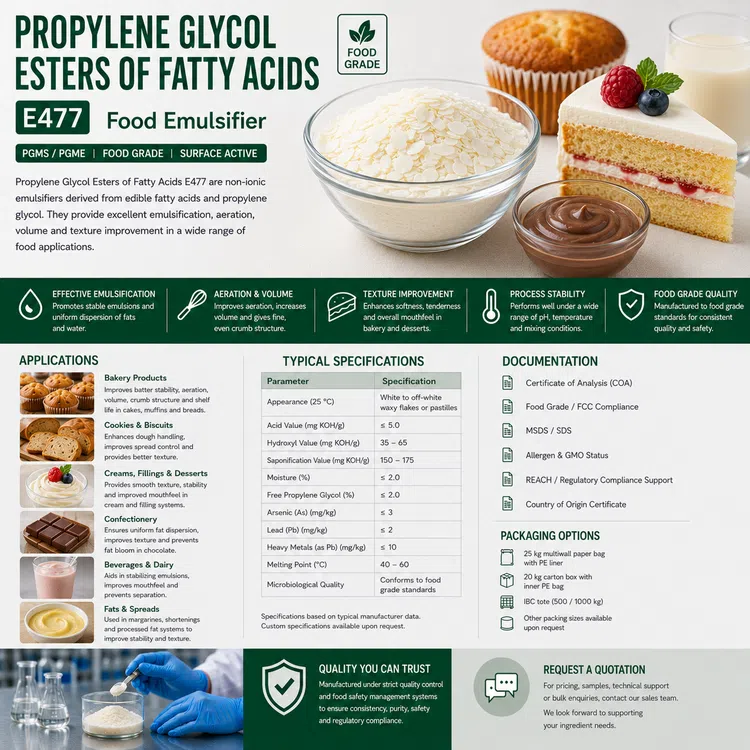
Propylene Glycol Esters of Fatty Acids, also known as E477, are food-grade emulsifiers produced from propylene glycol and edible fatty acids. They are selected in industrial food systems to improve aeration, emulsion stability, fat dispersion, crumb softness, whipping performance, processing tolerance and texture control. This page is prepared as a detailed technical sourcing guide for manufacturers, buyers, R&D teams and quality departments.
Product identity
| Product | Propylene Glycol Esters of Fatty Acids |
|---|---|
| Common names | E477, PGMS, PGME, Propylene Glycol Fatty Acid Esters |
| Category | Emulsifiers & Surface Active Ingredients |
| Function | Emulsifier, aeration aid, fat dispersion aid and texture support ingredient |
| E / INS number | E477 |
| CAS / identity | Mixture |
| Typical chemistry | Mixture of propylene glycol monoesters and diesters of edible fatty acids |
| Fatty acid source | May be based on vegetable oils, animal fats or declared fatty acid streams depending on supplier and customer requirement |
| Typical form | Powder, bead, flake, paste or liquid grade |
| Functional profile | Surface activity, oil-water interface control, aeration support, fat crystallisation influence and dispersion improvement |
Application fit
Potential use areas may include:
- Bakery products, cakes, sponge cakes and cake emulsifier systems
- Margarine, shortening, fat spreads and structured fat systems
- Ice cream, frozen desserts and aerated dairy or non-dairy systems
- Whipped toppings, creams and foam-stabilised food preparations
- Beverage emulsions, cloud systems and flavour dispersions where permitted
- Confectionery, fillings, coatings and fat-based processing systems
- Industrial premixes requiring improved dispersion of fat-soluble or surface-active components
Technical overview
Propylene Glycol Esters of Fatty Acids are non-ionic emulsifiers designed to interact at the interface between water, fat and air phases. Their industrial value depends on fatty acid composition, ester distribution, monoester content, melting profile, physical form, dispersibility and compatibility with the total recipe. In many food systems, E477 is not used alone but as part of an emulsifier blend with mono- and diglycerides, lecithins, sorbitan esters, polyglycerol esters, stearoyl lactylates or other formulation-specific ingredients.
In bakery and aerated systems, E477 can help improve batter aeration, foam structure, volume, crumb uniformity and eating softness when correctly hydrated, dispersed or blended into the fat phase. In fat-based systems, it may contribute to fat dispersion, processing tolerance, emulsion stability and texture consistency. In beverage or flavour systems, performance depends strongly on the oil phase, weighting agents, gum stabilisers, homogenisation pressure, droplet size distribution, pH and heat treatment.
Industrial functions
- Emulsion stabilisation: supports distribution of fat and water phases by reducing interfacial tension.
- Aeration support: helps stabilise air cells in selected cake batters, whipped systems and frozen desserts.
- Crumb softness: may contribute to softer texture and improved eating quality in bakery systems when used with suitable emulsifier blends.
- Fat dispersion: improves distribution of fats and oils in premixes, fillings, toppings and processed food systems.
- Processing tolerance: may improve stability during mixing, heating, cooling, freezing, whipping or mechanical handling.
- Texture control: contributes to mouthfeel, structure and consistency depending on formulation and dosage.
Specification review points
Industrial buyers should compare each offered grade against the target application and internal quality standard. Common review parameters include:
- Acid value and free fatty acid level
- Saponification value and ester profile
- Hydroxyl value and degree of esterification
- Iodine value and fatty acid unsaturation profile
- Monoester and diester distribution where declared
- Melting point, slip point or softening range
- Free propylene glycol and residual reactant limits
- Moisture, ash, colour, odour and appearance
- Heavy metals, lead, arsenic or other impurity limits where applicable
- Physical form, particle size, flowability and dispersibility
Application-specific purchasing guidance
For bakery manufacturers, the most relevant grade is usually selected according to cake type, batter density, mixing system, shortening or oil content, baking conditions, shelf-life target and desired crumb texture. Some users require E477 as a standalone emulsifier, while others purchase integrated cake gel, powder premix or emulsifier blend systems.
For margarine, shortening and fat-spread manufacturers, the grade should be reviewed for melting behaviour, fat compatibility, crystal behaviour, plasticity, water dispersion, storage stability and process conditions. In frozen desserts and whipped toppings, the buyer should evaluate overrun, foam stability, meltdown behaviour, mouthfeel, freeze-thaw tolerance and interaction with proteins, stabilisers and sugars.
For beverages, flavour emulsions and cloud systems, E477 must be assessed carefully because final performance depends on emulsifier blend design, oil load, gum system, homogenisation, density balance, pasteurisation conditions and packaging stability. Laboratory and pilot trials are recommended before industrial-scale approval.
Process and formulation considerations
- Determine whether the grade should be dispersed in water, melted into fat or pre-blended into an emulsifier system.
- Check melting temperature and mixing sequence before scale-up.
- Evaluate interaction with mono- and diglycerides, lecithin, SSL, DATEM, gums, starches, proteins and sugars.
- Measure viscosity, aeration, emulsion stability, particle dispersion and finished product texture during trials.
- Confirm whether the ingredient affects flavour release, colour, mouthfeel or label declaration.
- Test heat stability, freeze-thaw stability and storage stability under actual commercial conditions.
Quality assurance checklist
- Confirm supplier, manufacturer, country of origin and batch traceability.
- Check Certificate of Analysis values against the approved specification.
- Verify fatty acid source, especially where vegetable origin, halal, kosher or vegan status matters.
- Review allergen, GMO, BSE/TSE and residual solvent declarations where required.
- Confirm shelf life, retest date, storage conditions and packaging integrity.
- Request change-control notification expectations for raw material, process or origin changes.
Typical physical forms
Propylene Glycol Esters of Fatty Acids can be supplied in different physical forms depending on the fatty acid profile, melting behaviour, processing technology and final application. Powder and bead forms may be preferred for dry premixes and easier dosing. Flakes may be suitable for fat-based processing where melting is part of the production step. Paste or liquid grades may be selected for systems requiring faster incorporation or pre-dispersion.
The correct physical form affects warehouse handling, dosing accuracy, dust control, melting time, dispersion quality, mixing time and operator convenience. Buyers should define whether the material will be manually dosed, automatically dosed, melted in a fat tank, added into a dry blend, hydrated in water or supplied as part of a compound emulsifier preparation.
Storage and handling
Store E477 in original, tightly closed packaging in a clean, dry, cool and well-ventilated warehouse. Protect the product from moisture, foreign odours, direct sunlight, excessive heat and contamination. Some grades may soften, cake or lose flowability if exposed to unsuitable temperature or humidity. Follow the supplier's recommended storage temperature and shelf-life statement.
Before use, check the product name, batch number, expiry or retest date, packaging condition, appearance, odour and any signs of caking, melting or contamination. Production teams should follow FIFO or FEFO stock rotation and keep opened packaging closed when not in use.
Packaging and logistics
Packaging depends on supplier, grade and order quantity. Common industrial options may include multi-wall paper bags with inner liners, cartons, drums, pails or export-ready palletised units. For international shipments, buyers should confirm net weight, gross weight, pallet dimensions, container loading plan, label language, batch coding, storage instructions and export documentation before dispatch.
- Small packs for sample evaluation, pilot plant trials and formulation screening
- Bagged powder, bead or flake grades for routine industrial dosing
- Cartons or drums for paste, liquid or sensitive grades
- Palletised export packing with batch labels and handling marks
- Container-load options for high-volume manufacturers and regular supply programs
Regulatory and compliance notes
E477 is used as a food additive in selected markets and food categories, but permission, maximum use level, purity criteria and labelling requirements differ by country and application. Buyers must verify the ingredient's regulatory status in the destination market and confirm that the offered grade matches the final product category, use level and customer specification.
For sensitive markets or retailer-controlled supply chains, customers may require halal, kosher, vegan, non-GMO, allergen, palm-origin, animal-origin, BSE/TSE, residual solvent, heavy metal, contaminants, food contact and sustainability declarations. The exact document package should be agreed before order confirmation.
Documents to request
- Product specification or technical data sheet
- Certificate of Analysis for the available batch or lot
- Safety Data Sheet where applicable
- Food additive grade statement and E477 reference where applicable
- Fatty acid source declaration, including vegetable or animal origin where relevant
- Halal, kosher, vegan, allergen, GMO and BSE/TSE declarations when required
- Origin, manufacturer, shelf-life and storage information
- Heavy metal, contaminant and residual solvent information where required
- Label draft, packaging details and pallet configuration
- Market-specific declarations requested by the destination country or final customer
Commercial sourcing guidance
When reviewing Propylene Glycol Esters of Fatty Acids, compare the supplier specification against the intended food application, process conditions, target function, label expectations and local rules. For industrial purchasing, the most useful inquiry normally includes target grade, application, physical form, packaging size, quantity, destination, Incoterm, delivery schedule and document requirements.
If the ingredient is part of a larger emulsifier system, the buyer should also describe the full application: cake type, fat source, whipping system, emulsion type, required shelf life, processing temperature, packaging format and finished product performance target. This helps determine whether the correct E477 grade, blend or alternative emulsifier system should be evaluated.
How to request this product
Send the product name, E number, target grade, reference specification, application, desired physical form, quantity, destination country, packaging preference, expected shipment date and required documents. If you already purchase Propylene Glycol Esters of Fatty Acids, attach or describe your existing specification, label, Certificate of Analysis or approved supplier standard so supplier options can be compared more accurately.
Useful answers
What is Propylene Glycol Esters of Fatty Acids used for in food manufacturing?
Propylene Glycol Esters of Fatty Acids E477 are typically used as emulsifiers and surface-active ingredients. They may support emulsion stability, aeration, crumb softness, fat dispersion, whipping performance, frozen dessert stability and processing tolerance. Exact suitability depends on grade, application, process, regulations and supplier documents.
Which applications commonly use E477?
E477 may be evaluated in bakery systems, cakes, whipped toppings, margarine, shortening, ice cream, frozen desserts, beverage emulsions, fillings, coatings and other processed food applications where an approved emulsifier is technically suitable.
Which documents should be requested?
Buyers commonly request a technical data sheet or specification, Certificate of Analysis, Safety Data Sheet, origin statement, shelf-life information, storage guidance, fatty acid source declaration, allergen statement, GMO statement, halal or kosher documents where required, label details and packaging information.
Can Global Food Additives source Propylene Glycol Esters of Fatty Acids?
Global Food Additives can review sourcing options for Propylene Glycol Esters of Fatty Acids according to target specification, application, physical form, quantity, destination, packaging and required documentation.
Is this product permitted in every country?
No. Food additive use depends on destination-market rules, food category, use level, function, label requirements and buyer responsibility. The buyer should verify regulatory status before commercial use.
How should buyers compare different E477 suppliers?
Buyers should compare technical specification, fatty acid source, physical form, performance in the target application, Certificate of Analysis values, regulatory documents, packaging, shelf life, minimum order quantity, lead time, origin, price stability and supplier change-control practices.
Tell us which food additive or ingredient you need.
Send product names, target specifications, quantity, destination country, packaging preference, delivery term, and document requirements. Our team will review your inquiry and respond from orders@foodgradeadditives.com.
Your message has been received. You will be redirected to the home page.