
Sodium Acid Pyrophosphate E450
Sodium Acid Pyrophosphate, commonly abbreviated as SAPP, is a food-grade acidic phosphate used by manufacturers as a leavening acid, controlled gas-release ingredient, pH-control phosphate and process aid in selected bakery, batter, dough, dry-mix and prepared-food systems. It is especially relevant in cakes, biscuits, pancakes, tortillas, batters, refrigerated or frozen dough systems, baking powders and selected potato applications where reaction rate, neutralizing value, finished pH, colour, texture and process consistency must be controlled. This page is prepared as a detailed technical sourcing guide for purchasing, R&D, QA, production and regulatory teams.
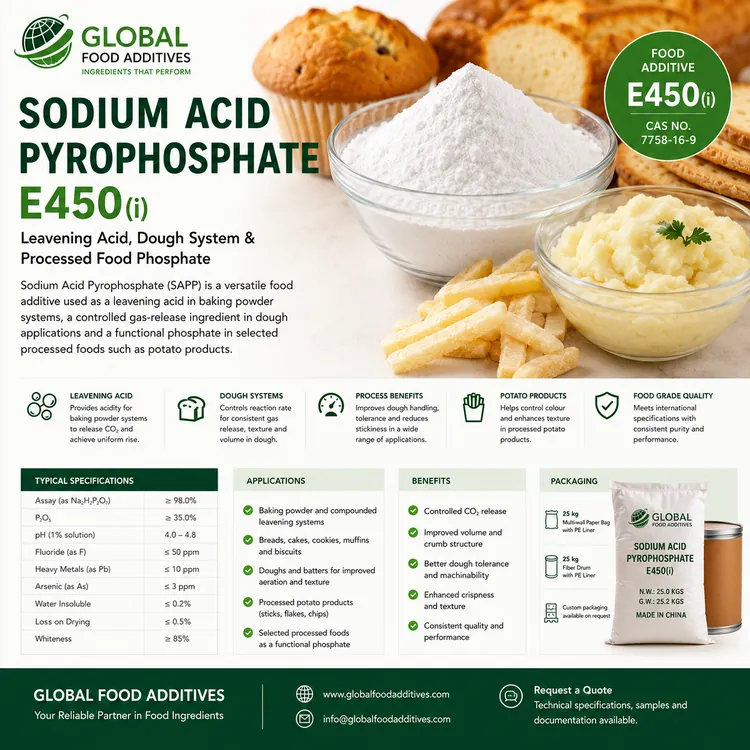
Product identity
| Product | Sodium Acid Pyrophosphate |
|---|---|
| Common names | SAPP; E450; E450(i); disodium dihydrogen pyrophosphate; disodium diphosphate; sodium acid diphosphate; baking powder acid |
| Category | Leavening, Raising & Dough Systems |
| Function | Leavening acid, raising agent, controlled gas-release ingredient, pH-control phosphate and dough-system component |
| E / INS number | E450 / E450(i), subject to destination-market classification |
| CAS / identity | 7758-16-9 |
| Typical formula | Na2H2P2O7 |
| Typical chemistry | Acidic sodium pyrophosphate used to react with bicarbonate and provide controlled leavening or pH adjustment |
| Typical form | White powder, granular grade, controlled reaction-rate grade or baking powder grade |
| Functional profile | Controlled gas release, dough aeration, batter lift, pH control, crumb structure support and process consistency |
Application fit
Potential use areas may include food systems where controlled acid reaction, leavening performance or phosphate functionality is required:
- Cakes, muffins, sponge cakes, cupcakes and chemically leavened bakery products
- Biscuits, cookies, crackers and bakery systems requiring controlled spread and lift
- Pancake mixes, waffle mixes, batter mixes and instant bakery preparations
- Tortillas, flatbreads, frozen dough and refrigerated dough systems
- Batters, coatings, breadings and fried products requiring lift or open structure
- Commercial baking powders, raising-agent blends and dry leavening premixes
- Potato products and selected processed foods where phosphate use is permitted and technically suitable
Technical overview
Sodium Acid Pyrophosphate is an acidic phosphate used as a controlled leavening acid in chemical raising systems. In bakery and batter applications, it reacts with sodium bicarbonate or another bicarbonate source to generate carbon dioxide. The generated gas expands during mixing, resting and heating, helping create lift, volume, open crumb, controlled spread and finished texture.
SAPP is often selected because different grades can offer different reaction rates. Fast-acting grades may release more gas early in the process, while slower-acting grades may reserve more gas for later processing or baking. This allows manufacturers to match the leavening system to the product: fast batters, consumer pancake mixes, cakes, biscuits, refrigerated doughs, frozen doughs, tortillas or industrial dry mixes may each require a different reaction profile.
Beyond leavening, SAPP may also be reviewed for pH control and selected phosphate functionality in specific foods where permitted. In potato applications, acidic pyrophosphate systems may be evaluated for colour control and after-cooking darkening management, but suitability depends on product type, process, regulatory status and customer specifications.
Industrial functions
- Controlled leavening: supports timed carbon dioxide release in baking powder, batter and dough systems.
- Batter lift: contributes to expansion, volume and aeration when balanced correctly with bicarbonate.
- Crumb structure: helps influence cell size, uniformity, tenderness, spread and finished product geometry.
- pH adjustment: helps neutralize bicarbonate and manage finished-product pH, flavour and browning.
- Dry-mix stability: supports leavening performance in packaged dry mixes when moisture is controlled.
- Process tolerance: selected grades help manage batter holding time, refrigerated storage or frozen dough processing.
- Colour-control support: may support selected potato and processed-food systems where permitted and technically validated.
Specification review points
Industrial buyers should compare every offered grade against the intended application and internal quality standard. Common review parameters include:
- Assay or active content by declared method
- P2O5 content and phosphate profile where declared
- Neutralizing value or acid value for leavening-system calculations
- Reaction rate, dough rate or gas-release profile in bicarbonate systems
- pH of solution or dispersion
- Water-insoluble matter and clarity or residue limits where relevant
- Loss on drying, moisture level and caking tendency
- Particle size distribution, mesh profile, bulk density and flowability
- Fluoride, heavy metals, lead, arsenic and elemental impurity limits where applicable
- Batch traceability, shelf life, storage requirements and packaging integrity
Leavening-system design
Effective chemical leavening requires the correct balance between acid and bicarbonate. If there is too much bicarbonate, the finished product can show high pH, yellowing, soapy flavour, excessive browning or coarse texture. If there is too much acid, the product may taste sour, show low pH, poor colour development or weak structure. SAPP selection should therefore be based on neutralizing value, reaction rate, process timing and finished-product pH.
Industrial formulators often build leavening systems with more than one acid. A fast acid may support gas release during mixing, while SAPP or another controlled-rate acid may release gas later during holding or baking. The final system should be validated through batter pH, finished pH, specific volume, spread, crumb grain, colour, flavour, texture and shelf-life testing.
Process and formulation considerations
- Define whether SAPP is used as the primary leavening acid or part of a blended baking powder system.
- Calculate bicarbonate balance using supplier neutralizing value and target finished-product pH.
- Select reaction-rate grade according to mixing time, holding time, refrigeration, freezing and baking conditions.
- Confirm particle size compatibility with bicarbonate, flour, sugar, cocoa, starch and other dry ingredients.
- Evaluate dry-blend uniformity, segregation risk, dusting, caking and filling performance.
- Check flavour impact, especially residual acidic, alkaline, mineral, bitter or soapy notes.
- Run pilot trials before changing supplier, reaction-rate grade, particle size, acid blend or packaging format.
Quality assurance checklist
- Confirm supplier, manufacturer, country of origin and batch traceability.
- Check Certificate of Analysis values against the approved specification.
- Verify food additive grade, E450 declaration and destination-market suitability.
- Confirm reaction-rate grade and ensure it matches the approved application standard.
- Review allergen, GMO, BSE/TSE, halal, kosher and vegan declarations where required.
- Check packaging integrity, caking condition, lot coding, expiry or retest date and storage conditions.
Reaction rate and grade selection
SAPP grades are often differentiated by reaction speed with bicarbonate. The reaction rate determines how much carbon dioxide is generated during initial mixing compared with later heating or baking. This is one of the most important technical parameters when selecting SAPP for bakery systems.
Fast-reaction grades may be useful where immediate gas release is desired. Medium or slower grades may be preferred for products that require batter holding tolerance, delayed oven spring, refrigerated dough handling, frozen dough stability or dry-mix storage performance. The correct reaction rate depends on product type, process time, temperature, moisture level, bicarbonate grade and desired final texture.
Application-specific purchasing guidance
For cakes, muffins and sponge products, SAPP may be evaluated for controlled gas release, volume, crumb uniformity, tenderness, colour and finished pH. The formulation team should review sugar level, fat level, emulsifier system, batter viscosity, deposit time, oven profile and bicarbonate balance.
For biscuits, cookies and crackers, reaction timing can affect spread, lift, surface cracking, bite, browning and internal texture. Buyers should test particle size, dry-blend distribution, finished pH and sensory profile because small changes in leavening acid grade can significantly affect product geometry.
For pancake and waffle mixes, SAPP should be evaluated for consumer preparation variability, batter holding tolerance, griddle or waffle-iron lift, browning, flavour and dry-mix shelf stability. Moisture protection is important because premature acid-bicarbonate reaction can reduce leavening power.
For refrigerated or frozen dough systems, a controlled reaction rate is especially important. The grade should be tested for gas retention, dough handling, freezer or chiller stability, thawing behaviour, bake-off volume, texture and final pH.
For potato products, SAPP may be reviewed for colour-control and pH-related functionality where permitted. Buyers should evaluate potato variety, blanching conditions, iron level, processing water, final colour, flavour, phosphate residue expectations, label requirements and destination-market rules.
Comparison with other leavening acids
Sodium Acid Pyrophosphate is one option within a broader family of leavening acids that may include monocalcium phosphate, sodium aluminium phosphate, sodium aluminium sulphate, dicalcium phosphate, glucono-delta-lactone, cream of tartar and other acid salts. Each acid has a different neutralizing value, reaction rate, temperature response, flavour effect, mineral contribution, label profile and regulatory status.
SAPP should not automatically be treated as a one-to-one replacement for monocalcium phosphate, sodium aluminium phosphate or other baking acids. Substitution can change gas-release timing, finished pH, product spread, volume, browning, flavour, phosphate contribution, sodium contribution and permitted use status. The buyer should define the exact leavening target before approving replacement.
Phosphate, sodium and label considerations
Sodium Acid Pyrophosphate contributes sodium and phosphate to the finished product. Buyers should review destination-market rules, customer standards, total phosphate calculation, sodium declaration and final label wording before commercial use. Some applications may require phosphate-related calculations or customer-specific limits in addition to general additive compliance.
Regulatory teams should confirm how the ingredient must be declared on the product label, whether E number declaration is allowed or required, whether phosphate-related limits apply, and whether the finished product category permits the intended technical function. The correct decision depends on target market, food category, use level, phosphate contribution, sodium contribution and customer positioning.
Dry-mix stability and moisture control
Leavening acids and bicarbonates can react prematurely when exposed to moisture. In dry mixes, SAPP should be protected from humidity, condensation and incompatible wet ingredients. Premature reaction can reduce gas release during baking and cause loss of volume, poor texture, package pressure issues or inconsistent product performance.
Dry bakery mixes should be tested for shelf-life stability under realistic temperature and humidity conditions. Packaging barrier, inner liner, water activity, ingredient moisture, anticaking system, particle size and storage time all affect leavening performance. Buyers should request supplier guidance on storage and handling, especially for high-humidity destinations or long supply chains.
Particle size and blending performance
Particle size affects both reaction behaviour and blend uniformity. Fine grades may distribute more easily but can increase dusting or accelerate reaction in some systems. Coarser grades may improve flow or delay reaction, but can increase segregation risk if the surrounding dry ingredients have a very different particle size or density. Granular grades may be preferred where flowability and reduced dust are important.
Industrial trials should evaluate segregation risk in ribbon blenders, tote handling, pneumatic transfer, bag filling, sachet packing and consumer preparation. A leavening acid that separates during transport can cause inconsistent lift, pH variation and visible product defects. Buyers should confirm particle size compatibility with bicarbonate, flour, sugar, cocoa, starches and other dry ingredients.
Storage and handling
Store Sodium Acid Pyrophosphate in original, tightly closed packaging in a clean, dry, cool and well-ventilated warehouse. Protect the product from moisture, condensation, direct sunlight, foreign odours, pests and contamination. Because leavening acids are moisture-sensitive and can cake or lose functional consistency under poor storage conditions, opened packaging should be resealed immediately after use.
Before production release, check the product name, batch number, expiry or retest date, packaging condition, appearance, odour and any signs of caking, wetting, foreign matter or contamination. Production teams should follow FIFO or FEFO stock rotation and maintain traceability from warehouse receipt to finished product batch.
Packaging and logistics
Packaging depends on supplier, reaction-rate grade, particle size, moisture sensitivity and order quantity. Common industrial formats may include multi-wall paper bags with inner liners, polyethylene-lined bags, cartons, fibre drums, big bags or palletized export units. For bakery premix manufacturers, packaging barrier and storage instructions are especially important because moisture exposure can affect leavening performance.
- Small sample packs for laboratory baking trials and reaction-rate evaluation
- Bagged powder or granular grades for regular industrial bakery production
- Fibre drums or cartons for sensitive grades or customer-specific packing
- Moisture-protected packaging for dry mixes, bakery blends and humid destinations
- Palletized export packing with batch labels, storage marks and document support
Regulatory and compliance notes
Sodium Acid Pyrophosphate is identified under E450 phosphate classifications in food additive contexts, but permitted use, food category, maximum level, phosphate-related limits and label declaration can differ by country and customer standard. Buyers must verify the regulatory status of the offered grade in the destination market and confirm that it matches the final food category, use level, leavening function, phosphate contribution, sodium contribution, label declaration and customer standard.
For export supply, customers may require halal, kosher, vegan, non-GMO, allergen, BSE/TSE, heavy metal, phosphate-related, fluoride, arsenic, lead, origin and food safety declarations. The exact document package should be agreed before order confirmation, especially for retailer-controlled, private-label, infant, bakery mix, frozen dough, potato, clean-label-positioned or export bakery products.
Documents to request
- Product specification or technical data sheet
- Certificate of Analysis for the available batch or lot
- Safety Data Sheet and handling guidance
- Food additive grade statement and E450 reference where applicable
- Assay method, P2O5 content and phosphate profile where required
- Neutralizing value, reaction-rate grade and gas-release information where available
- Particle size, moisture, pH, insoluble matter and loss on drying information
- Fluoride, heavy metal, lead, arsenic and elemental impurity information where applicable
- Origin, manufacturer, shelf-life and storage information
- Allergen, GMO, BSE/TSE, halal, kosher and vegan declarations where required
- Packaging details, moisture-barrier information, pallet configuration and batch traceability information
- Market-specific declarations requested by the destination country or final customer
Commercial sourcing guidance
When reviewing Sodium Acid Pyrophosphate, compare the supplier specification against the intended food application, process conditions, target gas-release profile, phosphate restrictions, sodium target, label expectations and local rules. For industrial purchasing, the most useful inquiry normally includes target grade, reaction-rate requirement, neutralizing value requirement, particle size, application, physical form, packaging size, quantity, destination, Incoterm, delivery schedule and document requirements.
If the product is used in a technical leavening system, the buyer should describe the complete application: food category, current baking powder system, bicarbonate level, desired reaction timing, target pH, mixing time, batter holding time, refrigeration or freezing step, baking temperature, desired volume, crumb target, packaging format and shelf-life objective. This helps determine whether Sodium Acid Pyrophosphate, another leavening acid or a blended baking powder system should be evaluated.
How to request this product
Send the product name, E number, target grade, reaction-rate requirement, reference specification, application, neutralizing value or gas-release target, particle-size requirement, quantity, destination country, packaging preference, expected shipment date and required documents. If you already purchase Sodium Acid Pyrophosphate, attach or describe your existing specification, label, Certificate of Analysis, baking powder formula, reaction-rate grade or approved supplier standard so supplier options can be compared more accurately.
Useful answers
What is Sodium Acid Pyrophosphate used for in food manufacturing?
Sodium Acid Pyrophosphate E450 is typically used as a leavening acid, raising agent and controlled gas-release ingredient in selected bakery, dough and batter systems. It may help with gas release, dough aeration, batter lift, controlled leavening and bakery process consistency. Exact suitability depends on grade, reaction rate, application, process, dosage, regulations and supplier documents.
Which applications commonly use Sodium Acid Pyrophosphate?
It may be evaluated in cakes, biscuits, pancakes, waffles, tortillas, batters, bakery mixes, baking powders, frozen dough, refrigerated dough, potato products and industrial raising-agent blends where SAPP functionality is technically useful and legally permitted.
Which documents should be requested?
Buyers commonly request a technical data sheet or specification, Certificate of Analysis, Safety Data Sheet, food additive grade statement, E450 reference, neutralizing value, reaction-rate information, particle-size data, origin statement, shelf-life information, storage guidance, impurity information, allergen statement, GMO statement, halal or kosher documents where required, label details and packaging information.
Can Global Food Additives source Sodium Acid Pyrophosphate?
Global Food Additives can review sourcing options for Sodium Acid Pyrophosphate according to target specification, grade, reaction profile, application, quantity, destination, packaging and required documentation.
Is this product permitted in every country?
No. Food additive use depends on destination-market rules, food category, phosphate-related limits, leavening function, use level, label requirements and buyer responsibility. The buyer should verify regulatory status before commercial use.
How should buyers compare Sodium Acid Pyrophosphate suppliers?
Buyers should compare assay, P2O5 content, neutralizing value, reaction rate, particle size, moisture, impurity profile, Certificate of Analysis values, regulatory documents, packaging barrier, shelf life, minimum order quantity, lead time, origin, price stability and supplier change-control practices.
Tell us which food additive or ingredient you need.
Send product names, target specifications, quantity, destination country, packaging preference, delivery term, and document requirements. Our team will review your inquiry and respond from orders@foodgradeadditives.com.
Your message has been received. You will be redirected to the home page.