
Sodium Ferrocyanide
Sodium Ferrocyanide, also known as sodium hexacyanoferrate(II) or yellow prussiate of soda, is a specialized anticaking agent used in selected food-grade salt and dry mineral applications where permitted. It helps reduce moisture-related caking, supports powder flow, improves packing performance and helps maintain free-flowing behavior during storage, transport and industrial dosing.
For industrial buyers, Sodium Ferrocyanide should be evaluated as a low-dosage functional additive with strict application scope. The correct sourcing decision depends on assay, hydrate basis, particle size, solubility, color, purity, heavy metal profile, intended salt grade, anticaking performance, regulatory status, label declaration, packaging quality and supplier documentation.
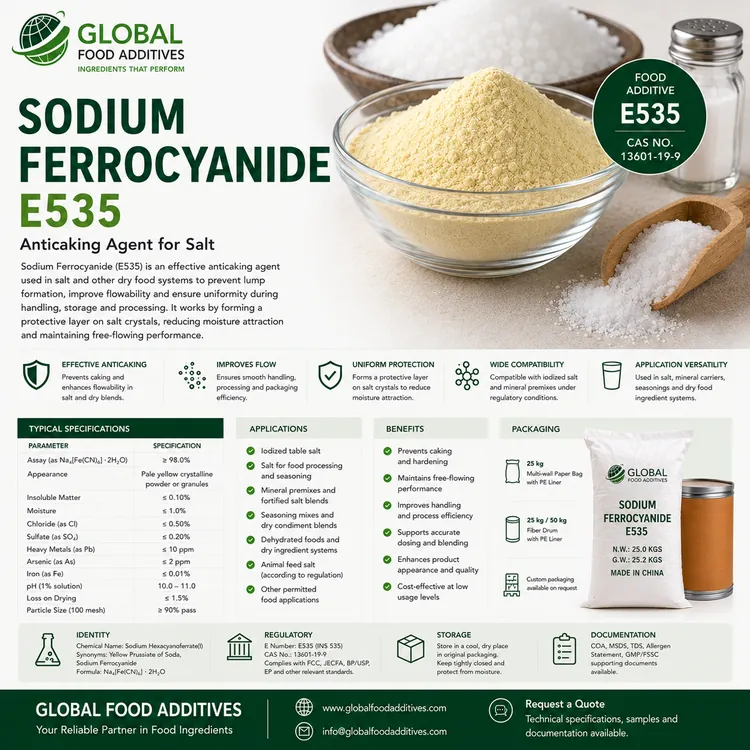
Product identity
| Product | Sodium Ferrocyanide |
|---|---|
| Common names | Sodium hexacyanoferrate(II), yellow prussiate of soda, YPS |
| Category | Anticaking, Flow & Mineral Carriers |
| Function | Anticaking agent / salt-flow aid / dry mineral handling support |
| E / INS number | E535 / INS 535 |
| CAS / identity | 13601-19-9 |
| Chemical identity | Sodium ferrocyanide / sodium hexacyanoferrate(II); hydrate basis should be confirmed from supplier documents |
| Ingredient family | Ferrocyanide anticaking agent |
| Typical form | Fine powder, crystal, granule or carrier grade depending on supplier specification |
| Main technical role | Caking prevention and flowability improvement in salt and selected dry mineral systems |
| Use status | Confirm permitted salt categories, maximum use levels and label declaration by destination market |
Application fit
Potential use areas may include controlled and legally permitted dry systems such as:
- Table salt, kitchen salt and consumer salt products
- Industrial food salt for processors and packers
- Iodized salt, fluoridated salt or fortified salt systems where permitted
- Salt used in seasoning blends, snack seasonings and dry mixes
- Salt for bakery, meat, cheese and prepared-food manufacturing
- Brine-salt preparation where free-flowing salt handling is important
- Dry mineral carrier systems where regulations allow use
- Export salt products requiring stable flow under humid logistics conditions
Industrial function and flow-control value
Sodium Ferrocyanide is valued for its ability to help prevent salt crystals from binding together under humid or compressed storage conditions. Salt is hygroscopic and can absorb moisture from the environment, especially when exposed to temperature changes, poor packaging, long storage or high humidity. Anticaking treatment helps maintain free-flowing behavior, reduce lump formation, improve dosing accuracy and support clean filling, conveying, bagging and end-use performance.
The industrial value of Sodium Ferrocyanide is usually measured by performance at low use levels. A suitable grade should disperse consistently, provide reliable anticaking action, minimize visible discoloration, maintain salt quality, comply with destination-market limits and be supported by strong documentation. The cost-in-use should be evaluated together with salt type, humidity exposure, packaging barrier, particle size, storage time and the buyer's final product requirements.
Technical specification points to compare
Composition and assay
- Sodium Ferrocyanide assay or active content on the supplier's declared basis
- Hydrate basis and water of crystallization where applicable
- Ferrocyanide content and calculation method
- Moisture or loss-on-drying value
- pH value of solution where specified
- Color, odor and appearance specification
- Compliance with food additive, FCC, JECFA, EU or customer-specific standards where required
Impurity and safety controls
- Heavy metals and elemental impurity limits
- Lead, arsenic, cadmium and mercury statements where required
- Free cyanide or related impurity limits where specified by the supplier or regulation
- Iron content and ferricyanide-related parameters where relevant
- Chloride, sulfate, insoluble matter or other inorganic impurity limits where specified
- Foreign matter and visible contamination controls
- Microbiological statement where relevant to the supplied grade
- Allergen, GMO, irradiation and contamination statements where required
Physical properties
- Particle size or mesh distribution
- Bulk density and flowability
- Solubility and dispersion behavior in salt systems
- Dusting tendency and operator exposure considerations
- Color impact on white salt or specialty salts
- Moisture sensitivity and caking behavior during storage
- Compatibility with dosing equipment, salt blending and carrier systems
Process compatibility
- Suitability for table salt, industrial salt, iodized salt or specialty salt systems
- Compatibility with iodine compounds, fluoride systems, minerals and dry seasonings where relevant
- Effect on salt flow, clump resistance, dosing accuracy and packing speed
- Behavior under humidity exposure, pallet compression and long-distance export logistics
- Impact on color, label declaration, customer restrictions and regulatory limits
- Compatibility with filling lines, screw feeders, silos, hoppers and salt dosing systems
Formulation and application guidance
Sodium Ferrocyanide should be selected according to the final salt product, expected humidity exposure, packaging quality and target shelf life. Industrial salt used in automated dosing lines may need strong flow reliability, while retail salt may require attractive appearance, consistent pourability and stable behavior in small packages. In iodized or fortified salt, compatibility with the fortificant system and label requirements must also be reviewed.
- Table salt: evaluate pourability, visual appearance, humidity resistance, packaging barrier, label declaration and consumer-market rules.
- Iodized salt: confirm compatibility with potassium iodate, potassium iodide or other iodine systems, along with fortificant stability and anti-caking performance.
- Industrial food salt: review silo flow, feeder performance, dosing accuracy, clump formation, humidity exposure and line-cleaning needs.
- Seasoning blends: assess salt interaction with spices, flavors, sugars, acidulants, powders and packaging headspace.
- Bakery and processed-food salt: verify flow in dry dosing systems, blend uniformity, label expectations and carry-through into finished formulas.
- Export salt products: validate performance under expected shipping time, climate, container humidity, pallet compression and warehouse conditions.
Anticaking mechanism and performance design
Caking in salt is driven by moisture pickup, partial dissolution, recrystallization, crystal bridging, pallet compression and temperature cycling. Anticaking agents help interrupt this process by modifying crystal-surface behavior, reducing crystal bridging or improving dry flow. Sodium Ferrocyanide is especially associated with salt anticaking because it can help control salt crystal adhesion at very low usage levels when properly dispersed.
Performance depends on more than the additive itself. Salt crystal size, fines content, moisture level, surface area, packaging barrier, storage humidity, filling temperature and warehouse conditions all influence caking risk. Buyers should validate Sodium Ferrocyanide performance in their actual salt grade, packaging format and logistics route before commercial approval.
Performance drivers
- Salt crystal size and particle distribution
- Fine-particle content and dust level
- Moisture content and humidity exposure
- Storage time, pallet compression and temperature cycling
- Packaging film, liner, closure and moisture barrier
- Distribution route and container conditions
- Uniform dispersion of the anticaking additive
Typical validation work
- Flowability and angle-of-repose comparison
- Caking tendency under controlled humidity
- Clump-resistance testing after compression
- Salt-pouring and dosing-line performance checks
- Blend uniformity and additive distribution testing
- Color and visual appearance review
- Label and regulatory confirmation before launch
Salt quality, fortification and dry-blend behavior
When Sodium Ferrocyanide is used in salt, the buyer should review the complete salt system. Iodized salt, reduced-sodium salt, mineral salt blends and seasoning salts may contain additional components that affect flow, moisture sensitivity and shelf life. The anticaking strategy must be compatible with fortification, color, flavor, particle size and packaging requirements.
In dry blends, the salt fraction can influence the entire mix. Poor salt flow can create segregation, inconsistent dosing, blocked feeders, variable seasoning strength and packaging problems. Sodium Ferrocyanide may help maintain the flow of the salt component, but the complete blend still requires validation because sugars, spices, flavors, acids, starches and powders may have their own caking behavior.
Sodium Ferrocyanide compared with other anticaking agents
Sodium Ferrocyanide belongs to a wider group of anticaking and flow-control ingredients. It should not be substituted one-for-one with silicon dioxide, calcium silicate, magnesium carbonate, sodium aluminosilicate, tricalcium phosphate or potassium ferrocyanide without technical and regulatory review. Each additive has different permitted food categories, maximum levels, particle behavior, label impact, appearance, moisture-control mechanism and performance in salt.
| Ingredient | Typical consideration |
|---|---|
| Sodium Ferrocyanide | Specialized salt anticaking agent used at low levels where E535 / INS 535 is permitted and documented. |
| Potassium Ferrocyanide | Related ferrocyanide anticaking agent with potassium contribution and separate regulatory identity. |
| Calcium Ferrocyanide | Related ferrocyanide salt with different mineral contribution and market-specific permissions. |
| Silicon Dioxide | Common dry-powder anticaking agent used in many powders and blends; different mechanism and appearance impact. |
| Calcium Silicate | Moisture-absorbing anticaking aid used in selected dry products; not equivalent to ferrocyanides in salt applications. |
| Magnesium Carbonate | Traditional anticaking ingredient for some salts and dry powders; performance and label profile differ from E535. |
| Tricalcium Phosphate | Mineral anticaking and carrier ingredient often used in powders and dry blends with different permitted uses. |
Quality and food safety review
A robust Sodium Ferrocyanide sourcing review should include more than product name and price. Buyers should confirm exact grade, food-grade suitability, assay, hydrate basis, color, particle size, solubility, impurity profile, free-cyanide control where required, heavy metal limits, packaging integrity, shelf life, origin, traceability and supplier qualification. For salt producers, documentation quality can be as important as anticaking performance.
Before commercial approval, compare the supplier specification against the intended salt category, use level, blending process, packaging format, customer requirements and destination-market additive rules. If Sodium Ferrocyanide will be used in an export salt product, regulatory and labeling review should be completed before production scale-up.
Regulatory and labeling considerations
Sodium Ferrocyanide is associated with E535 / INS 535, but permission depends on the destination market, food category, salt category, maximum use level, technical need and declaration format. Some markets may permit ferrocyanides only in salt or salt substitutes, while others may have different restrictions or labeling requirements.
Label declaration may require the ingredient name, additive class, E number, INS number or market-specific wording. Customer standards may also restrict ferrocyanides even where local regulations permit them. Buyers should review additive limits, salt standards, import rules, nutrition claims, clean-label expectations and final-pack label wording before commercial launch.
Global Food Additives can support supplier communication and document collection; however, final responsibility for regulatory approval, use level, finished-product labeling, customer approval and market placement remains with the buyer, importer, brand owner or manufacturer.
Documents to request
- Product specification or technical data sheet
- Batch-specific certificate of analysis for available lot
- Safety data sheet in the required language or format
- Food-grade or intended-use declaration where available
- Assay, hydrate basis, moisture and pH information
- Particle-size distribution and appearance specification
- Heavy metal and impurity statements
- Free cyanide or related impurity statement where required by the buyer or destination market
- Iron, chloride, sulfate and insoluble-matter data where relevant
- Microbiological statement where relevant
- Allergen, GMO, vegan, halal or kosher statements where required
- Origin, manufacturer, shelf-life and storage information
- Label draft, packaging details and pallet configuration
- Manufacturing site certification such as GMP, HACCP, ISO or FSSC where available
- Market-specific declarations requested by the destination country, customer or importer
- Change-control, traceability and recall-support information for audited supply chains
Packaging, storage and logistics
Sodium Ferrocyanide packaging should protect the product from contamination, moisture, light exposure where recommended, caking, label damage and handling loss. Depending on supplier format and quantity, it may be supplied in sealed bags, drums, cartons, pails or other controlled packaging systems. Packaging should support safe storage, clear identification, dosing control and batch traceability.
- Packaging size: confirm net weight per bag, drum, carton or pail and whether small-pack options are available for controlled dosing.
- Moisture protection: request information on inner liner, sealing method, closure integrity, pallet wrapping and recommended storage humidity.
- Handling: review particle size, dusting tendency, PPE recommendations, spill control and safe weighing procedures from the SDS.
- Storage: keep in original packaging, tightly closed, dry, labeled and separated from incompatible materials and ordinary ingredients.
- Dosing control: use calibrated equipment and documented procedures because permitted use levels are normally low.
- Transport: confirm HS code guidance, labeling requirements, pallet configuration, transport classification and country-specific import documents.
- Traceability: ensure each package is clearly labeled with product name, batch number, net weight, shelf life and supplier identification.
Commercial purchasing notes
For industrial purchasing, quotation accuracy depends on the quality of the inquiry. The most useful request normally includes target grade, reference specification, intended salt type, required assay, particle-size preference, target use level, quantity, destination country, Incoterms preference, packaging size, required documents and expected shipment date.
If the buyer already uses Sodium Ferrocyanide, sharing an existing COA, label, TDS, SDS or internal specification helps compare alternatives more accurately. It is also useful to mention the salt type, crystal size, moisture level, packaging format, target shelf life, humidity exposure, domestic or export market and whether the additive will be dosed directly or supplied through a premix or carrier system.
Best-fit inquiry details
- Product name: Sodium Ferrocyanide
- Common name accepted: Yellow Prussiate of Soda / YPS
- Required food grade and intended salt application
- E535 / INS 535 declaration requirement
- Assay, hydrate basis, moisture and particle-size expectations
- Powder, crystal, granule or carrier-grade preference
- Target use level and blending method if known
- Quantity, annual forecast and repeat-order potential
- Destination country and delivery term
- Preferred packaging and labeling language
- Required certificates, SDS and regulatory declarations
What we can coordinate
- Supplier specification comparison
- Document collection and pre-shipment review
- Packaging and logistics communication
- Export-ready quotation support
- Alternative anticaking-agent discussion
- Customer-specific documentation requests
How to request this product
Send the product name, target grade or reference specification, intended salt application, target use level, quantity, destination country, packaging preference, expected shipment date and required documents. If you already purchase Sodium Ferrocyanide, attach or describe your existing specification, label, safety data sheet or certificate of analysis so supplier options can be compared more accurately.
Useful answers
What is Sodium Ferrocyanide used for in food manufacturing?
Sodium Ferrocyanide is used as an anticaking agent and salt-flow aid in selected dry mineral systems, especially salt products, where permitted. It helps reduce caking, improve flowability and support clean handling during packing, storage, dosing and transport.
Is Sodium Ferrocyanide mainly used in salt?
Yes. Sodium Ferrocyanide is most commonly reviewed for table salt, industrial food salt, iodized salt and selected salt-containing dry systems. Suitability for any application depends on destination-market rules and final product category.
Is Sodium Ferrocyanide the same as free cyanide?
No. Sodium Ferrocyanide is a stable iron-cyanide complex used under specific regulatory limits. It should not be confused with free cyanide salts. Buyers should still follow supplier SDS, permitted-use limits and food-grade documentation requirements.
Can Sodium Ferrocyanide replace silicon dioxide?
Not automatically. Sodium Ferrocyanide and silicon dioxide have different mechanisms, permitted uses, label declarations, particle behavior and application profiles. Substitution should be validated through salt-flow testing and regulatory review.
Can Global Food Additives source Sodium Ferrocyanide?
Global Food Additives can review sourcing options for Sodium Ferrocyanide according to target specification, food grade, assay, particle size, quantity, destination, packaging and required documentation.
Which documents should be requested?
Buyers commonly request a technical data sheet or specification, certificate of analysis, safety data sheet, origin statement, shelf-life information, label and packing details, impurity statements, assay data, particle-size information and market-specific declarations.
Is this product permitted in every country?
No. Food additive use depends on destination-market rules, salt category, food category, maximum permitted level, label declaration, technical need and buyer responsibility.
Tell us which food additive or ingredient you need.
Send product names, target specifications, quantity, destination country, packaging preference, delivery term, and document requirements. Our team will review your inquiry and respond from orders@foodgradeadditives.com.
Your message has been received. You will be redirected to the home page.