
Succinic Acid E363
Succinic Acid, also known as butanedioic acid, is a food-grade organic acid used by industrial food manufacturers for acidity regulation, buffering, savory-acid flavor balance, pH control and process stability. It is selected where formulators need a controlled acid profile, mild lingering acidity, taste rounding and compatibility with sauces, seasonings, beverages, confectionery, dairy systems and processed foods. This page is prepared for purchasing teams, R&D technologists, QA departments, regulatory teams and import managers who need structured technical information before requesting a quotation.
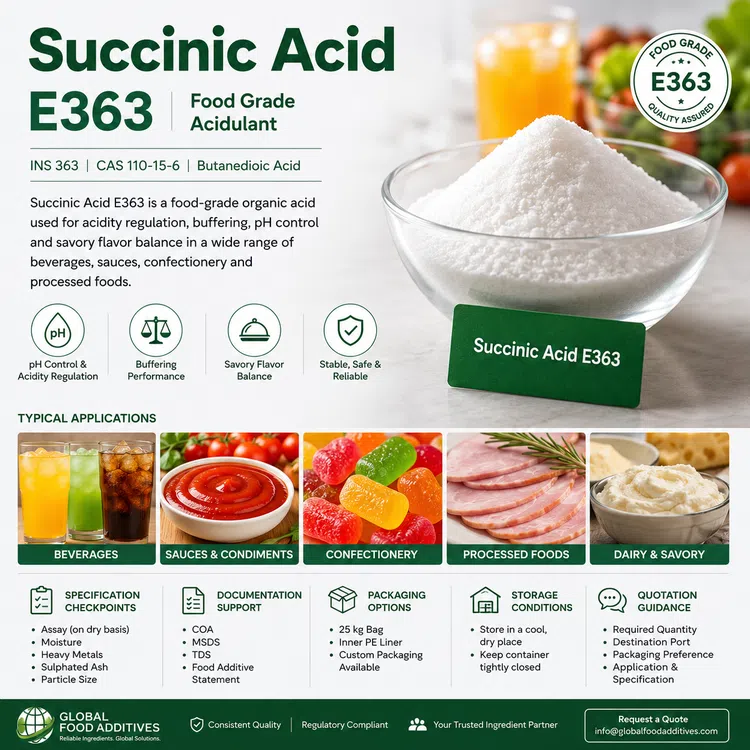
Product identity
| Product name | Succinic Acid |
|---|---|
| Common names | Succinic Acid E363, butanedioic acid, ethane-1,2-dicarboxylic acid |
| Chemical formula | C4H6O4 |
| CAS number | 110-15-6 |
| E / INS number | E363 / INS 363 |
| Category | Acidulants & Acidity Regulators |
| Primary function | Acidity regulator, acidulant, buffering ingredient and flavor-balance tool |
| Acid type | Dicarboxylic organic acid with two dissociation stages and useful buffering behavior |
| Typical appearance | White to off-white crystalline powder, crystals or granules depending on grade |
| Typical handling form | Dry acidulant for direct addition, dry blending, solution preparation or premix manufacturing |
Application fit
Succinic Acid is evaluated where controlled acidity, buffering behavior, savory flavor impact or pH adjustment is required. Potential use areas may include:
- Sauces, dressings, condiments, marinades and savory flavor systems
- Seasonings, bouillons, soups, broths, meat analogues and umami-style applications
- Beverages, beverage concentrates, syrups and acidified drinks where permitted
- Confectionery, gummies, jellies, hard candy and acid-sugar systems
- Dairy systems, fermented products, plant-based alternatives and cream-style products
- Processed foods requiring pH control, buffering or flavor adjustment
Technical overview for industrial buyers
Succinic Acid is a four-carbon dicarboxylic acid with a distinctive acid profile that can be useful when a formula requires more than sharp acidity. Compared with commonly used acids such as citric, malic, lactic, acetic or fumaric acid, Succinic Acid may contribute a more rounded, savory and lingering acid impression. This makes it relevant in formulations where acidity is linked to flavor complexity, saltiness perception, umami balance, fermented notes or cooked-food character.
For industrial procurement, Succinic Acid should be reviewed by assay, purity, moisture, residue on ignition, melting range, particle size, solubility, appearance, odor, organic impurity profile, heavy metals, microbial expectations where required, packaging protection, shelf-life and documentation completeness. The best grade depends on the final application: beverage producers may prioritize solubility and low insoluble matter, dry-blend manufacturers may prioritize particle size and flowability, and sauce or seasoning producers may prioritize sensory profile and consistent acid strength.
Functional role in formulation
- pH control: helps adjust acidity in sauces, beverages, seasonings and processed foods.
- Buffering support: contributes to pH stability in systems where acid balance must remain consistent during storage.
- Flavor balance: can provide a savory, rounded and lingering acid note depending on dosage and product matrix.
- Salt and umami perception: may support taste depth in broths, meat-style flavors, sauces and seasoning systems.
- Preservation support: lowering pH can support microbial control as part of a complete preservation strategy.
- Process stability: can help manage acid-sensitive reactions, texture behavior and finished product consistency.
Key buying parameters
| Grade | Food grade; confirm E363 / INS 363 identity and destination-market compliance |
|---|---|
| Assay | Request Succinic Acid assay and test method on specification and COA |
| Purity profile | Review organic impurities, residue on ignition and market-specific contaminant limits where required |
| Particle size | Important for dry blending, dissolution speed, dusting, segregation risk and dosing accuracy |
| Solubility | Relevant for beverages, syrups, concentrates, brines and liquid dosing applications |
| Moisture | Controls flowability, caking tendency, shelf life and dry-mix performance |
| Sensory profile | Evaluate acid character, savory note, aftertaste and interaction with salt, acids, sweeteners and flavors |
| Packaging | Commonly supplied in lined bags, cartons, fiber drums, HDPE containers or palletized export packaging |
Industrial application notes
In sauces, dressings and condiments, Succinic Acid can contribute pH adjustment, acidity control and savory flavor balance. It may be evaluated in soy-style sauces, marinades, meat sauces, gravies, vinegar-based systems, pickling liquids, savory spreads and seasoning liquids. Product developers should test the interaction with salt, vinegar, citric acid, lactic acid, monosodium glutamate, yeast extract, hydrolyzed vegetable protein, spices and preservatives. Final pH and sensory profile should be measured after processing and after storage, not only immediately after mixing.
In seasoning, soup and broth systems, Succinic Acid may help build depth, cooked notes and rounded acidity. It can support flavor systems where acidity should not be sharp or citrus-like. Dry seasoning manufacturers should evaluate particle size, blend uniformity, moisture pickup, caking, carrier compatibility and segregation risk. In instant soups and bouillons, dissolution behavior and final flavor balance in hot water should be validated under consumer-use conditions.
In beverages and beverage concentrates, Succinic Acid may be used as part of an acid blend where a different acid profile is desired. Beverage formulators should evaluate solubility, clarity, pH, acid bite, sweetness balance, preservative performance, heat process, packaging interaction and shelf-life stability. Because Succinic Acid is less commonly used as the main beverage acid than citric or malic acid, pilot trials and sensory evaluation are especially important.
In confectionery and acid-sugar systems, Succinic Acid may contribute controlled acidity and flavor nuance. The product developer should test dissolution, acid release, crystallization, hygroscopicity, interaction with sugar or polyols, color stability and flavor release. For gummies and jellies, pH can affect gelatin, pectin or starch systems, so acid addition timing and buffering behavior must be validated.
Acid system design
- Define the target function: pH reduction, buffering, flavor balance, preservation support or acid profile adjustment.
- Compare Succinic Acid against citric, malic, lactic, fumaric, acetic or phosphoric acid in the finished product matrix.
- Measure final pH, titratable acidity and sensory impact after processing and during shelf-life testing.
- Evaluate interactions with salt, sweeteners, flavors, proteins, starches, hydrocolloids, minerals and preservatives.
- Confirm whether Succinic Acid will be used alone or as part of an acid blend.
- Validate dosage against legal limits, label requirements and customer specifications.
Process and handling considerations
- Use accurate weighing and controlled addition because acid dosage strongly affects pH and flavor.
- Dissolve completely before addition when used in clear beverages, syrups or brines.
- For dry mixes, validate blend uniformity and segregation risk against other powders and salts.
- Manage dusting during bag opening, weighing, transfer and blending.
- Protect from moisture, contamination and strong odors during storage.
- Maintain lot traceability from raw material receipt through finished product batch records.
Quality control checkpoints
Food manufacturers usually evaluate Succinic Acid through chemical purity, physical handling and finished-product performance. Because acidulants affect pH, preservation, taste and texture, supplier changes should be tested in the real application before commercial approval. Incoming QC should confirm that each batch matches the approved specification and performs consistently in the buyer’s process.
Typical laboratory checks
- Appearance, color, odor and foreign matter inspection
- Identification as Succinic Acid / E363
- Assay or purity confirmation
- Moisture or loss on drying
- Residue on ignition or ash where required
- Melting range or other identity-supporting physical parameter
- Particle size distribution or sieve analysis
- Solubility and solution clarity for liquid applications
- Organic impurities or related acids where specified
- Lead, arsenic, mercury, cadmium or other heavy metals according to destination rules
- Microbiological status where required by application and specification
- Lot number, manufacturing date and shelf-life verification
Functional performance checks
- Finished product pH and titratable acidity
- Buffering behavior during heat treatment, storage and dilution
- Flavor impact in savory, sweet, acidic or fermented systems
- Comparison with approved acid blend or benchmark product
- Dissolution speed in process water, syrup, brine or sauce base
- Dry blend homogeneity and caking behavior in seasoning or premix systems
- Compatibility with preservatives, hydrocolloids, proteins, minerals and colors
- Packaging seal integrity and pallet condition on receipt
Regulatory and compliance notes
Succinic Acid is commonly identified as E363 or INS 363. Permitted food categories, maximum use levels, additive naming, acidity-regulator declarations and label requirements can differ by country and final application. Buyers should confirm whether Succinic Acid is allowed in the intended food category and whether the final product must declare it by name, additive class, E number or another market-specific wording.
Succinic Acid may be sourced from different production routes, including conventional chemical production or bio-based fermentation routes depending on supplier. If the buyer requires non-GMO, fermentation-derived, vegan, halal, kosher, allergen-free, organic-compatible or sustainability-related positioning, supporting documentation must be requested before purchase. These claims should not be assumed from the product name alone.
Recommended documents to request
- Product specification or technical data sheet with assay, purity and physical parameters
- Certificate of analysis for available batch or lot
- Safety data sheet where applicable
- Food-grade declaration and statement of intended food use
- Origin statement and manufacturer information where available
- Production-route statement where required, such as fermentation-derived or synthetic route information
- Allergen, GMO, vegan, halal, kosher or animal-origin declarations when required
- Heavy metals statement and market-specific contaminant compliance where applicable
- Particle size, solubility, moisture and organic-impurity information where specified
- Shelf-life, storage condition and humidity-protection recommendation
- Label draft, net weight, drum, carton, bag or container dimensions, pallet configuration and container loading estimate
- Traceability information, batch coding format and recall-support documentation
Specification information useful for quotation
For a faster and more accurate quotation, provide the target specification, required grade, physical form, annual and first-order quantity, destination country, delivery term, packaging preference, required certifications, inspection requirements and expected shipment date. If you already purchase Succinic Acid, share the existing COA, technical data sheet, product label, particle size requirement, approved sample or benchmark supplier specification so equivalent options can be compared by assay, purity, particle size, solubility, origin, documentation and logistics cost.
Packaging and logistics
Industrial Succinic Acid is usually quoted according to product form, net weight, packaging type, palletization, container loading, port of loading, Incoterms and destination. Moisture protection is important to maintain flowability and prevent caking. Export shipments should be reviewed for shelf-life remaining, documentation deadlines, pallet wrapping, humidity exposure, bag integrity and destination import requirements.
Commercial evaluation criteria
- Food-grade status and documentation completeness
- Consistency of assay, purity, particle size, moisture and sensory profile
- Suitability for sauces, seasonings, beverages, confectionery, dairy systems or dry blends
- Availability of allergen, GMO, vegan, halal, kosher, origin or production-route documentation when required
- Lead time, stock position and minimum order quantity
- Packaging suitability for manual, semi-automatic or automated handling
- Regulatory fit for the destination market and final product category
- Total landed cost and cost-in-use, not only unit price
How to request this product
Send the product name, grade, target specification, physical form, quantity, destination country, packaging preference, expected shipment date and required documents. If the ingredient will be used in beverages, confectionery, sauces, dressings, seasonings, dairy systems, plant-based products or processed foods, include the application category, target pH, acid blend, flavor objective and any label claim requirement so the supplier review can focus on the most relevant technical and regulatory parameters.
Useful answers
What is Succinic Acid used for in food manufacturing?
Succinic Acid is used as an acidity regulator, acidulant, buffering ingredient and flavor-balance tool. It may support pH control, savory-acid taste development, preservation strategy and process stability in approved food and beverage applications.
Is Succinic Acid the same as citric acid?
No. Succinic Acid and citric acid are different organic acids with different taste profiles, acid strength, solubility and buffering behavior. Succinic Acid can provide a more savory and lingering acid impression, while citric acid is usually sharper and more citrus-like.
Which applications commonly use Succinic Acid?
Succinic Acid may be evaluated in sauces, dressings, condiments, seasonings, soups, broths, beverages, confectionery, dairy systems, plant-based products and processed foods where permitted by local regulations.
Can Succinic Acid be used in acid blends?
Yes. Succinic Acid can be evaluated with citric, malic, lactic, acetic, fumaric or phosphoric acid depending on the desired acidity, buffering behavior and flavor profile. The final blend should be tested for pH, taste, stability and legal compliance.
Which specification parameters matter most?
Important parameters include assay, identity, moisture, residue on ignition, melting range, solubility, particle size, appearance, odor, organic impurities, heavy metals, microbiological status where required and functional performance in the buyer’s application.
Can Global Food Additives source Succinic Acid?
Global Food Additives can review sourcing options for Succinic Acid according to target specification, physical form, application, quantity, destination, packaging, certification needs and required documentation.
Which documents should be requested?
Buyers commonly request a technical data sheet, certificate of analysis, safety data sheet, food-grade declaration, origin statement, allergen statement, GMO status, halal or kosher certificate, particle size or solubility information, shelf-life and storage information, label details and packing configuration.
Is this product permitted in every country?
No. Food additive use depends on destination-market rules, food category, use level, label requirements and buyer responsibility. Always verify local regulations before commercial use.
Tell us which food additive or ingredient you need.
Send product names, target specifications, quantity, destination country, packaging preference, delivery term, and document requirements. Our team will review your inquiry and respond from orders@foodgradeadditives.com.
Your message has been received. You will be redirected to the home page.