
L(+)-Tartaric Acid
L(+)-Tartaric Acid is a food-grade diprotic organic acid used for acidification, flavor development, pH and titratable-acidity adjustment, chemical leavening, buffering-system design and process standardization.
Chemically identified as C4H6O6, Tartaric Acid contains two carboxylic-acid groups and two hydroxyl groups. It produces a pronounced, clean sourness and can provide a different sensory and technical profile from citric, malic, lactic, fumaric or phosphoric acid.
Industrial performance depends on acid purity, stereochemical form, particle size, dissolution, product buffering capacity, mineral content, process temperature, final pH, titratable acidity, package conditions and interactions with proteins, hydrocolloids, colors, preservatives and bicarbonates.
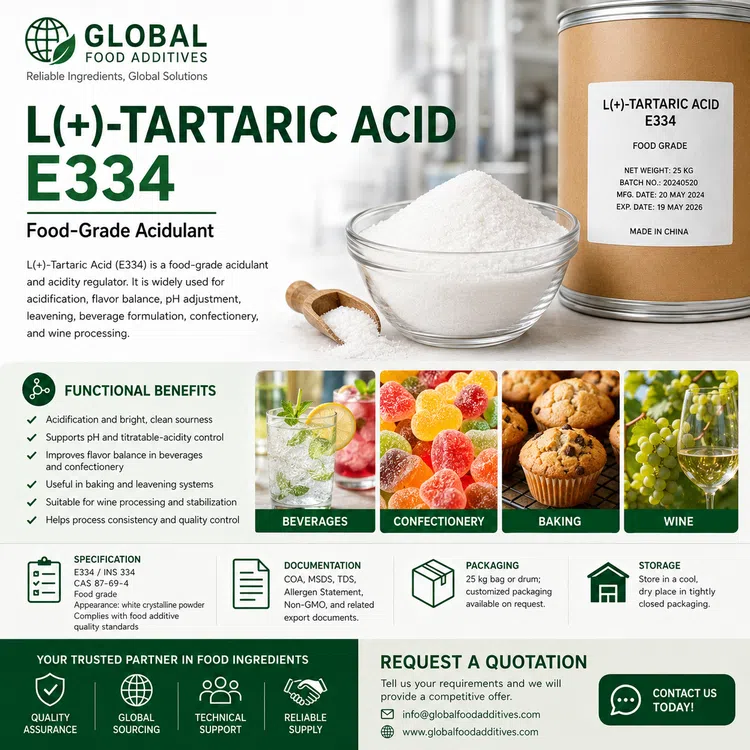
Product identity
| Product name | L(+)-Tartaric Acid |
|---|---|
| General name | Tartaric Acid |
| Chemical name | 2,3-Dihydroxybutanedioic Acid |
| Product category | Organic acidulant, acidity regulator and processing ingredient |
| E number | E334 |
| INS number | INS 334 |
| CAS number | 87-69-4 for L(+)-Tartaric Acid |
| Chemical formula | C4H6O6 |
| Molar mass | Approximately 150.09 g/mol |
| Chemical class | Diprotic hydroxy dicarboxylic acid |
| Typical appearance | White crystalline powder or colorless crystals |
| Typical sensory profile | Pronounced, clean and persistent sourness |
| Water behavior | Readily soluble in water; dissolution increases with appropriate temperature and agitation |
| Thermal behavior | Stable under many normal food processes but can decompose under sufficiently severe heating |
| Typical commercial forms | Fine powder, crystalline powder, granules, screened grades and application-specific blends |
Primary industrial functions
- Reduces pH in beverages and formulated foods
- Increases and standardizes titratable acidity
- Provides a pronounced sour flavor profile
- Balances sweetness and fruit flavor
- Supports chemical leavening with bicarbonates
- Contributes to buffering-system design
- Supports preservation hurdles through pH control
- Helps manage selected metal-ion interactions
- Standardizes natural acidity between raw-material lots
- Supports process control in wine and grape-based products
Why optical identity matters
Tartaric Acid contains two stereogenic carbon atoms and can exist in multiple stereochemical forms. Commercial food-grade material is normally specified as L(+)-Tartaric Acid, the naturally occurring optically active form associated with grapes and wine production.
Specific optical rotation is therefore an important identity and purity parameter. It helps distinguish the required L(+)-form from racemic, D(-) or meso material and supports compliance with the selected food-grade monograph.
L(+)-Tartaric Acid
The form generally specified for food applications. Supplier documentation should state identity, assay, optical rotation and compliance with the required standard.
D(-)-Tartaric Acid
The mirror-image enantiomer of L(+)-Tartaric Acid. It should not be accepted as food-grade L(+)-Tartaric Acid without explicit regulatory and specification authorization.
DL-Tartaric Acid
A racemic mixture containing equal proportions of the two enantiomers. Its regulatory status and technical identity differ from a specified L(+)-grade.
Meso-Tartaric Acid
A stereoisomer that is optically inactive despite containing stereogenic centers. It may be controlled as an impurity in food-grade specifications.
Commercial sourcing routes
Commercial L(+)-Tartaric Acid may be produced from tartrate-rich materials associated with grape and wine processing or through other validated manufacturing and purification routes. Source, process and claim status are supplier specific.
Buyers requiring a particular origin, natural-source statement, non-GMO status, wine-industry by-product origin or sustainability claim should request documented evidence rather than relying on the product name alone.
Grape and wine-derived routes
Tartrate-containing by-products can be recovered, converted, purified and crystallized into food-grade L(+)-Tartaric Acid. Traceability and processing declarations should be reviewed.
Other manufacturing routes
Alternative validated processes may be used by some producers. Regulatory identity, stereochemical purity and food-grade compliance remain more important than a general marketing description.
Natural-source claims
Claim language is market specific. Buyers should obtain origin, manufacturing-process and legal-position statements before using natural-source or upcycled-origin claims.
Supply-chain variability
Availability and price can be influenced by agricultural by-product supply, purification capacity, energy, freight and food-grade certification requirements.
Technical parameters to evaluate
Food-grade Tartaric Acid should be purchased against a signed specification linked to the required national, international or customer standard. Exact limits vary by monograph and supplier, so the parameters below are specification categories rather than universal acceptance limits.
| Parameter | Industrial significance | Purchasing guidance |
|---|---|---|
| Assay | Confirms active Tartaric Acid concentration. | Specify minimum and maximum assay, analytical method and reporting basis. |
| Identification | Confirms chemical identity against the approved standard. | Require compliance with the selected compendial or regulatory identification tests. |
| Specific optical rotation | Confirms stereochemical identity and helps detect non-L(+) material. | Specify solvent, concentration, temperature and acceptable range. |
| Appearance | Provides an initial indication of color, contamination, moisture exposure or storage damage. | Define acceptable color, crystal form and visible contamination criteria. |
| Solution appearance | Indicates clarity, color and insoluble contamination. | Define acid concentration, water quality, container and visual acceptance method. |
| Loss on drying or moisture | Affects active concentration, flow and caking. | Include a maximum value and defined drying method. |
| Sulfated ash | Indicates inorganic residue remaining after ignition. | Set a maximum limit according to the selected purity standard. |
| Oxalate | Important organic-acid impurity parameter. | Include a limit and approved method where required by the applicable standard. |
| Sulfate | May indicate purification or raw-material-related inorganic residue. | Confirm the maximum permitted level. |
| Chloride | Can indicate inorganic contamination or process residues. | Include a limit when required by the selected monograph. |
| Calcium | Can affect solution clarity and tartrate precipitation in sensitive systems. | Use a controlled limit for beverages, wine and clear-liquid applications. |
| Iron | Can affect color, flavor and oxidative stability. | Request a suitably low limit for clear or oxidation-sensitive products. |
| Lead | Critical elemental-contaminant parameter. | Include a specific maximum value and approved analytical method. |
| Arsenic | May be separately controlled under food-additive standards. | Confirm the destination-market or customer limit. |
| Other elemental impurities | Cadmium, mercury or total heavy metals may be controlled in certain markets. | Align requirements with current destination-country rules. |
| Particle-size distribution | Influences dissolution, dust, dry blending and feeder performance. | Specify fine powder, standard crystal, granular or screened grade. |
| Bulk density | Affects packaging volume, hopper capacity and feeder calibration. | Confirm whether loose or tapped bulk density is required. |
| Microbiological status | Dry organic acids generally have low microbial growth potential, but hygienic manufacture remains necessary. | Include microbiological limits when required by customer policy or the intended food category. |
pH and titratable acidity are not the same
pH measures hydrogen-ion activity at a specific point in the formulation. Titratable acidity measures the total acid capacity neutralized under a defined analytical method. Two products can have the same pH but different titratable acidity and therefore different sourness, buffering behavior and processing performance.
Tartaric Acid is diprotic, meaning it can release two acidic protons in stages. Its effect on final pH depends on the formulation's buffering capacity, mineral content, proteins, salts and other acids or bases.
| Measurement | What it indicates | Industrial relevance |
|---|---|---|
| pH | Instantaneous acid-base condition of the product. | Affects microbial behavior, protein stability, color, preservative performance and process controls. |
| Titratable acidity | Total neutralizable acid under a defined titration endpoint. | Closely related to flavor intensity, acid load and formulation standardization. |
| Buffering capacity | Resistance of the formulation to pH change. | Determines how much acid is needed to reach and maintain the target pH. |
| Acid neutralizing value | Amount of base neutralized by a defined quantity of acid. | Important for chemical leavening and acid-blend calculations. |
| Acid profile | Combined sensory and chemical behavior of all acids present. | Influences sourness onset, persistence, flavor authenticity and aftertaste. |
Flavor profile and acid blending
Tartaric Acid is often selected when a pronounced, clean and relatively persistent sourness is desired. It can reinforce grape, berry, tamarind, sour confectionery and wine-associated flavor profiles.
Acid blends can provide a more complex sensory curve than a single acid. Tartaric Acid may be combined with permitted citric, malic, lactic, fumaric, phosphoric or other acids to balance sourness onset, duration, pH, solubility and cost.
| Acid | General formulation role | Comparison consideration |
|---|---|---|
| Tartaric Acid | Pronounced sourness, grape and wine association, diprotic acidification and leavening capability. | Mineral interactions and tartrate precipitation can be relevant. |
| Citric Acid | Widely used bright acidity and effective buffering through citrate systems. | Direct replacement changes acid equivalents and sensory profile. |
| Malic Acid | Persistent sourness often used in fruit and confectionery applications. | Can provide a different flavor duration and pH response. |
| Fumaric Acid | Strong, persistent acidity with relatively low water solubility. | Dissolution and dry-product applications require specific process design. |
| Lactic Acid | Mild acid profile and liquid dosing in dairy, savory and fermented-style products. | Delivered concentration and water contribution must be included. |
| Phosphoric Acid | Mineral acid used in selected beverage and process applications. | Different buffering, labeling and sensory profile. |
Industrial food applications
Beverages and concentrates
- Fruit-flavored beverages
- Grape and berry drinks
- Powdered beverage mixes
- Syrups and concentrates
- Energy and sports drinks
- Frozen beverage bases
Evaluate final pH, titratable acidity, mineral content, sweetness, preservative system, color stability and package conditions.
Confectionery
- Hard-boiled candy
- Gummies and jellies
- Sour coatings
- Chewing gum
- Compressed tablets
- Fondants and fillings
Tartaric Acid can provide pronounced sourness and may be used in dry blends or syrup phases. Moisture migration and acid crystallization should be evaluated.
Bakery and chemical leavening
- Baking powders
- Biscuits and cookies
- Cakes and sponge products
- Wafer systems
- Dry bakery premixes
- Specialty leavening formulations
Tartaric Acid reacts rapidly with bicarbonates. Reaction rate, neutralization value, premix moisture and gas-release timing should be matched to the process.
Wine and grape products
- Wine acidification where legally permitted
- Grape juice adjustment
- Wine-based beverages
- Grape must standardization
- Flavor and acidity correction
Acid adjustment can affect pH, titratable acidity, sensory balance and tartrate stability. Laboratory trials and legal review are required before cellar-scale addition.
Sauces, dressings and preserves
- Fruit sauces
- Chutneys
- Dressings
- Condiments
- Jams and fruit preparations
- Pickle-style sauces
Acidification should be validated against product buffering, heat treatment, preservative system, viscosity and finished equilibrium pH.
Dairy and plant-based systems
- Desserts and puddings
- Fruit preparations for yogurt
- Dairy-alternative desserts
- Acidified protein drinks
- Cheese-style products where permitted
Direct localized acid contact can precipitate or destabilize proteins. Addition sequence, dilution and mixing must be controlled.
Designing an acidified beverage system
- Characterize the process water. Measure alkalinity, hardness, calcium, magnesium, iron and baseline pH.
- Define the finished flavor target. Establish sweetness, sourness, fruit profile and aftertaste.
- Measure buffering ingredients. Juice, proteins, minerals, salts and botanical extracts can substantially increase acid demand.
- Prepare an acid stock solution. Dissolve under controlled agitation and protect the solution from contamination.
- Add acid gradually. Avoid localized low-pH zones that can destabilize proteins, gums or colors.
- Adjust at final volume. Water addition and concentrates can change both pH and titratable acidity.
- Confirm equilibrium pH. Recheck after all ingredients are hydrated and the product has reached the defined temperature.
- Validate processing. Measure pH before and after pasteurization, hot filling, cooling or carbonation.
- Complete shelf-life testing. Follow pH drift, flavor, precipitation, color, package condition and microbiological stability.
Sourness, crystallization and moisture control
In confectionery, Tartaric Acid may be added to a cooked syrup, incorporated into a dry blend or applied as part of a surface coating. The addition point affects flavor, acid retention, inversion, texture, moisture pickup and color stability.
- Delay addition where prolonged high-temperature exposure is undesirable.
- Control acid particle size in dry sour coatings.
- Match acid crystal size to sugar and carrier particle size.
- Evaluate moisture pickup and surface stickiness.
- Check interactions with high-intensity sweeteners.
- Measure sourness immediately and after storage.
- Evaluate color stability at the final acid concentration.
- Control acid migration between filling, shell and coating.
- Review packaging moisture barrier and storage humidity.
Reaction with bicarbonates
Tartaric Acid can react with sodium bicarbonate, potassium bicarbonate or other permitted alkaline leavening materials to release carbon dioxide. Because the free acid is readily available, gas release can begin rapidly when moisture is introduced.
The required acid quantity should be calculated from acid purity, neutralization value, bicarbonate level and target finished-product pH. Excess bicarbonate can create alkaline flavor or yellowing, while excess acid can produce excessive sourness and low pH.
| Leavening variable | Why it matters |
|---|---|
| Acid neutralizing value | Determines the amount of bicarbonate neutralized by the acid. |
| Reaction rate | Influences gas release during mixing, resting, depositing and baking. |
| Premix moisture | Can trigger premature reaction and reduce available leavening power. |
| Particle size | Influences blending uniformity and reaction speed. |
| Mixing time | Affects gas retention before thermal setting. |
| Dough or batter pH | Influences color, flavor, protein behavior and browning. |
| Oven profile | Determines gas expansion and structural setting. |
| Final sodium or potassium | Depends on the selected bicarbonate and full formulation. |
Acid adjustment and tartrate stability
Tartaric Acid is naturally associated with grapes and wine and may be used for acid adjustment where permitted. Addition can lower pH, increase titratable acidity and alter sensory balance, color expression and microbial stability.
The final result depends on potassium, calcium, ethanol, temperature, existing tartrate concentration, buffering compounds and cellar treatment. Some added acid can later participate in potassium hydrogen tartrate or calcium tartrate precipitation.
- Confirm legal permission and maximum adjustment before use.
- Conduct bench trials using the actual wine or must.
- Measure initial pH and titratable acidity.
- Evaluate sensory balance at several addition levels.
- Recheck pH after equilibration.
- Assess potassium and calcium tartrate stability.
- Evaluate cold stabilization requirements.
- Monitor color and protein stability where relevant.
- Record addition lot, quantity and tank traceability.
Tartrate salts and precipitation risk
Tartaric Acid can form salts with potassium, sodium, calcium, magnesium and other cations. The solubility of these salts differs, which can affect clarity, sediment and long-term product stability.
| Mineral or salt | Potential interaction | Evaluation point |
|---|---|---|
| Potassium | Can form potassium hydrogen tartrate under suitable conditions. | Important in wine, grape concentrates and potassium-rich products. |
| Calcium | Can form calcium tartrate with limited solubility. | Evaluate in hard water, calcium-fortified products and wine. |
| Magnesium | Contributes to buffering and mineral load. | Include actual process water in bench trials. |
| Iron | May influence color and oxidation-sensitive systems. | Control incoming water, equipment corrosion and raw materials. |
| Copper | Can participate in oxidation and precipitation chemistry. | Evaluate in beverages, wine and metal-sensitive products. |
| Sodium bicarbonate | Neutralization releases carbon dioxide. | Calculate stoichiometry and control reaction timing. |
| Potassium bicarbonate | Neutralization releases carbon dioxide and forms potassium salts. | Include final potassium and taste contribution. |
Interactions with formulation components
| Component | Potential interaction | Development guidance |
|---|---|---|
| Proteins | Localized low pH can cause aggregation, precipitation or viscosity change. | Predilute acid and add under strong, controlled agitation. |
| Pectin | pH and calcium influence gelation and set. | Coordinate acid addition with sugar, calcium and thermal process. |
| Gelatin | Acid can alter gel strength and setting behavior. | Evaluate acid level, addition temperature and storage time. |
| Starch | Acid and heat can reduce viscosity through hydrolysis. | Consider late acid addition where process design allows. |
| Hydrocolloids | Low pH can change hydration, viscosity or gel structure. | Hydrate the gum according to supplier guidance before severe acidification where appropriate. |
| Anthocyanin colors | pH strongly affects shade and stability. | Evaluate final acid system under light and heat exposure. |
| Synthetic colors | Stability varies with acid, reducing agents and process conditions. | Conduct real-time color-retention testing. |
| Benzoate and sorbate preservatives | Lower pH can increase the proportion of undissociated preservative acid. | Validate the complete preservation system and legal dosage. |
| High-intensity sweeteners | Acid level can modify sweetness onset, bitterness and aftertaste. | Complete sensory optimization at finished-product temperature. |
| Flavor systems | Acid changes flavor release and perceived authenticity. | Evaluate complete flavor-acid-sweetener balance. |
Dissolution and addition guidance
Tartaric Acid should be incorporated using a validated procedure that prevents agglomeration, localized low pH, premature bicarbonate reaction and destabilization of sensitive ingredients.
- Confirm the required acid grade. Verify L(+)-identity, assay, particle size and food-grade standard.
- Inspect process water. Hardness, alkalinity, calcium, iron and temperature affect acid demand.
- Start effective agitation. Establish circulation before introducing the acid.
- Add acid gradually. Avoid dumping the complete quantity into one static location.
- Use moderate water temperature where appropriate. Warmer water may accelerate dissolution, but process and safety limits must be observed.
- Allow complete dissolution. Confirm absence of crystals before transfer or final product addition.
- Control contact with proteins and gums. Predilute and add under agitation to avoid localized precipitation.
- Separate from bicarbonate until the intended reaction stage. Moisture can trigger premature carbon-dioxide release.
- Adjust at final volume. Recheck pH and titratable acidity after all components are present.
- Allow equilibration. Some matrices require time before a stable pH reading is obtained.
Recommended industrial trial measurements
| Trial stage | Measurements to consider |
|---|---|
| Incoming acid | Appearance, assay, optical rotation, moisture, package integrity, lot coding and certificate-of-analysis compliance. |
| Stock solution | Dissolution time, clarity, color, sediment, temperature and concentration. |
| Initial formulation | pH, titratable acidity, dissolved solids, viscosity and sensory balance. |
| Thermal processing | pH shift, viscosity, color, flavor and precipitation after pasteurization, baking or retorting. |
| Protein system | Aggregation, sediment, emulsion stability and heat stability. |
| Leavened product | Dough pH, gas release, batter density, volume, crumb structure and residual flavor. |
| Wine or grape product | pH, titratable acidity, sensory profile, potassium, calcium and tartrate stability. |
| Finished-product shelf life | pH drift, precipitation, flavor, color, texture and package condition. |
| Microbiological validation | Product-specific pathogen, spoilage and challenge-testing criteria where applicable. |
| Regulatory verification | Final additive level, ingredient declaration and destination-market compliance. |
Common processing observations
| Observation | Possible contributing factors | Areas to investigate |
|---|---|---|
| Undissolved crystals | Low water volume, low temperature, insufficient mixing, rapid addition or coarse grade. | Adjust water ratio, temperature, agitation, addition rate and particle size. |
| Final pH is lower than expected | Overdosing, low buffering capacity, incorrect acid assay or calculation error. | Verify scales, assay basis, batch volume and formulation. |
| Final pH is higher than expected | High water alkalinity, protein buffering, mineral load or insufficient acid. | Measure process-water alkalinity and complete-product buffering. |
| Product tastes too sour | High titratable acidity, sweetener imbalance or unsuitable acid blend. | Rebalance acid profile, sweetness, flavor and dosage. |
| Product pH is correct but flavor is weak | Low titratable acidity or high flavor masking. | Evaluate total acid load and acid blend rather than pH alone. |
| Protein precipitation | Localized low pH, rapid acid addition, high temperature or insufficient agitation. | Predilute acid, alter addition sequence and control temperature. |
| Starch viscosity decreases | Acid exposure during extended heating. | Consider later acid addition or a more acid-stable starch. |
| Crystals or sediment form during storage | Potassium, calcium or other tartrate precipitation. | Review mineral profile, temperature, concentration and stability testing. |
| Baked product has alkaline aftertaste | Excess bicarbonate or insufficient acid neutralization. | Recalculate neutralization and verify ingredient distribution. |
| Baked product is overly sour | Excess acid, incomplete bicarbonate addition or poor blending. | Review leavening balance, scale accuracy and premix uniformity. |
| Powder cakes in storage | Moisture exposure, damaged liner, humid warehouse or opened packaging. | Improve packaging integrity, resealing and humidity control. |
Role in food-safety and shelf-life design
Tartaric Acid can support preservation by lowering pH and increasing the effectiveness of selected antimicrobial hurdles. Its effect depends on equilibrium pH, product composition, preservative type, water activity, heat treatment, packaging and storage temperature.
Acidification alone should not be assumed to make a product safe. Manufacturers should validate the finished process through an appropriate food-safety plan, microbiological testing and, where needed, challenge studies.
- Define the required equilibrium pH.
- Measure pH using calibrated equipment and a validated method.
- Confirm pH throughout particulate and multiphase products.
- Include preservatives at legally permitted levels where required.
- Validate heat treatment and cooling.
- Control post-process contamination.
- Assess water activity and package integrity.
- Verify shelf life under realistic distribution conditions.
Permitted uses, labeling and market review
Tartaric Acid use is controlled by destination-market food-additive regulations. Permission, maximum levels, good-manufacturing-practice provisions and labeling can differ by food category.
The correct regulatory identity may depend on stereochemical form, purity standard, production route and intended use. Buyers should confirm that the supplied material is specifically acceptable as food-grade L(+)-Tartaric Acid for the destination market.
Regulatory review
- Permission for E334 or INS 334
- Permitted food category
- Maximum level or good-manufacturing-practice status
- Wine-sector rules where applicable
- Ingredient-list designation
- Processing-aid or additive classification
- Carry-over provisions
Identity review
- L(+)-stereochemical declaration
- CAS identity
- Specific optical rotation
- Compendial compliance
- Source and production-process statement
- Impurity profile
Supplier compliance
- Current food-grade specification
- Lot-specific certificate of analysis
- Traceability and recall capability
- Change-notification procedure
- Food-fraud controls
- Third-party food-safety certification
Market declarations
- Country of origin
- Manufacturing location
- GMO status where requested
- Allergen and cross-contact statement
- Halal and kosher certification
- Vegan or vegetarian suitability
Industrial powder and solution precautions
Concentrated Tartaric Acid powder and solutions are acidic and can irritate the eyes, skin and respiratory system. Workplace handling should follow the supplier's current Safety Data Sheet and site risk assessment.
- Minimize airborne dust during bag opening and weighing.
- Use local exhaust ventilation where dust may form.
- Wear suitable eye protection and work gloves.
- Use respiratory protection where required by risk assessment.
- Avoid direct eye contact and prolonged skin exposure.
- Use corrosion-compatible tanks, pumps, seals and piping.
- Add acid to water or product using a controlled plant procedure.
- Keep concentrated acid separate from bases and bicarbonates.
- Provide access to washing and eye-rinsing facilities.
- Clean spills using methods appropriate for an acidic powder.
Documents to request before approval
- Current signed product specification
- Technical data sheet
- Lot-specific certificate of analysis
- Safety Data Sheet
- Food-grade compliance declaration
- E334 or INS 334 identity declaration
- L(+)-stereochemical identity declaration
- Specific optical-rotation specification
- Applicable compendial or purity-standard declaration
- Country-of-origin statement
- Manufacturing-site statement
- Production-route or source statement where required
- Oxalate, sulfate and chloride limits
- Calcium, iron and elemental-contaminant limits
- Allergen and cross-contact declaration
- GMO statement where requested
- Halal and kosher certificates where required
- Vegan or vegetarian suitability statement
- Food-safety certification and audit scope
- Packaging and food-contact compliance declaration
- Shelf-life and storage statement
- Traceability and recall procedure
- Change-notification policy
- Irradiation statement where required
- Nanomaterial statement where required
Industrial packing, storage and shipment
| Primary packaging | Multiwall paper bags, woven bags or drums with a sealed food-grade inner liner are commonly used. |
|---|---|
| Typical commercial pack | Industrial pack sizes such as 20 kg or 25 kg may be available; exact net weight depends on supplier. |
| Bag labeling | Product name, stereochemical grade, lot, net weight, production date, best-before date, storage conditions and responsible supplier should be identifiable. |
| Palletization | Request bags per pallet, pallet dimensions, pallet material, net and gross weight, stretch wrapping and stacking limits. |
| Storage | Store tightly closed in a cool, dry, clean and ventilated area, protected from moisture, contamination and incompatible alkaline materials. |
| Moisture protection | Maintain liner integrity to reduce caking and preserve flowability. |
| Shelf life | Shelf life depends on purity, packaging and storage. Confirm the supplier's declared period and minimum remaining shelf life. |
| Transport | Vehicles and containers should be dry, clean, covered, odor-free and suitable for food ingredients. |
| Opened packaging | Reseal promptly, identify the opening date and protect the remaining product from humidity and cross-contamination. |
| Stock rotation | Apply first-expired, first-out controls and retain full lot traceability. |
Spill, wastewater and resource control
Concentrated acid solutions and acid-bearing wash water should be managed to avoid uncontrolled pH discharge and corrosion. Local wastewater limits and neutralization procedures should be followed.
- Use calibrated dosing equipment to prevent overuse.
- Collect dry spills before wet cleaning where safe and appropriate.
- Segregate concentrated acidic waste streams where practical.
- Monitor wastewater pH before discharge.
- Use controlled neutralization procedures.
- Prevent acidic solution contact with incompatible materials.
- Inspect storage and transfer systems for corrosion or leakage.
- Train operators in spill prevention and emergency response.
Compare active value and process performance
Purchase price per kilogram is not a complete measure of Tartaric Acid value. Assay, stereochemical purity, particle size, dissolution, impurities, packaging, freight and application performance can all affect industrial cost-in-use.
A complete commercial comparison may include:
- Delivered price per kilogram
- Certified assay
- Cost per kilogram of active acid
- L(+)-identity and optical-rotation compliance
- Dissolution time
- Solution clarity
- Particle-size consistency
- Dust and handling loss
- Acid dose needed to reach target pH
- Acid dose needed to reach target titratable acidity
- Sensory performance
- Tartrate-precipitation risk
- Batch-to-batch consistency
- Packaging and freight efficiency
- Minimum order quantity
- Production and shipment lead time
- Documentation quality
- Supply continuity and alternative-origin options
Information to include in a sourcing request
- Product name: L(+)-Tartaric Acid
- Required designation: E334 or INS 334
- CAS number: 87-69-4
- Required food-grade or compendial standard
- Minimum and maximum assay
- Specific optical-rotation range
- Maximum moisture or loss on drying
- Maximum sulfated ash
- Oxalate, sulfate and chloride limits
- Calcium and iron limits
- Lead, arsenic and other elemental limits
- Solution-clarity requirement
- Fine powder, crystal, granular or screened grade
- Particle-size distribution
- Bulk-density or flowability requirement
- Required source or production-route statement
- Intended food application
- Target pH and titratable acidity
- Expected process temperature
- Packaging format and net bag weight
- Trial quantity and annual demand
- Destination country and delivery address
- Preferred Incoterm
- Required shipment date
- Minimum remaining shelf life
- Required certificates and declarations
Recommended qualification workflow
- Confirm regulatory permission for the intended food and market.
- Define the required L(+)-identity and purity standard.
- Issue a target chemical and physical specification.
- Review supplier technical, regulatory and safety documents.
- Obtain a representative sample of the commercial grade.
- Verify identity, assay, optical rotation and physical condition.
- Test dissolution using actual plant water.
- Establish the pH and titratable-acidity response curve.
- Conduct sensory comparison against the current acid system.
- Evaluate compatibility with minerals, proteins, colors and hydrocolloids.
- Complete pilot-scale processing and shelf-life trials.
- Verify tartrate stability where relevant.
- Confirm final additive level and ingredient declaration.
- Approve the final specification, packaging and use procedure.
- Compare the first commercial lot with the approved sample.
- Establish routine certificate review and periodic verification testing.
Frequently asked questions
What is Tartaric Acid used for in food manufacturing?
Food-grade L(+)-Tartaric Acid is used for acidification, sourness development, pH and titratable-acidity adjustment, chemical leavening, buffering-system design and process standardization.
What is the E number for Tartaric Acid?
Tartaric Acid is commonly identified as E334 in the European additive numbering system and INS 334 in the International Numbering System.
What is the chemical formula of Tartaric Acid?
The chemical formula is C4H6O6, and the molar mass is approximately 150.09 g/mol.
Which stereochemical form is normally used in food?
Food-grade material is normally specified as L(+)-Tartaric Acid. The supplier specification should include stereochemical identity and specific optical rotation.
Is Tartaric Acid the same as cream of tartar?
No. Tartaric Acid is the free acid, while cream of tartar is potassium hydrogen tartrate. Their acidity, molecular weight, solubility and leavening calculations differ.
How does Tartaric Acid differ from citric acid?
They differ in structure, acid equivalents, sensory character, buffering behavior and mineral interactions. A direct kilogram-for-kilogram substitution can change pH, flavor and process performance.
Is Tartaric Acid naturally derived?
Some commercial L(+)-Tartaric Acid is produced from tartrate-rich grape and wine-industry materials. Source and claim status are supplier specific and should be supported by documentation.
Does Tartaric Acid preserve food?
It can support preservation by lowering pH, but it does not replace validated heat treatment, hygiene, water-activity control, packaging or approved antimicrobial preservatives.
How should Tartaric Acid be dissolved?
It is generally added gradually to agitated process water. Water temperature, concentration, particle size and mixing should be controlled until all crystals are dissolved.
Can Tartaric Acid react with bicarbonate?
Yes. It reacts with bicarbonates to release carbon dioxide and can function as an acid component in chemical leavening systems.
Why can tartrate crystals form in beverages or wine?
Tartaric Acid can form salts with potassium and calcium. Under suitable concentration, temperature and alcohol conditions, these salts may crystallize or precipitate.
Which documents should buyers request?
Buyers should request a signed specification, certificate of analysis, Safety Data Sheet, L(+)-identity statement, optical rotation, purity and contaminant limits, origin statement, packaging specification, shelf-life information and relevant certifications.
Can Global Food Additives source different particle sizes?
Global Food Additives can review fine powder, standard crystal, granular or screened grades according to the required purity, dissolution rate, application, quantity, destination, packaging and documentation.
Send your Tartaric Acid specification and application details.
Include the required food-grade standard, L(+)-identity, assay, optical rotation, particle size, intended application, target pH or titratable acidity, quantity, destination, packaging preference, delivery term and documentation requirements. Our team will review your inquiry and respond from orders@foodgradeadditives.com .
Your message has been received. You will be redirected to the home page.